Trendos review (2026): AI search visibility tool for brands
Being behind major reports like The Mother of All Breaches and RockYou2024, our in-house cybersecurity experts and journalists provide unbiased, real-world testing and in-depth analysis.
We maintain complete transparency by openly sharing our testing methodologies with our audience.
Learn more

With the rise of AI search, brands can no longer ignore AI engines when planning their outreach campaigns. What was once a niche market is now used by nearly half of America's internet users. AI helps internet users make informed decisions, making optimizing for them a must for companies that want to build their brands. In the past, the first companies to adapt to the rise of search engines were the first ones to reap the rewards of the .com revolution.
In this Trendos review, I will explore how you can use the tool to track your brand's AI presence and get actionable insights into how your products are perceived. I will also evaluate if Trendos really lets you see how multiple AI engines see your competitors. With a database of over 2.5 million brands, Trendons gives you a wide overview of popular and niche products to help you explore the way AI treats your brands.
| Rating: | |
| Starting from: | $0/month |
| Supported LLMs: | ChatGPT, DeepSeek, Gemini, Google AI Overview, |
| Free version: | ✅ Yes |
| Best for: | Agencies, large teams, brand managers |
What is Trendos?
Trendos is an AI search visibility platform that monitors how AI search engines like ChatGPT, Perplexity, or Gemini describe your brands. It also compares you to your competitors, allowing you to see where you place in each engine's internal rankings.
Launched in March 2026 by Tesonet, the group responsible for products like NordVPN, Hostinger, Oxylabs, and nexos.ai. With experience in a diverse ecosystem, Trendos aims to help brands understand their place in the new AI landscape. Unlike traditional SEO tools, Trendos doesn't focus on rankings or placements, but analyzes presence and sentiment, giving you an idea of how AI engines see your product.
With a free database of 2.5 million brands, you can not just observe how your brand is viewed by search engines, but also see how the competition is doing. For example, if you're running a clothing store, you can compare yourself to big players like Zara or H&M, but also some more niche companies in the space.
Why AI search visibility matters in 2026
AI search visibility is a key weapon in your marketing arsenal. Almost 50% of US users now refer to AI results when making decisions. This means that half of the customers in the world's largest market are using chatbots for guidance. Optimizing your AI search visibility is probably just as important as running ad campaigns and doing SEO.
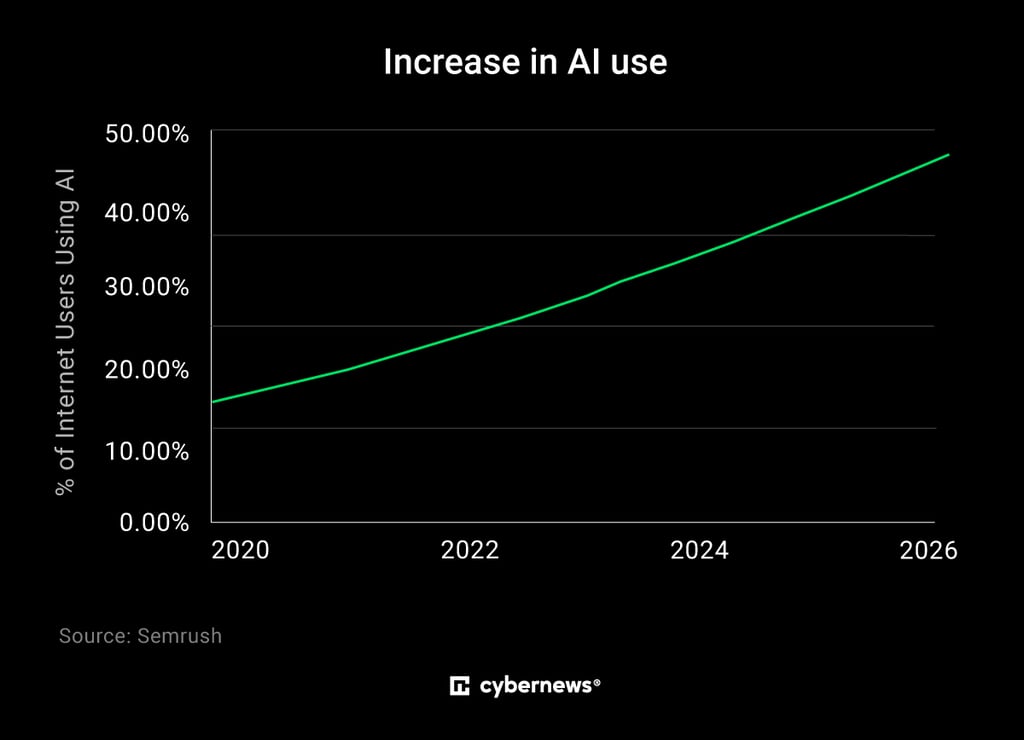
Additionally, compared to SEO rankings, AI mentions are a more complex story. It's not just about showing up – it's also about how you show up in the results. After all, if AI mentions your brand every time someone searches in your niche, but does so in a negative light, that's perhaps worse than not being mentioned at all.
AI search visibility tools like Trendos help you understand how LLMs see your brand. You can see whether they're accurately describing your products or hallucinating false details. Essentially, they give you a better idea of where your business stands in terms of the AI search engine landscape, and might lead you to changing your marketing strategy by, for example, instituting a word-of-mouth marketing strategy.
Trendos key features
To help you decide whether Trendos is the right choice for you, I looked at some of its key features. In this breakdown, I cover what I found to be the most interesting functionalities of the software.
Sentiment and positioning analysis
Trendos doesn't just look at how often your brand is mentioned. It looks at how it's mentioned. Using its regularly updated database of 2.5 million brands, Trendos combines brand sentiment with positioning to give you deeper insights into how your brand is seen by LLMs.
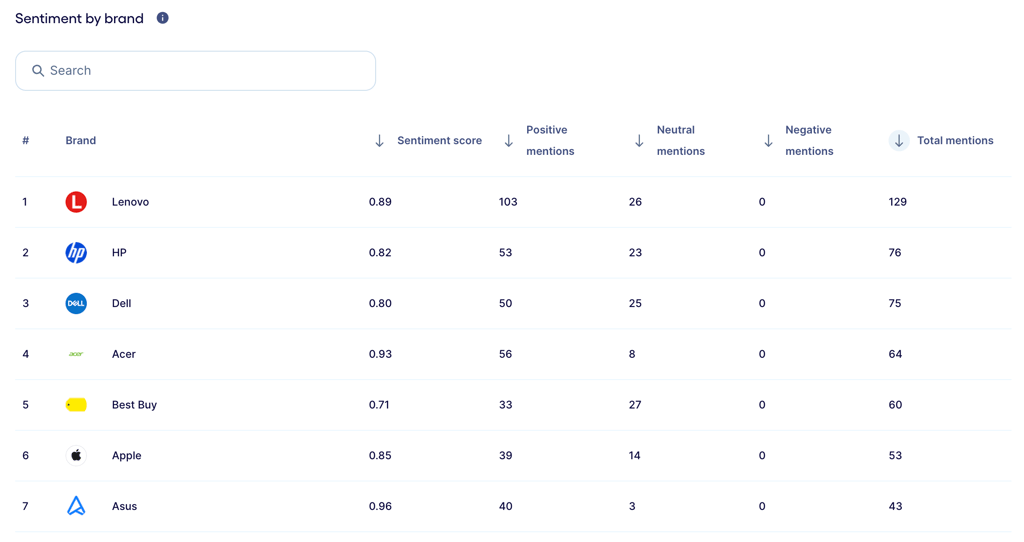
Trendos’ analytics are pretty simple to understand. Trendos explores the brand's primary areas and prompts AI models with a given prompt, for example, "best laptops 2026”. It then counts the response for each brand and evaluates whether they're positive, neutral, or negative. It then repeats it for a different prompt, like “top budget laptops for students,” and does the same. After repeating this several times, it categorizes its prompts into groups like "Laptops” or "Desktop computers”.
After this process was completed, I was able to filter the results based on both prompt groups and specific prompts, exploring their results in detail. I was also able to create custom prompt groups that Trendos also started monitoring and evaluating.
In addition to analyzing sentiment, Trendos also examines your brand's positioning. This is essentially the average spot your brand is placed at whenever an LLM makes a list. So, for my best laptops and best student laptop prompts, I saw that Lenovo placed at an average of 3.3 for the former and 5.0 for the latter. This shows that LLMs see Lenovo as a brand that produces solid laptops but point users to other brands for budget laptops.
Unfortunately, this analysis is also where I've seen Trendos’ first big issue. Its concept of brands is quite inconsistent. For example, each Apple laptop seems to have its own brand entry, which is counted separately from the Apple brand as a whole. Meanwhile, when looking for ASUS laptops, I wasn't able to find specific products – this makes the data murkier, and means you'll have to parse some of the data separately to account for product variety.
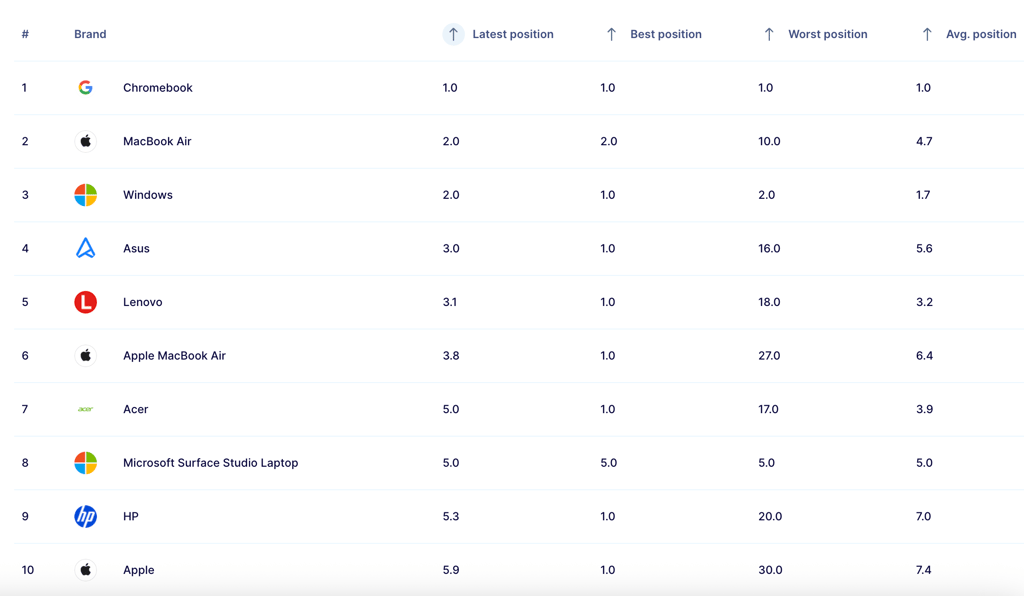
Another shortcoming is that Trendos doesn't give you access to its source data – you can't explore what "neutral sentiment” means, since you can't see the answers Trendos is basing its dataset on. This makes it hard to verify its findings across real tests.
Dynamic competitor benchmarking and share of voice
Trendos doesn't just have to be used for your brands. You can also use it to track your competition's performance and compare it against your brands. With Trendos’ data updating in real time, I was able to track multiple brands using both pre-generated and custom prompts.
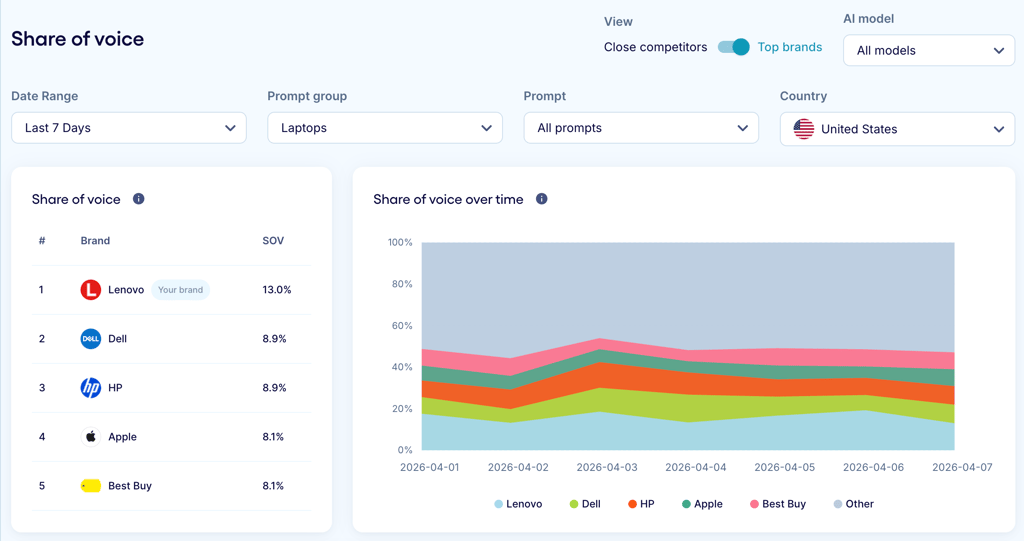
Share of voice is essentially a metric of how often your brand is mentioned by AI across the tested prompts. Trendos counts the number of your brand mentions and then divides it by the total number of all brands mentioned.
In my example, you can see that Lenovo has the highest share of voice in the laptop space, even though it doesn't rank the highest in these prompts. If I were a Lenovo analyst, I'd be able to go to my marketing team saying that Lenovo is seen as a solid choice. Never the best, but most frequently mentioned in multiple contexts. A jack of all trades of sorts.
Just like with sentiment and positioning, you can filter this by specific prompts and groups to gain insights that you can use to change your strategy. For example, if you see that you're lagging behind in the budget laptops niche, you can focus more of your marketing efforts on catering to students.
Unfortunately, Trendos struggles with brand contextuality – for example, when looking for laptops, Best Buy has a high share of voice in the US. While it's very likely that LLMs send users to Best Buy to buy their products, Best Buy's presence won't be of interest to laptop manufacturers, as it's not really competition.
Multi-engine AI tracking
Trendos currently offers tracking in ChatGPT, Gemini, Google AI Search, Perplexity, and DeepSeek. Essentially, it covers basically every large LLM outside of Claude. Every metric on Trendos can be filtered by engine, and the software also provides a summary of how your brand performs in each model.
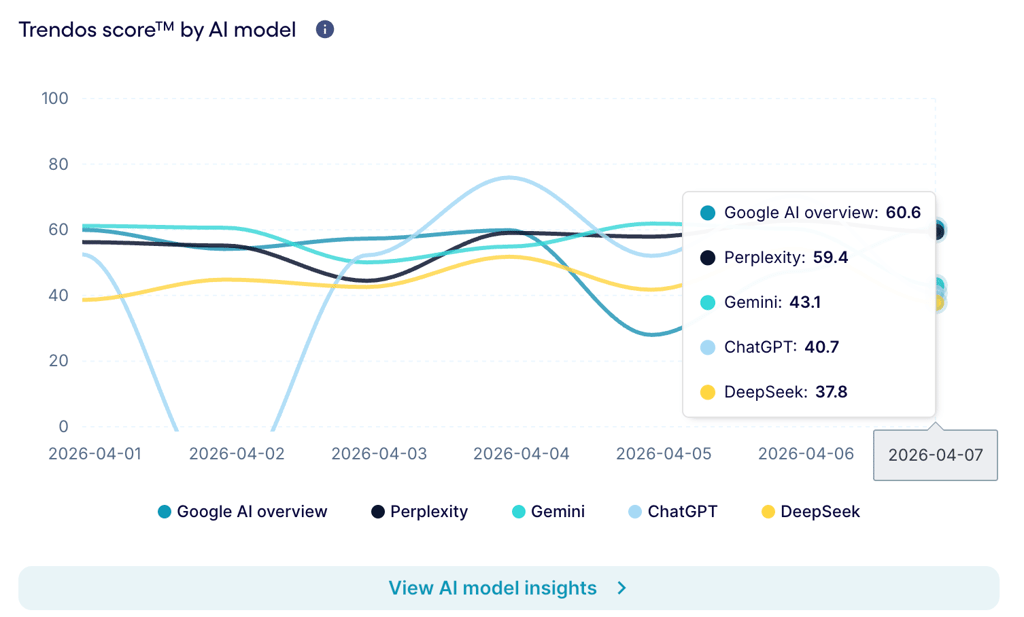
Trendos doesn't just show you a synthetic score, though. Using its dashboard, you can go in-depth, exploring every detail of Trendos' ranking. These include share of voice, sentiment, visibility, and position.
Each of these metrics is calculated based not just on your brand, but also on specific prompts. Trendos automatically analyzes your brand and suggests prompts based on it. For example, I decided to use several laptop brands to test Trendos for my review. For Lenovo, it created prompts related to laptops and desktop computers. For Apple, it generated prompts related to laptops but also to other consumer electronics produced by the company, like headphones and phones.
These features allow you to look at not just your overall brand results but how different AI models see your brand in specific contexts. Trendos includes multi-engine rankings for separate prompts, giving you in-depth insights into various aspects of your brand's online presence.
Global market visibility
Trendos isn't just excellent at tracking sentiment across various models – it's also a great tool for finding out how AI models in different regions react to your product. As of the time of writing, Trendos offers insights into 14 countries on the free plan: Australia, China, France, Germany, India, Israel, Japan, Lithuania, the Netherlands, Spain, the United Kingdom, and the United States and unlimited countries on the paid plan.
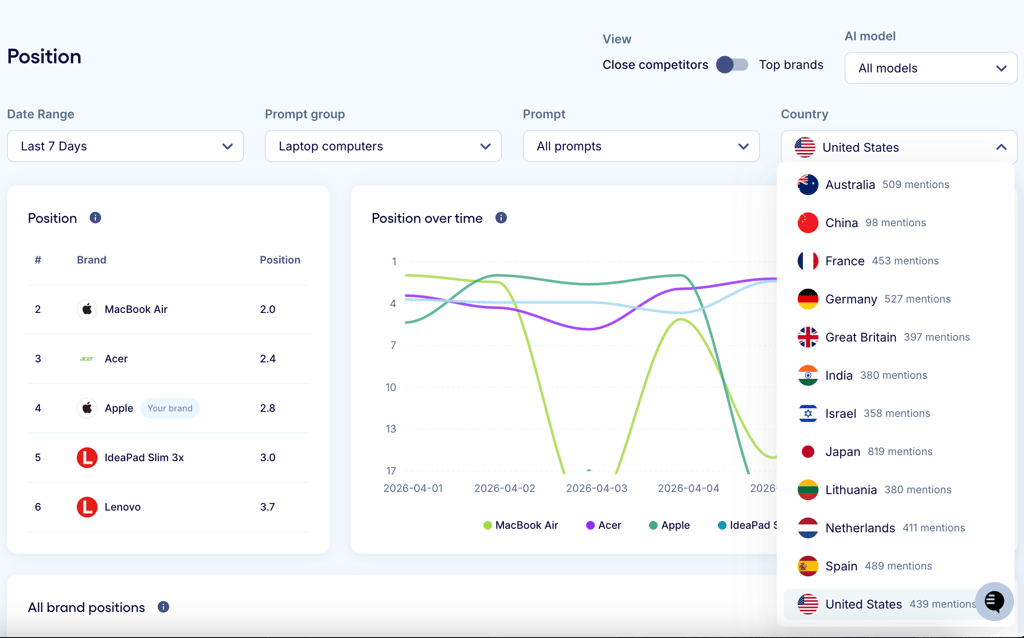
Testing the Trendos features with laptop brands, I found that the results really do differ depending on location. For example, while Apple products were routinely in the top 5 search results for the US, UK, and France, they were ranked much lower in Lithuania and the lowest in India. This is in line with wages in these countries, as Apple computers are often considered to be premium products, which likely impacts the sentiment in these regions.
Essentially, every metric on Trendos is filtered on a by-region basis, giving you detailed information about your performance in various regions. After all, an LLM in the US may have a completely different sentiment to your brand than Lithuania or Spain. While I do appreciate the depth of insights, I also wish that there was a "global” filter available, letting me view a summary of all the results in a single page, rather than focusing on single markets, if only for easier trend tracking.
Trendos pricing: Free vs Pro
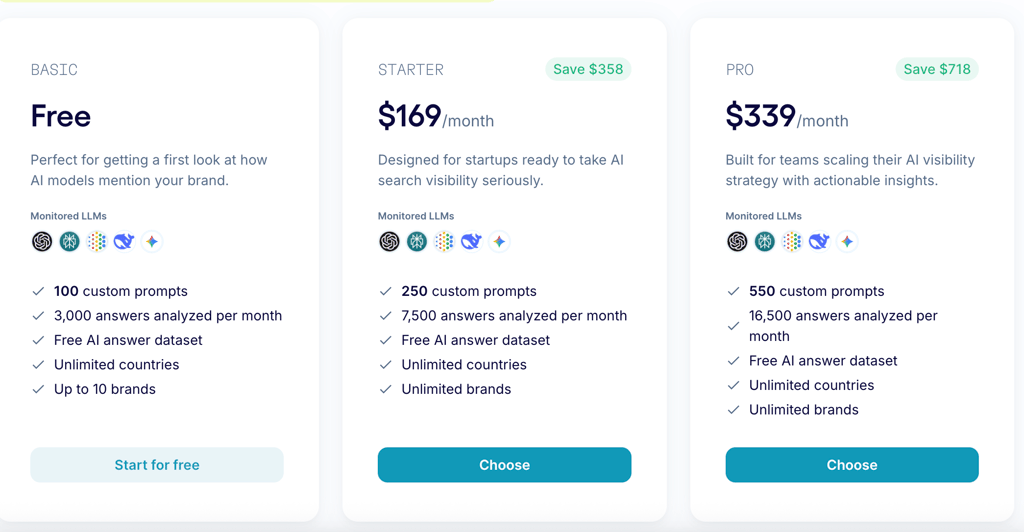
Trendos offers three tiers of pricing. The free tier has most of the features the paid plans do, with some usage and country limits. Here are the functionalities you get with each plan:
| Basic | Starter | Pro | |
| Price (yearly billing) | Free | $169.00/month | $339.00/month |
| Price (monthly billing) | Free | $199.00/month | $399.00/month |
| Monitored LLMs | 5 models | 5 models | 5 models |
| Custom prompts | 100 | 250 | 550 |
| Answers analyzed | 3,000 per month | 7,500 per month | 16,500 per month |
| Dataset access | Free AI answer dataset | Free AI answer dataset | Free AI answer dataset |
| Geographic reach | Unlimited countries | Unlimited countries | Unlimited countries |
| Brand tracking | Up to 10 brands | Unlimited brands | Unlimited brands |
Trendos’ pricing scales quite aggressively. What is perhaps missing is a small-business plan between Basic and Starter for about $50.00/month, or a pay-as-you go option allowing smaller businesses to budget smart around their Trendos use.
AI search visibility platforms: head-to-head comparison
While the AI search visibility space is a relatively new niche, Trendos isn't the only company in the space. Its competitors include Otterly.AI, Peec AI, ZipTie, AIclicks, and Profound.
- Otterly.AI focuses on its generative engine optimization (GEO) audit features. It gives you precise actions you have to take to fix your brand to improve your standing with generative engines. While it's not as powerful as Trendos for competitor analysis, Otterly is an excellent tool for improving your standing with AI engines.
- Peec AI is focused on providing agencies with tools to serve their clients. With unlimited seats on a $89.00/month basis, it can be used to provide value to multiple clients, exploring their content gaps.
- ZipTie can be used in combination with Google Search Console to give you a fuller overview of your overall internet presence. With searches focused on simulating real user intent, it's an excellent tool for optimizing your content.
- AIclicks offers built-in writing tools that will help you generate GEO content that will improve the way AI sees you. It combines share-of-voice analytics with active suggestions for how to impact the GEO rankings.
- Profound offers the most LLMs among the products compared, with over 10 engines analyzed. Its agents will also research, plan, and execute content designed to improve your standing with AI chatbots.
To help you visualize the difference between the products, I've created a simple breakdown table comparing the most popular GEO products.
| Feature | Trendos | Otterly.AI | Peec AI | ZipTie | AIclicks | Profound |
| Free plan availability | ✅ Yes (Core visibility database) | ❌ No | ❌ No (7-day trial available) | ❌ No (14-day trial available) | ❌ No (3-day trial available) | ❌ No (Free AEO report only) |
| Starting price | $0/month | $29.00/ month | $89.00/ month | $69.00/month | $59.00/ month | $99.00/ month |
| Brand database size | 2.5M+ indexed brands | Project-based tracking | Project-based tracking | Project-based tracking | Project-based tracking | Project-based tracking |
| Custom prompt limits | Scales with tier | 15 (Lite), 100 (Standard) | 50 (Starter), 150 (Pro) | 500 AI checks/month (Basic) | 30–50 (Starter), to 150 (Pro) | 50 (Starter), to 100 (Growth) |
| Hallucination detection | ❌ No (Focuses on context/sentiment analysis) | ❌ No | Yes (Explicit focus on accuracy scoring) | ❌ No | ❌ No | ❌ No |
| GEO recommendations | ❌ No | ✅ Yes (GEO Audit Engine, 20+ factors) | ✅ Yes (Actionable content gaps) | ✅ Yes (10–-200 Content Optimizations/month) | ✅ Yes (AI Agent content generation) | ✅ Yes (Profound Agents) |
| Real-user simulation vs API | Automated Crawlers / API | API | Real-user simulation (UI scraping) | API | API | API |
| Google AI Overviews tracking | ✅ Yes | ✅ Yes | ✅ Yes | ✅ Yes | ✅ Yes | ✅ Yes (Growth tier and above) |
Who should (and shouldn't) use Trendos
Trendos isn't a tool for everyone. While it has a lot of use cases, it also has limitations. To help you decide whether you should commit to Trendos, I'll break down the use cases where Trendos works and where it's not the best choice.
Trendos is excellent for:
- Brand marketers looking to explore AI perception at a large scale. Trendos is an excellent tool for analyzing how multiple LLMs see your brand. Thanks to its insights, you can see how you compare to other brands.
- eCommerce brands tracking AI product recommendations. Online sellers can use Trendos to see how their brand is received by AI and find out if their products rank well or need some GEO.
- Agencies managing multiple brand reputations. PR agencies may be interested in seeing how their clients are seen by AI engines, adjusting their communications if needed.
- Communications teams monitoring brand narrative in AI. Similarly, internal comms teams can use Trendos as an indirect way of measuring user sentiment.
Trendos is not ideal for:
- Traditional SEO-only teams. Trendos is not an SEO optimization tool and won't replace a solid tool focusing on Google rankings.
- Small businesses and solopreneurs. With its $169.00/month price tag to unlock unlimited brands, Trendos’ pricing isn't great for smaller companies. Luckily, you can still use the free tier if you only want to track your brand.
- Users who need actionable optimization recommendations. Trendos provides data but doesn't offer separate optimization guides, and it doesn't generate content. If you need direct insights rather than data, I recommend a tool like Profound.
Final verdict: is Trendos worth it?
Trendos is a new product in a relatively new market. This means that choosing whether it's the right product for you can be hard. However, Trendos offers a free tier which you can use to try the product out – or, if you're a small company, use it long-term.
As for whether it's worth it to purchase the subscription, that depends on your needs. Trendos's database of 2.5 million brands is great for getting a broad picture of how AI models see your brand and your competitors. Its intuitive dashboards and excellent filtering lets you quickly find the information you're looking for.
On the other hand, Trendos is a tool that requires some analytical experience to get the most out of. Unlike tools like Profound, it won't give you optimization recommendations or generate content. You will have to figure that out on your own, making it a bad choice for brands with little analytical experience.
Given its recent launch, I'm sure Trendos will grow its offering with time. But as of now, it's a very solid information database that I would recommend to anyone who needs data to make their own conclusions.
FAQ
What is Trendos?
Trendos is an AI search visibility and Generative Engine Optimization (GEO) platform. It helps businesses track, benchmark, and analyze how their brand, products, and competitors are mentioned and positioned within AI-generated search responses.
Is Trendos free?
Yes, Trendos offers a robust free tier that allows users to track up to 10 brands and use 100 custom prompts to explore its database. For deeper analytics and larger-scale tracking, it offers paid subscription plans (Starter and Pro).
How does Trendos compare to Otterly.AI?
While both tools monitor brand presence in AI search engines, their core focuses differ. Trendos specializes in broad market intelligence, boasting a massive historical database of over 2.5 million brands and requiring zero integration to start pulling competitive insights. Conversely, Otterly.AI leans into actionable GEO workflows, offering features like on-page auditing tools, data integrations, and dedicated workspace management tailored for marketing agencies.
What AI engines does Trendos track?
Trendos currently tracks brand visibility across major AI assistants and models, including ChatGPT, Google AI Overviews, Google Gemini, Perplexity, and DeepSeek.
Is my brand data safe with Trendos?
Yes. Trendos is backed by Tesonet, the global venture builder behind major data and cybersecurity giants like Nord Security (NordVPN) and Surfshark. This backing provides the platform with enterprise-grade data handling and highly secure infrastructure.
What is AI search visibility?
AI search visibility measures how frequently, accurately, and favorably a brand is recommended or cited in the conversational answers generated by AI models. It shifts the focus from traditional SEO (ranking links on a search results page) to Generative Engine Optimization (ensuring the AI natively recommends your brand as the answer to a user's prompt).