Windscribe VPN vs ExpressVPN: which one is better?
Our in-house cybersecurity experts and journalists, renowned for major reports like The Mother of All Breaches, conduct transparent, unbiased VPN testing and in-depth analysis.
With 750+ articles crafted based on real-world research, we empower readers to make informed purchasing decisions through first-hand expertise.
Learn more
Windscribe and ExpressVPN are both respected VPNs, but they target slightly different needs. Windscribe is known for its generous free plan and flexible pricing, while ExpressVPN focuses on premium performance, reliable streaming, and strong privacy.
For this Windscribe vs ExpressVPN comparison, I evaluated both services using the same core criteria, including speed, security, streaming capabilities, features, and pricing.
If you’re unsure which one to choose, keep reading – by the end of this guide, you’ll see how they stack up and find out which VPN is the better fit for most users.
Windscribe vs ExpressVPN: overview
Windscribe and ExpressVPN are both strong VPNs, with Windscribe offering more flexibility and a generous free plan, while ExpressVPN focuses on premium performance and consistent streaming. The key difference is that Windscribe excels in customization and value, whereas ExpressVPN delivers a more polished, high‑end experience. Overall, ExpressVPN comes out ahead in most categories, especially for users who prioritize speed, reliability, and ease of use.
| ExpressVPN | Windscribe VPN | |
| ⭐ Rating: | ||
| 🥇 Overall rank: | #4 out of #41 | #18 out of #41 |
| 🖥️ Servers: | 3,000+ servers in 113 countries | 480+ servers in 69 countries |
| 📖 No logs policy: | No logs | No logs |
| 💵 Price: | From $2.99/month | From $5.75/month |
| 🔥 Coupons: | ExpressVPN coupon 80% OFF | Cybernews VPN Coupons |
| 🔒 VPN protocols: | OpenVPN, WireGuard, Lightway | WireGuard, OpenVPN, IKEv2/IPsec, WStunnel and StealthVPN |
| 🍿 Streaming services: | Netflix, Hulu, BBC iPlayer, Disney+, and more | Netflix, BBC iPlayer, YouTube |
| 🖥️ Platforms: | Windows, macOS, Linux, Android, iOS | Windows, macOS, Linux, Android, iOS |
| 📥 Simultaneous connections: | 14 | Unlimited |
| 💁🏻 Support: | Knowledge base, email, 24/7 live chat | Self-help, bot chat, tickets |

Recent Updates




We spare no effort to test the products & their features. All information is gathered by our in-house research team & fact-checked by our team of experts. Discover the ins and outs of our testing procedures.
Windscribe vs ExpressVPN: key differences
Windscribe and ExpressVPN are both known names among the best VPNs out there, but they serve different needs.
Choose Windscribe if:
- You want a generous free plan and flexible pricing. Windscribe offers a substantial free‑forever tier and a few paid plans, letting you tune your budget and features to your needs.
- You like tinkering with your VPN settings. The app gives you deep control over protocols, firewall rules, and split‑tunnel‑style Whitelist mode, which appeals to more advanced users.
- You care about customization and privacy‑focused tools. Windscribe includes features like unlimited server switching, location‑based plans, and a focus on no‑logs and privacy‑conscious server locations.
Check out our full Windscribe review for detailed feature and performance breakdowns.
Choose ExpressVPN if:
- You prioritize speed and reliability. ExpressVPN consistently delivers fast, stable connections across locations, making it ideal for streaming, gaming, and video calls.
- You care about streaming access and ease of use. It reliably unblocks major platforms like Netflix, BBC iPlayer, and Hulu, with a clean, intuitive app that works well on all major devices.
- You want a more premium, polished package. With RAM‑only servers, audit‑backed no‑logs policies, and a wide range of browser extensions, ExpressVPN offers a more streamlined, high‑end VPN experience.
See our complete ExpressVPN review for in‑depth speed, security, and pricing analysis.
Speed, streaming, and torrenting performance
I tested Windscribe vs ExpressVPN in terms of speed, performance, and streaming. Below you can see what I found.
Speed comparison
When it comes to VPNs, speed matters – you don’t want constant lag ruining streaming, gaming, or video calls. A slow connection can be frustrating and may even hamper some online activities. For this Windscribe vs ExpressVPN comparison, we tested both for speed, measuring average download and upload performance across several locations.
ExpressVPN speed test results:
| Server location | Download speed | Upload speed | Ping |
| Local | 724.19Mbps | 370.83Mbps | 17ms |
| London, UK | 573.30Mbps | 459.13Mbps | 40ms |
| New York, US | 468.69Mbps | 200.41Mbps | 97ms |
| Perth, Australia | 382.37Mbps | 91.45Mbps | 220ms |
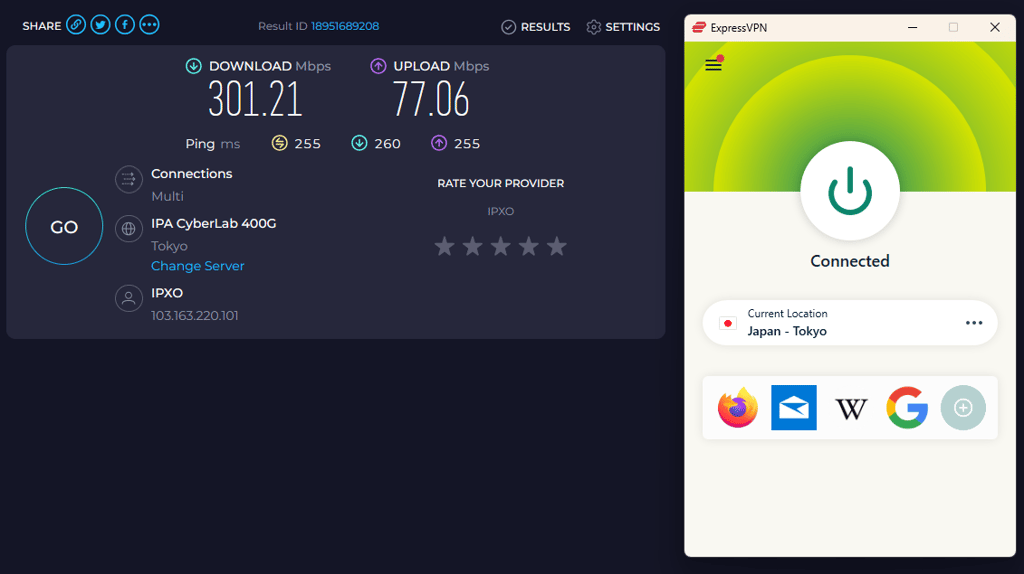
| Tokyo, Japan | 301.21Mbps | 77.06Mbps | 255ms |
Windscribe's speed test results:
| Server location | Download speed | Upload speed | Ping |
| UK | 364Mbps | 272Mbps | 36ms |
| US | 175Mbps | 17Mbps | 101ms |
| Germany | 381Mbps | 64Mbps | 25ms |
| Hong Kong | 0.3Mbps | 2Mbps | 485ms |
The results show a clear gap: ExpressVPN averaged around 490Mbps for downloads and up to 370Mbps for uploads, with pings starting as low as 17ms locally and staying under 255ms even on distant servers like Tokyo. In contrast, Windscribe averaged roughly 300–380Mbps on downloads but dropped sharply in uploads, with some routes staying under 60Mbps and the Hong Kong server slowing to just 0.3Mbps down and 2Mbps up. Its pings also climbed to 485ms on that route.
Streaming performance
Both ExpressVPN and Windscribe are strong options for unblocking geo‑restricted content and delivering smooth streaming, but ExpressVPN has the edge in performance and reliability.
It consistently unblocks major platforms such as Netflix, BBC iPlayer, Hulu, Disney+, Amazon Prime Video, HBO Max, Apple TV+, and others, with optimized routing and server‑selection that help keep buffering and lag low.
Windscribe is also very good for streaming, working with Netflix, BBC iPlayer, Hulu, Prime Video, and several other major services, especially via its Windflix‑style or dedicated streaming servers. Still, it can be slightly less consistent on some libraries and long‑distance routes.
Torrenting
ExpressVPN and Windscribe are both solid choices for torrenting, with strong security, fast speeds, and P2P‑optimized servers.
ExpressVPN allows torrenting on all servers and provides P2P‑optimized options in many locations, paired with AES‑256 encryption and a reliable kill switch for privacy.
Windscribe also supports torrenting, but only on selected P2P‑optimized servers, which can become crowded. However, it offers port forwarding, which can help boost torrent speeds on compatible setups.
Pricing
ExpressVPN and Windscribe are both competitively priced, especially on longer plans, but Windscribe is generally the more budget‑friendly option.
| Plan | Monthly billing | Yearly billing | 2-year billing/Build a plan |
| ExpressVPN Basic | $14.99/month | $4.99/month | $2.99/month |
| ExpressVPN Advanced | $16.99/month | $5.99/month | $4.49/month |
| ExpressVPN Pro | $22.99/month | $8.99/month | $7.49/month |
| Windscribe Pro | $9.00/month | $5.75/month | $1.00/month per location |
Windscribe starts at $9.00/month on its standard Pro plan, with an annual price of $5.75/month. It also offers a customizable “build‑your‑own” plan at $1.00/month per location for those who want to pay only for specific server access. It also includes a free plan with a 2GB monthly data cap, which is great for testing but limited in terms of features and server selection.
ExpressVPN is more expensive, with no free tier, but it does offer a 30‑day money‑back guarantee and a 3-day free trial for mobile users via the Google Play Store and Apple App Store. ExpressVPN monthly pricing starts as low as $2.99/month on the 2‑year Basic tier.
Overall, Windscribe is the better pick for tight budgets and free‑tier users, while ExpressVPN can be very cost‑effective if you commit to a longer‑term subscription.

Server locations
| Windscribe | ExpressVPN | |
| Servers | Undisclosed | Undisclosed |
| Countries (total) | 69 | 113 |
| Virtual locations | ✅ Yes | ✅ Yes |
| Specialty servers | ❌ No | ❌ No |
Regarding server locations, ExpressVPN offers broader global coverage, with servers in 113 countries and multiple locations within many of them, even though it no longer publicly discloses the exact number of individual servers. This wide footprint makes it easier to find a server that can unblock the content you want and helps keep traffic spread across less‑crowded routes.
ExpressVPN also uses some virtual server locations, where the registered IP address matches the chosen country but the physical hardware is in a nearby region, which aids both compliance and performance.
Windscribe has a smaller but still solid network, covering around 69 countries, again without revealing its exact server count. Within those countries, it operates multiple locations and data centers, so you can often pick several servers per region for better performance and local‑content access. Like ExpressVPN, Windscribe also offers virtual servers, mainly for special or experimental locations.
Features overview
Both VPNs are solid choices for protecting multiple devices. They offer apps for all major operating systems, plus Linux command‑line installers, with features such as split tunneling, Smart DNS‑style options, and built‑in ad/malware blocking.
Split tunneling
Each provider supports split tunneling, which lets you bypass the VPN for selected apps or websites. ExpressVPN offers this feature for Windows, Mac, Android, and routers, and it’s easy to use. You can head over to settings and select which apps use ExpressVPN when connected.

However, Windscribe’s split tunneling is limited to Windows, Mac, and Android apps and does not offer a dedicated split‑tunnel UI for routers, which is a notable limitation compared with ExpressVPN. In Windscribe’s app, you can simply navigate in split tunneling settings and select which apps, IP addresses, or hostnames you want to include or exclude from the VPN tunnel.

Smart DNS
Both VPN providers have a variation of a Smart DNS feature. It’s useful, as most of the devices you use for media streaming, like a smart TV, don't always have native VPN support. So, ExpressVPN and Windscribe came up with ways to provide VPN-like functionality without an app.
ExpressVPN’s Smart DNS feature is called MediaStreamer. It doesn’t add any protection layers and has nothing to do with safer browsing. It can make your streaming experience easier, though, as you can change the DNS address, and the device will act as if it's using a VPN when connecting to geo-restricted sites.
With Windscribe, this feature typically requires manual DNS configuration on the router or device, and you can work around it by routing traffic through a Windscribe‑enabled device, such as a PC or phone. In addition, you can use the Windscribe app on another device to redirect traffic from your Smart TV or gaming console using the proxy gateway feature.
Overall, ExpressVPN's spin on the same feature is more user-friendly and, in my opinion, easier to set up.
Threat Manager
Another feature both VPN providers offer is a variation of an ad blocker.
ExpressVPN Threat Manager is essentially a feature that blocks all tracking and other potentially malicious activity from third parties when browsing or using apps. This is a useful tool to enhance online privacy and anonymity, and to stay safe while browsing.

Windscribe also comes with a similar feature called R.O.B.E.R.T., an IP address-blocking tool you can customize. Its free version blocks ads and trackers, while those who have a paid subscription to Windscribe will also get protected from malicious pages that can infect the computer with malware.

Even though Windscribe offers powerful customization, ExpressVPN wins this round for its more polished, user‑friendly feature set and smoother integration across devices.
Windscribe vs ExpressVPN: which is more secure?
In terms of security, both Windscribe and ExpressVPN offer strong protections, including military‑grade encryption, RAM‑only servers, and kill switches.
| ExpressVPN | Windscribe | |
| Encryption | 4096-bit RSA keys and 256-bit AES | 4096-bit RSA keys and 256-bit AES |
| Hash | ❌ No | ❌ No |
| RAM servers | ✅ Yes | ✅ Yes |
| A member of the 14-eyes alliance? | ❌ No | ✅ Yes |
| No-logs policy | Audited | Audited |
| Kill switch | ✅ Yes | ✅ Yes |
Both VPNs use 4096‑bit RSA keys and 256‑bit AES encryption, widely regarded as unbreakable, and run their own DNS servers to reduce the risk of outside interference. If your connection drops, ExpressVPN’s Network Lock acts as a kill switch, blocking internet traffic until the VPN reconnects. This feature is available on all major platforms.
Another important thing to mention is that ExpressVPN is based in the privacy‑friendly British Virgin Islands, whereas Windscribe is headquartered in Canada, a member of the Five‑Eyes alliance.
All things considered, ExpressVPN wins in the security category, thanks to its stronger jurisdiction, audited no‑logs policy, and consistently reliable kill‑switch support.
Infrastructure
Most of Windscribe’s and ExpressVPN’s servers run entirely on RAM. It’s encouraging to hear that Windscribe has changed its architecture to RAM-only servers, meaning that the servers’ data is permanently deleted upon server reboot and never written to a hard drive.
ExpressVPN stops the operating system and applications from ever connecting to the hard drive using TrustedServer. Instead, RAM or volatile memory runs the server. Since RAM needs the power to hold data, every time a server switches on and off, its contents are erased, preventing data and potential hackers from remaining on the computer.
Privacy
ExpressVPN has a slight edge in terms of security as it is based in the British Virgin Islands, which has strict data protection laws, and it has also undergone independent audits to verify its security claims.
On the other hand, Windscribe is based in Canada, which belongs to the Five‑Eyes alliance, but it has since been independently audited in 2024 by Packetlabs, adding some extra transparency to its no‑logs claims
ExpressVPN rejects keeping any personally identifying data on its servers. However, it does maintain a few records, such as the time of your connection, the server you selected, and the amount of data you sent, but primarily to assist with technical troubleshooting.
Logging
Both ExpressVPN and Windscribe claim to have strict no-logs policies, which means they do not collect or store any information about your online activity, such as your browsing history, IP address, or connection timestamps.
However, ExpressVPN has undergone a third-party audit by PwC to verify its policy, and its host country is not a member of the Five-Eyes alliance.
Windscribe remains safe: it only stores limited data, such as 30‑day bandwidth usage and the date of your last login, mainly to manage inactive accounts and free‑plan data caps, while still adhering to its no‑logs policy. Being based in a Five‑Eyes country is a consideration, but its 2024 independent audit by Packetlabs adds reassurance.


Platforms, interface, and ease of use
When it comes to interface and ease of use, both services are user-friendly and easy to navigate.
| Windscribe | ExpressVPN | |
| Automatic setup wizard | Windows, macOS, Linux, Android, iOS | Windows, macOS, Linux, Android, iOS |
| Main location selection | List-based | List-based |
| Extra settings pages | ✅ Yes | ✅ Yes |
| Mobile-friendly | ✅ Yes | ✅ Yes |
ExpressVPN has a clean and straightforward interface, with a simple one-click connect feature that makes it easy to get started. It also offers a range of advanced features, such as split tunneling and a kill switch, for users who want more control over their VPN settings.
Windscribe’s interface is also user-friendly, with a modern and colorful design that is easy on the eyes.
Desktop apps
ExpressVPN’s desktop app is easy-to-use and user-friendly. Logging into ExpressVPN takes less than a minute. With options to just use your current server or the best location, it has a fast-connection button that makes connecting and disconnecting from ExpressVPN pretty easy. Although the server list is organized by continent, you can always search for a particular country if you’d like.
Although there aren’t many settings to experiment with, the fact that they are divided into numerous tabs makes everything organized. In addition, this app provides direct access to speed tests, IP address checkers, and leak testers, so you can confirm its proper operation.

Although Windscribe has a unique look, some people might find it distracting. The app has an unusual design and displays its server list in a pop-out menu. On the bright side, there is an integrated speed tester, and you can connect with just one click. However, with so many options available, it can be challenging to select one. Furthermore, it’s unclear why a firewall button is present on the home page, given that you shouldn’t typically disable it.


What’s really important, it doesn’t matter whether you use Windscribe on Linux or Windows – you still get the same interface.
Mobile apps
Both VPNs have user-friendly smartphone apps. Most of ExpressVPN’s features are still present and comparable to the desktop version. The app even provides an automated connection option, which is missing from the main desktop app.

Windscribe iOS switches to a more standard layout on smaller screens, rather than its more stylized look. The firewall and proxy gateway features are disabled, but most other tools are still accessible, and the settings menu has been cleaned up, making it much simpler to use than the desktop version.

Customer support
Customer support is another essential aspect I reviewed for this Windscribe vs ExpressVPN comparison. In this final section, you’ll see which VPN will come running when you need their help.
| ExpressVPN | Windscribe | |
| Live chat | ✅ Yes | ❌ No |
| Ticket support | ✅ Yes | ✅ Yes |
| Email support | ✅ Yes | ❌ No |
| Phone support | ❌ No | ❌ No |
| Knowledge base | ✅ Yes | ✅ Yes |
| Video guides | ✅ Yes | ✅ Yes |
The good news is that the help sections of both VPNs are excellent and can guide you through some of the most typical issues you might run across. Furthermore, customers with more technical issues can submit support tickets for assistance or watch YouTube video guides.
Still, ExpressVPN has an advantage in this category due to its round-the-clock live chat service. The most important thing is that you get a response immediately. You don’t even need to be a subscriber to ask general questions about the service.
In comparison, Windscribe offers a chatbot that points you toward the knowledge-base articles.
Windscribe vs ExpressVPN – which one is the winner?
Windscribe delivers strong speed, solid security, and notable versatility, especially given that it includes a free‑tier subscription with a modest data allowance. It shines as a budget‑friendly option that still offers good performance and customization for everyday use.
However, ExpressVPN takes the lead in key areas: it offers more server locations, consistently faster speeds, broader streaming support, and 24/7 live chat, along with an extended 30‑day money‑back guarantee. This makes it easier to test the service in real‑world conditions and stay protected across more regions.
As such, ExpressVPN is the overall winner for those who prioritize speed, streaming, and full‑featured, polished service.
| Feature | Windscribe | ExpressVPN | Verdict |
| Speed | ExpressVPN wins thanks to consistently higher speeds and lower ping across distances. | ||
| Streaming | ExpressVPN is more reliable and versatile for unblocking global platforms. | ||
| Torrenting | ExpressVPN scores higher with universal P2P support and broader server choice. | ||
| Pricing | Windscribe wins on budget‑friendliness and its free tier. | ||
| Server locations | ExpressVPN wins with 113 countries vs Windscribe’s 69. | ||
| Features | ExpressVPN takes the edge with a more polished, streamlined feature set. | ||
| Security | ExpressVPN wins thanks to its stronger jurisdiction and thorough audits. | ||
| Interface and ease of use | Draw – both are user‑friendly. ExpressVPN offers more consistency, and Windscribe offers more customization. | ||
| Customer support | ExpressVPN wins with 24/7 live chat and strong ticket support. |
FAQ
Is ExpressVPN better than Windscribe?
Yes, it is. ExpressVPN and Windscribe are high-quality VPN services, and the choice might depend on your specific needs and priorities. Still, ExpressVPN has proved it's more advanced across most categories during our hands-on testing.
Which VPN is stronger than Windscribe?
ExpressVPN proved to be the more powerful VPN during our tests. Alternatively, market-leading VPNs like NordVPN or Surfshark also have the upper hand compared to Windscribe.
What VPN is better than ExpressVPN?
There are a great number of the next-gen VPNs that could be considered better than ExpressVPN. Some of the best VPN providers are NordVPN and Surfshark.