Anduril showcases connected defense to deter Russia on NATO’s eastern flank
Anduril, a major US defense tech company specializing in autonomous systems, has detailed how it’s contributing to efforts to protect NATO’s eastern flank. It sounds impressive, but some Europeans are unhappy that American technology is being used.

Image by Cybernews.

 Follow us
Anduril, a major US defense tech company specializing in autonomous systems, has detailed how it’s contributing to efforts to protect NATO’s eastern flank. It sounds impressive, but some Europeans are unhappy that American technology is being used.
Russia’s war on Ukraine might end or at least pause soon if both sides agree on a ceasefire deal, pushed on Kyiv by the US President Donald Trump administration. But Europe’s security environment is almost certain to remain very tense.
In September, more than twenty Russian drones violated Polish airspace. Days later, Russian fighter jets entered Estonian airspace without flight plans or transponders.
Lastly, Germany’s Foreign Office quoted the country’s intelligence services on Tuesday, saying Russia might be “creating the option for itself” to wage war against NATO by 2029 and urging the alliance to further deter the Kremlin.
Putin eyes the #EU and #NATO. Our intelligence services are issuing urgent warnings: at the very least, Russia is creating the option for itself to wage war against NATO by 2029. We have to deter further Russian aggression, together with our partners and allies. @AussenMinDE
undefined GermanForeignOffice (@GermanyDiplo) November 25, 2025




Clearly, Anduril says, these incursions show that NATO’s eastern defenses must be “faster, smarter, and more connected than ever.”
Digital Shield 1.0
To be fair, the alliance has already developed a fresh way to meet the challenge. Last week, NATO, supported by US Army Europe and Africa, unveiled the Eastern Flank Deterrence Line (EFDL).
It’s a regional initiative to “defeat adversary mass and momentum with low cost, attritable uncrewed systems, AI-enabled targeting, and layered defenses.”
Essentially, the EFDL functions as a digital shield stretching across NATO’s eastern border. A radar in Estonia, for example, could detect incoming aircraft and instantly share that data with air-defense batteries in Latvia or command centers in Poland.






Each nation remains responsible for defending its own territory, but through the EFDL, its systems contribute to a collective deterrence posture.
Anduril also plays its part. In early November, the company joined the US Army’s 10th Army Air and Missile Defense Command (AAMDC) and the Estonian Defense Forces in Tallinn, Estonia, for exercise Digital Shield 1.0, one of the first major events to put the EFDL concept into practice.
“Over five days, Anduril engineers worked alongside US and Estonian units to connect previously separate sensors, radars, and command and control systems into a single distributed network – the kind of digital infrastructure the EFDL will rely on across Europe,” the company said in a release.
The need to move faster than the threat
Anduril’s team contributed by setting up multiple Menace-T tactical compute and comms kits and establishing Lattice nodes running in the cloud. This way, a resilient network kept data moving – crucially, even when connections were jammed, weak, or cut off.
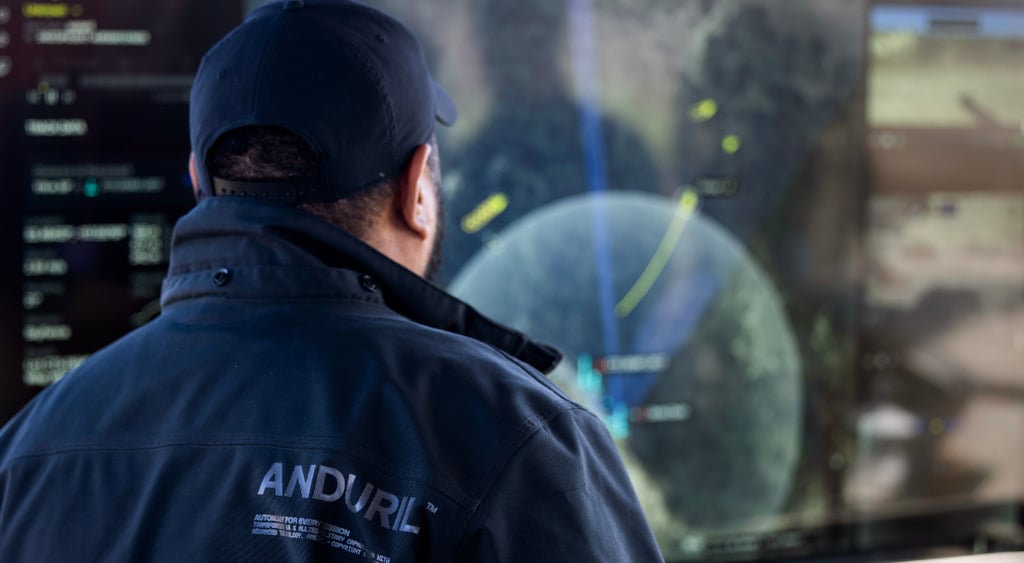
Feeds that once operated independently were synchronized and shared instantly across US and Estonian command nodes, allowing operators at radar sites, the Estonian Control and Reporting Centre, and US Army Europe’s G-3 Operational Data Team to see the same tracks simultaneously, distinguishing drones from birds, validating detections, and coordinating faster responses.
According to Anduril, work that traditionally takes months of integration and certification was completed in days, proving how digital speed and interoperability can outpace an adversary’s ability to mass.
“Innovation is not a one-time effort,” said 10th AAMDC Commanding General, Brig. Gen. Curtis W. King, speaking about the EFDL initiative.
“It takes consistent teamwork and trust among allies. Our goal is to ensure every soldier, system, effector, and sensor contributes to the EFDL and enhances NATOs collective defense.”
Companies like Anduril, Palantir, and, of course, Starlink are now a firm part of the military-tech complex, owning satellite communications, data, computing, and AI – all of which are vital to national security.
Future iterations of the new system are expected to expand integrations, introduce automated data fusion and layered effects, and deepen participation across the alliance – all that to be able to move faster than the threat.
Increased dependency on the US?
Anduril’s role in NATO operations is a sign that times are changing. Just a few decades ago, states completely owned and paid for their armed forces, monopolizing all military capabilities.
“Countries also supported a private indigenous defence industry to supply their forces. The state had effectively integrated the whole of the defence sector,” Anthony King writes in his recent book “AI, Automation, and War: The Rise of a Military-Tech Complex.”
Today, though, the situation has reversed. Companies like Anduril, Palantir, and, of course, Starlink are now a firm part of the military-tech complex, owning satellite communications, data, computing, and AI – all of which are vital to national security.
Founded in 2017 and named after the fictional sword of Aragorn from The Lord of the Rings, Anduril is not without controversy, though.
Anduril has received funding from Peter Thiel, a libertarian billionaire who is controversial for his criticisms of democracy, and has invested heavily in defense and security technologies, such as Palantir, a company specializing in mass data analysis and surveillance.
Have thoughts about this topic? Others do, too. Join them in the discussion.
When Rheinmetall, the German arms manufacturer, signed a strategic deal with Anduril to manufacture autonomous drones, some European experts were deeply disappointed, saying the partnership poses ethical problems and could actually be dangerous to European security in the event of a major disagreement with the US.
“Anduril may be a great company, but I don’t understand why Rheinmetall doesn’t prefer to work with Helsing (a Franco-German-British start-up founded in 2021 and specializing in autonomous drones and AI in armaments), which does the same thing, or another company in Europe,” said Guntram Wolff, an economist at Bruegel, an independent European research institute.
Unlock more exclusive Cybernews content on YouTube.