New study reveals top reasons why Ukrainians use VPNs during wartime


 Follow us
When Russia began its full-scale invasion of Ukraine on February 24, 2022, internet search traffic in Ukraine shifted almost immediately. One of the fastest-rising keywords was VPN, short for virtual private network.
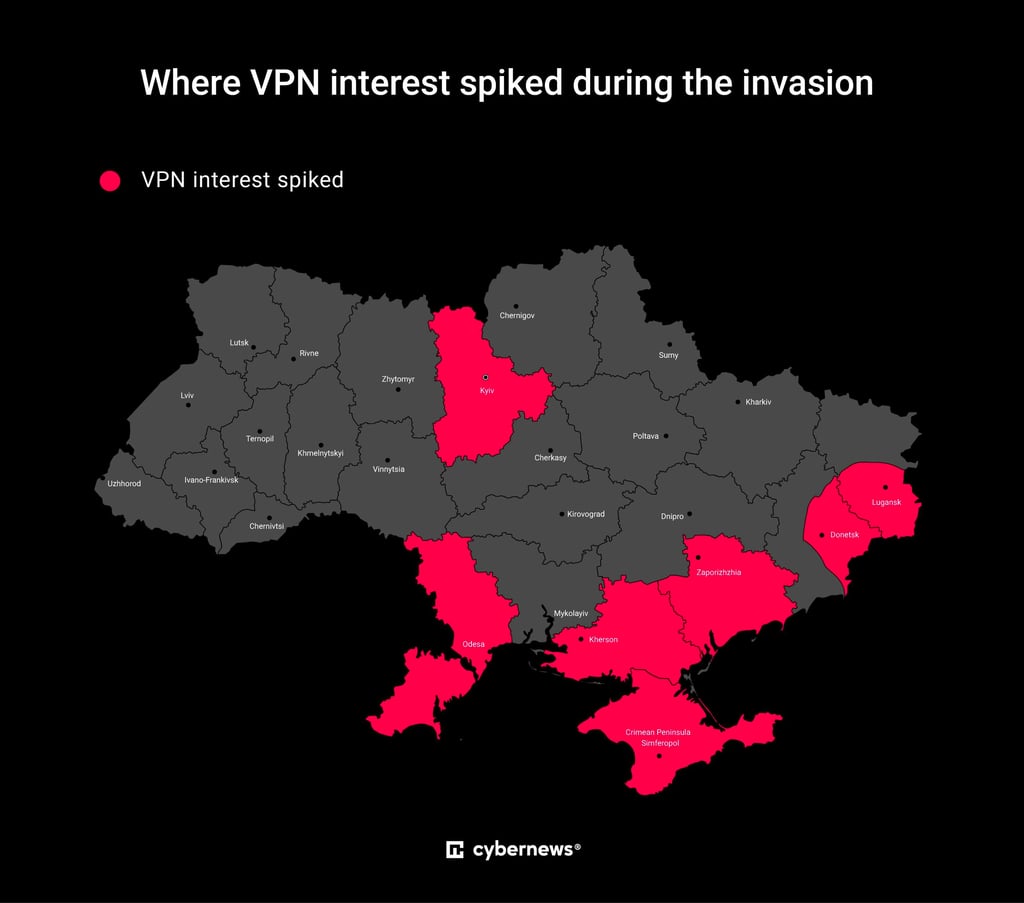
According to the Cybernews study, search interest in VPN surged across Ukraine, especially in regions already occupied or under threat: Crimea, Luhansk, Donetsk, Kherson, Zaporizhzhia, Kyiv, and Odesa.
- VPN interest spiked in Ukraine after Russia’s full-scale invasion, especially in occupied or threatened regions, such as Donetsk or Zaporizhzhia.
- Actual VPN use was limited due to physical risks in occupied areas, where certain apps could trigger phone checks or punishment.
- Russia saw a 668% rise in VPN use, driven by state censorship and media bans.
- Platform use shaped discourse: Telegram focused on official information and digital safety. Reddit emphasized digital activism, including DDoS coordination.
- Common VPN use cases, such as geo-unblocking or Russian censorship, were rarely discussed (10% and 5% of posts, respectively).
- VPNs in Ukraine were context-dependent tools – used selectively, or avoided entirely, based on risk.
The instinct behind the spike was clear: secure communications, bypass surveillance, and stay connected. But as the data reveals, intent didn’t always translate into action. Despite the spike in searches, VPN downloads in Ukraine remained far lower than in Russia, where censorship drove adoption.




According to data scientist Katharina Buchholz, in Russia, usage soared 668% following the restrictions as the state banned Facebook, Twitter, and foreign news outlets. For many Russians, VPN services became the only option for accessing uncensored information.
In Ukraine, the calculus was more complex.
“In Kherson, under Russian occupation, having Signal or a VPN app on your phone wasn’t just risky,” the study notes. “It could get you arrested. Or worse.”
This was not a hypothetical concern. In occupied territories, soldiers conducted routine phone checks at checkpoints.
Though designed for privacy, apps like Signal, Tor, and VPN clients were viewed as suspicious. Telegram, by contrast, survived not because it was the most secure, but because it was tolerated.
As cybersecurity scholars Ksenia Ermoshina and Francesca Musiani wrote in 2024, Ukrainians were living in what they called an “asymmetric risk” landscape: encryption might protect one user, while placing another in danger.
Journalists, soldiers, civilians, and volunteers all navigated radically different threat models. There was no singular digital defense strategy – only shifting responses shaped by geography, occupation status, and risk exposure.
Public discourse around VPNs was shaped by platform and audience type
To chart how Ukrainians actually talked about VPNs in the war’s first year, the Cybernews research team analyzed 111 posts from Reddit and Telegram. The content was coded into eight categories – from censorship circumvention and privacy protection to digital activism and discount offers. The taxonomy is clinical; the results, anything but.
A third of the posts were simple information sharing – usually on Telegram, often by official sources. Think: government advisories, news bulletins, influencer summaries. Functional, fast, and public.
More interesting was the split in tone and usage across platforms. On Reddit, VPNs were tools for digital activism – 28% of posts focused on tactics: how to safely DDoS Russian sites, how to mask location, how to wage cyberwar from a keyboard.
On Telegram, the tone was different. Here, the VPN appeared as a quieter suggestion, embedded in security advice or survival protocols, particularly for users under occupation.
Both platforms were telling the truth, just different versions of it.
And then there was what didn’t trend: geo-unblocking and Russian censorship. The stereotypical VPN use case – accessing Netflix or navigating blocked news – barely registered. Only 10% of posts referenced region-locked content, and just 5% focused on Russia’s information blackout.
Summary of VPN-related discourse in Ukrainian Reddit and Telegram posts
| Category | Description | % of total posts | Platform distribution | Notes |
| Information sharing | Mentions of VPN within broader informational content (news, institutional alerts, general updates). | 33.6% | Telegram: 55.5% Reddit: 18% | Dominated by official Telegram channels (e.g., UNIAN, ministries). Reflects top-down information flow. |
| Digital activism | Posts encouraging VPN use for DDoS attacks, cyber protest, or information disruption efforts. | 19.6% | Reddit: 28% Telegram: 8% | Mostly grassroots on Reddit. Telegram mentions came only from state institutions like IT Army of Ukraine. |
| Security and privacy protection | Posts recommending VPNs for personal safety, encrypted browsing, or avoiding surveillance. | 17% | Telegram: 26% Reddit: 11% | Often included official safety advice or peer-to-peer risk mitigation strategies. |
| Geo-unblocking | Use of VPN to access region-locked content (media, websites, services). | 10% | Reddit only | Examples include accessing BBC documentaries or cross-border reproductive health services. |
| Free VPN offers | Posts about free or solidarity-based VPN services for Ukrainian users. | 8.5% | Reddit: Majority Telegram: 1 post only | Simple announcements (e.g., Windscribe’s 30GB for Ukrainians). Indicative of global support. |
| Miscellaneous | Posts that didn’t fit into other categories; content varied. | 6% | Reddit and Telegram | Heterogeneous content. No unifying theme; low frequency. |
| Censorship circumvention (Russia) | Posts about using VPNs to access blocked Russian websites or to support Russian users. | 5% | Reddit and Telegram | The least represented category. Shows limited focus on Russian information access from Ukrainian users. |
The study acknowledges its platform limitations. Reddit is an open forum – global, unfiltered, and speculative. Telegram, conversely, functioned as an essential wartime tool for Ukrainians. The differences in tone, frequency, and thematic focus reflect those audiences.
VPNs as contextual tools, not universal fixes
VPN use in Ukraine during the first year of the full-scale war was highly dependent on location, risk level, and audience.
While interest in VPNs was widespread, and public discourse reflected a range of motivations, the actual use of VPNs in high-risk areas was often limited by the threat of physical consequences.
In occupied territories, merely having a VPN app installed could result in increased scrutiny or harm. In safer regions or among users abroad, VPNs were used more freely, often to participate in digital activism or access external information.
Privacy tools cannot be separated from real-world risks. In a warzone, even routine technologies are subject to new calculations. For some, VPNs enabled resistance. For others, they were avoided entirely.