Mending your socks won't save the planet. Do it anyway
Ever since ChatGPT unleashed chaos and uncertainty on our world following its release, we’ve come to understand that consuming less is not the answer. Or we just gave up.

Man darning socks 1937. By GettyImages

 Follow us
Ever since ChatGPT unleashed chaos and uncertainty on our world following its release, we’ve come to understand that consuming less is not the answer. Or we just gave up.
It's like when you are trying to lose weight but soon plateau and decide it's just not worth it.
Honestly, our energy-saving light bulbs, paper straws, and enormous containers for recycled clothes seem like a little side quest given to a small kid so they wouldn't bother their parents.
Once big tech and, to be honest, every employer around the world sensed the potential of artificial intelligence (AI) tools, energy consumption surged. And coal is the largest source of electricity for data centers, accounting for about 30%.
Plus, big tech companies are reaching for small nuclear reactors to satisfy their future energy needs, despite the fact that no one has yet solved the problem of how to dispose of nuclear waste (or the fact that enriched uranium from decommissioned power plants can be used to make a nuclear bomb).






At this point, I'd want to give up on my diet, right? Why beat yourself up about some fast fashion item you bought, knowing it could cost a turtle its life?
The reality is not as terrible as one might think from just scanning headlines.
Here’s what the data (International Energy Agency) really shows us.
- Energy demand grew by 2.2% in 2024. It is almost twice as much as during 2013-2023, when yearly growth was 1.3%. So yes, it’s an acceleration, but I would use the word “skyrocketed” to describe the growing demand for electricity.
- Electricity demand grew faster, by 4.3%, but data centres and AI aren’t even the biggest contributors. It’s mainly electricity-intensive appliances like air conditioning and electricity-intensive manufacturing driving the growth.
- Renewables supply about 27% of the electricity consumed by data centres globally. That is less than coal (30%), but it‘s growing faster than coal-based electricity supply.
- Between 2024 and 2030, renewable energy should meet nearly 50% of the growth in data centre electricity demand.
- Data centers were responsible for only 1.5% of global electricity consumption in 2024. It might grow to 3% by 2030 in the base-case scenario and 4.4% in the liftoff scenario. Still, it doesn’t sound that terrible, does it?
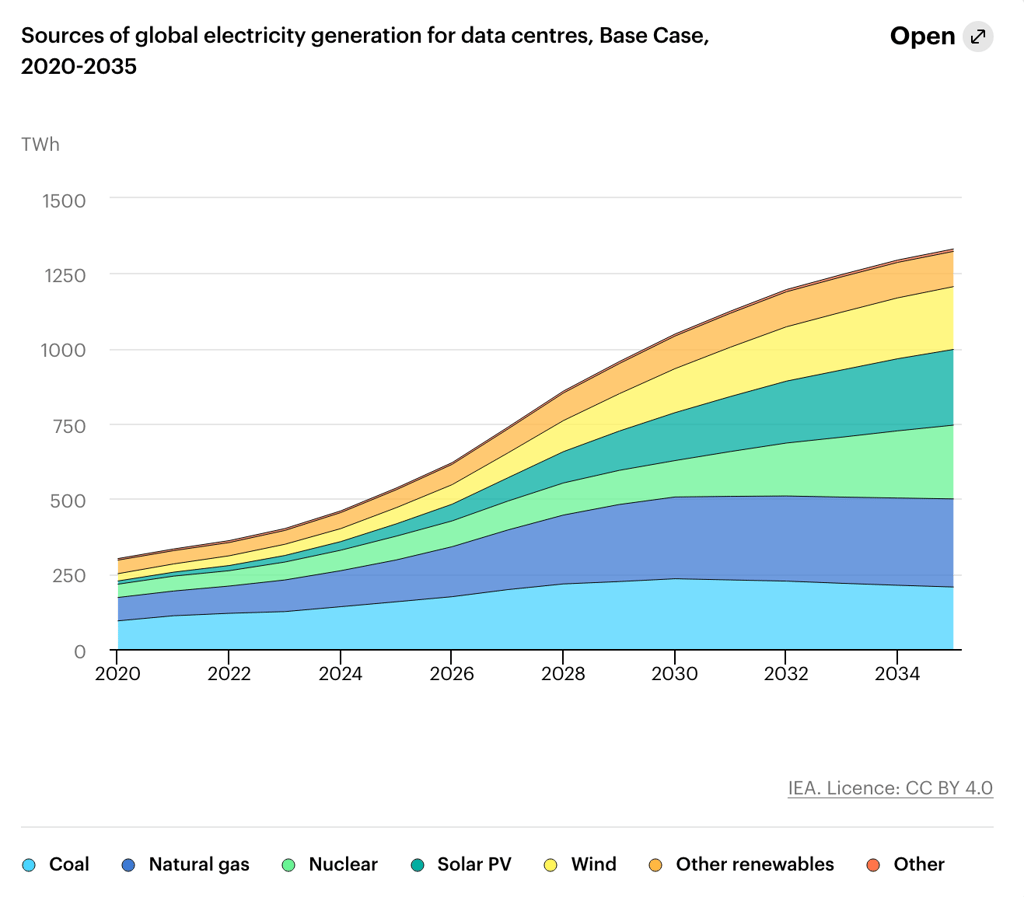
Data isn't terrifying if you read past the headlines. It's good news and bad news. It means the world is figuring out the energy problem as it goes, not wanting to slow progress while addressing problems along the way. It also means (to me, at least) that every little step we take to be more conscious about what we consume and how we behave matters.
Darning an old sock might not exactly feel like a planet-changing initiative at the moment. But that's how I first lost my appetite for clothes shopping and turned to crafting and mending my own couture.
If you don't want to do it for the planet, do it for yourself. Consuming, unless it's books and water, is bad for you.