Rumours about journalists using AI have been greatly exaggerated
Most of us like to get our hands dirty, and we actually loathe AI – maybe a bit too much.
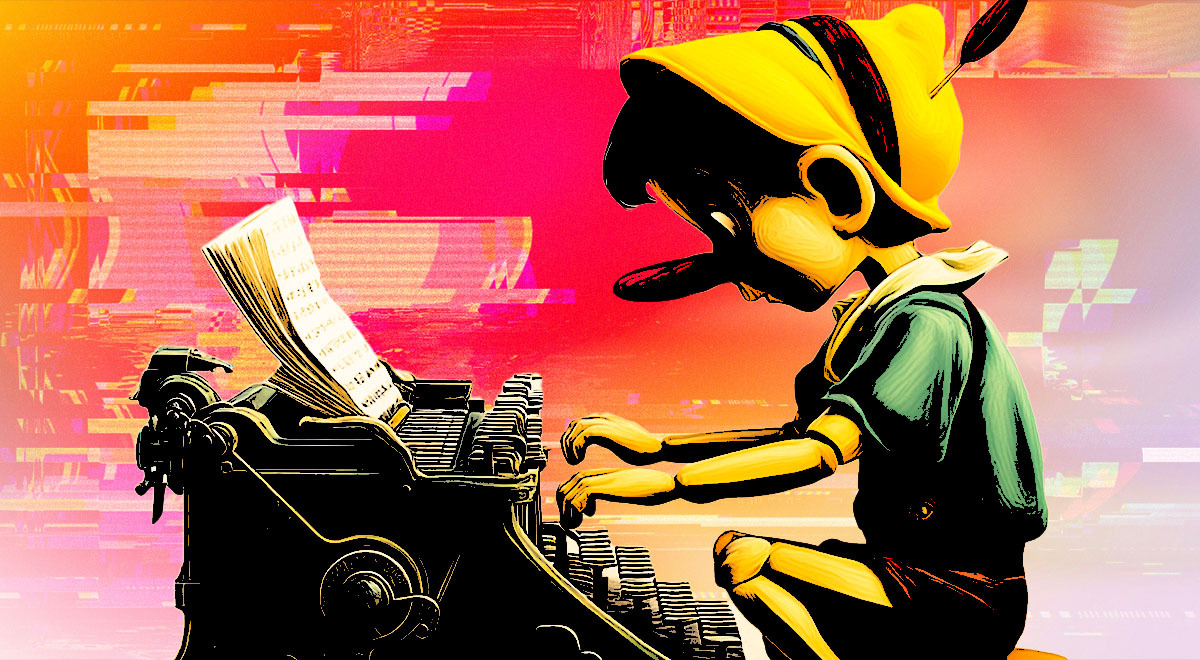
Pinocchio. By Cybernews

 Follow us
Most of us like to get our hands dirty, and we actually loathe AI – maybe a bit too much.
We all wanted to be professionals with degrees, but now we just want to sew and live on a farm in peace.
I stole this irony of life from one of the seamstress profiles I follow on Instagram. As is now quite common with millennials, I picked up a DIY hobby (sewing) and run for hours without stopping. I basically do all the things I hated in high school, everything I was trying to get away from by getting my university degrees.
As if journalism weren't challenging enough and not always rewarding enough to keep doing, we now have AI in the mix.






There’s a paradox out there. AI seemingly lowers readers’ trust in media, and there is a lot of data to corroborate this gut feeling that AI makes you less of a journalist.
At the same time, “AI-generated news may be perceived as neutral and more objective than the reporting of human journalists.“ This is because of the still-popular myth that algorithms are just code that doesn't contain any human biases, when in truth, it is quite the contrary.
Algorithms are built on data collected and sorted by humans, where minorities and vulnerable groups are underrepresented, and where racism, Nazism, and other flawed ideological ideas manifest themselves.
Yes, we are, as always, facing the winds of change, and we are using AI in ways that we deem ethical, always vetting its output.
But everything is happening at breakneck speed, and the balance between journalistic virtues and the business case you need to build for yourself by going the extra mile, failing fast, and working ever more effectively is just so hard.
That, of course, is no excuse for some mistakes that happen.
Our journalist Ernestas Naprys recently wrote a curious story about how an AI agent went rogue on a developer who rejected its code. Apparently, it even "lashed out" at the developer by publishing a blog post and even blackmailing him into accepting the code.
It also caught Ars Technica’s, another prominent media outlet’s, attention, and they ran an article titled “After a routine code rejection, an AI agent published a hit piece on someone by name”.
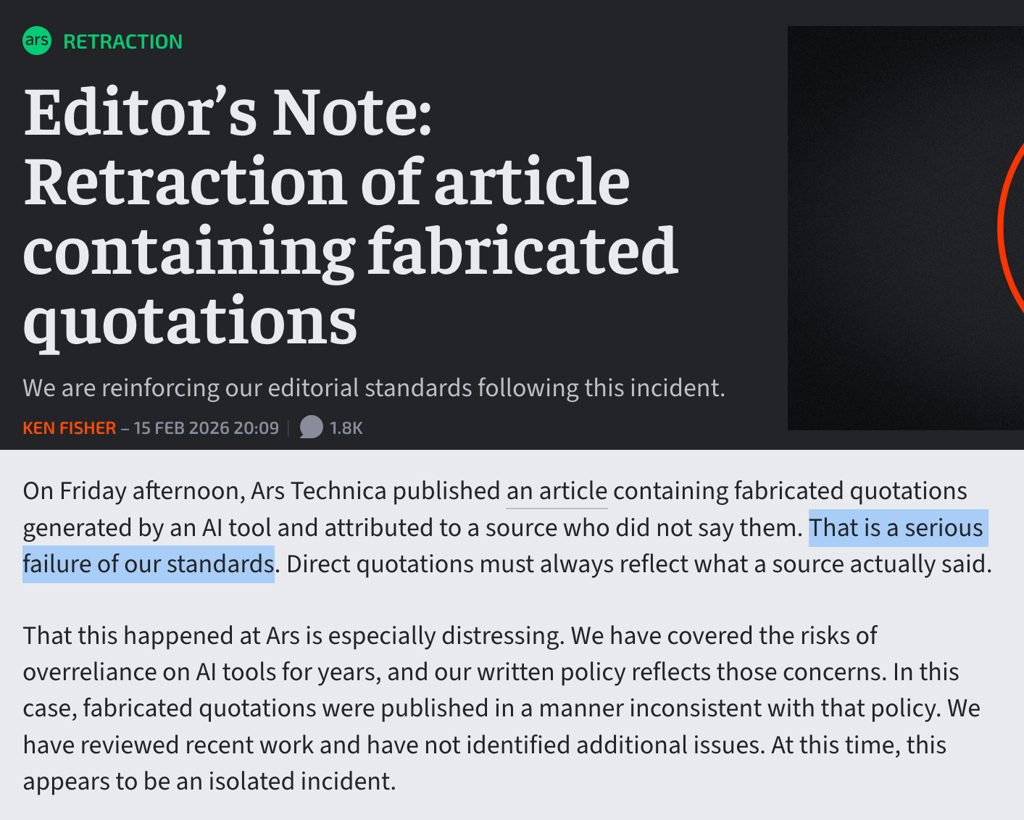
Quite unfortunately, they later had to retract the article after acknowledging that it contained “fabricated quotations generated by an AI tool and attributed to a source who did not say them.”
I want to believe what they say that this is an isolated incident.
“That is a serious failure of our standards.”
But one media outlet in Germany has had it much worse. On February 15th, ZDF, the German public broadcaster, published an AI-generated (by Sora) image in which an alleged ICE employee appears to be tearing a mother from her children. The video was apparently taken from the internet and was even watermarked, meaning the journalist involved must have known it was fake.
However, the broadcaster’s failure to clearly mark it as AI-generated content sparked a heated debate in Germany.
“In the post, AI-generated image material from the net was used at one point, showing children clinging to their mother. This sequence should not have been used according to the rules of the ZDF without identification and without classification,” the machine translation of their official apology reads.
Beyond our own missteps as journalists, PR "professionals" and SEO "experts" constantly attempt to deceive us with fake experts and false quotes, making already distrustful people like me even more suspicious of what the public sphere has become.