Renpho vs Hume scale: which smart body scale is better for tracking progress?
Being behind major reports like The Mother of All Breaches and RockYou2024, our in-house cybersecurity experts and journalists provide unbiased, real-world testing and in-depth analysis.
We maintain complete transparency by openly sharing our testing methodologies with our audience.
Learn more

In my Renpho vs Hume scale comparison guide, I’m pitting the entire Renpho smart scale lineup against the Hume Body Pod, but I will primarily use Renpho’s latest model, the MorphoScan Nova, as a reference for specs.
In short, Renpho offers an affordable, mainstream smart-scale ecosystem with good app tracking, while the Hume Body Pod is a premium body composition device that offers deeper insights.
With the help of the Cybernews research team, I’ve analyzed the two brands extensively by reviewing the official product documentation, app details, and user feedback to provide you with a comprehensive comparison of Renpho and Hume.
Renpho is the budget-minded choice, but only its MorphoScan Nova can compare to the Hume Body Pod in terms of accuracy, metrics covered, and breadth of data. Hume is the better choice for users seeking detailed insights.
Renpho vs Hume scale overview
Renpho’s MorphoScan Nova is the company’s latest flagship smart scale, featuring a 4.3-inch display and the ability to track over 50 body metrics at 98% DEXA accuracy.
Most other Renpho scales are simpler and more affordable. However, they all pair with the Renpho Health app for detailed readings that you can integrate into Apple Health and Health Connect.
The Hume Body Pod also offers clinical accuracy (98% DEXA-level). It tracks 45 metrics and delivers personalized insights. The scale has its own dedicated app and can pair with Apple, Fitbit, and Samsung devices and apps.
Here’s a quick overview of both:
| Brand | Hume Body Pod | Renpho |
| Rating | ||
| Body composition metrics | 45 health metrics with segmental measurements | 50+ body metrics with segmental fat and muscle analysis |
| Measurement technology | 8 BIA electrodes and clinical-grade precision focus | 8 BIA electrodes with consumer-friendly tracking |
| Display & usability | 2.8" display and personalized health programs | 4.3" color TFT display, retractable handle, voice guidance |
| Best for | High-precision, clinical-grade full-body composition analysis | Affordable daily and long-term body composition tracking |
| Price | From $229 to $352 | From $25 to $210 |


Our team of in-house researchers, writers and editors reviews and analyzes health tech products using a research-driven approach. We gather data from multiple sources, fact-check all information, and conduct our research based on peer-reviewed studies, expert opinions, consumer ratings, and regulatory approvals.
You can learn more about how we test health tech products here.
About Renpho smart scales
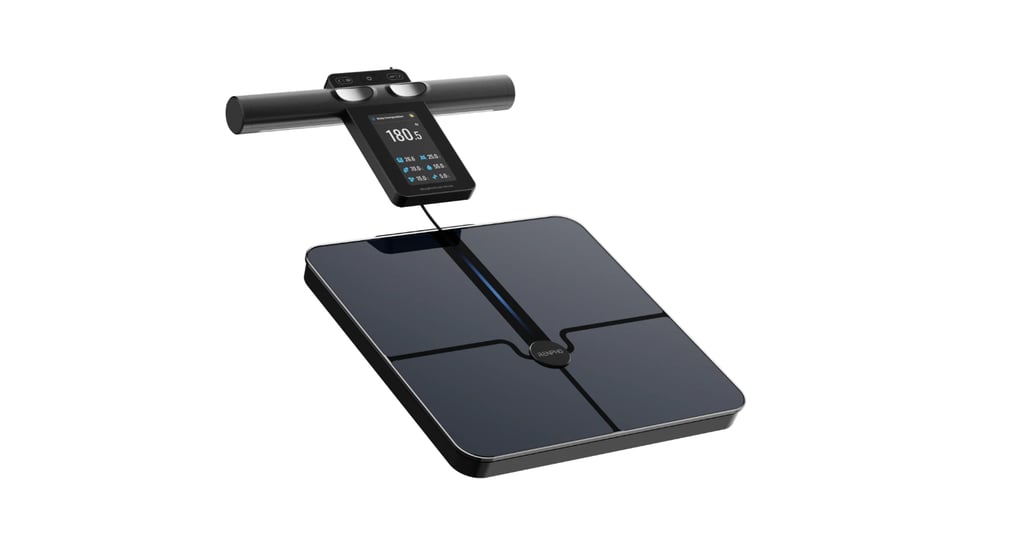
Renpho is a popular consumer smart-scale brand offering multiple models through its entry-level Elis collection, and the newer, premium-level MorphoScan collection. All are part of the Renpho Health app ecosystem.
The typical Renpho experience involves weight measurements on the scale and body composition metrics in the app. Elis models typically offer 7 or 13 metrics, while MorphoScan devices track more than 50.
These scales can pair with multiple fitness apps and devices, including Apple Health, Health Connect, Fitbit, and Samsung Health.
About the Hume Body Pod scale
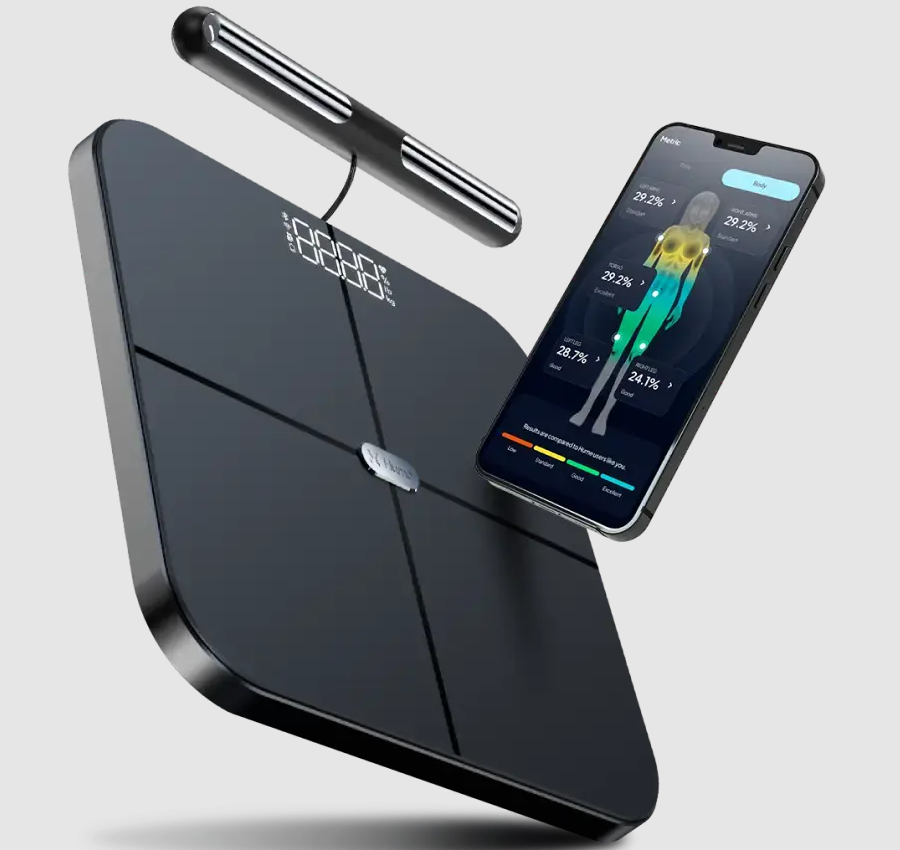
The Hume Body Pod is a premium body composition device that offers clinical-grade precision, using multi-frequency bioelectrical impedance analysis (BIA) with eight sensors.
With this technology, you get detailed in-app metrics. There’s a paid-for Hume+ app version for $9.99/month. It’s not required to use the device, but it provides more detailed insights, such as a health score, personalized coaching, and workout videos.
Hume also offers free worldwide shipping, a 45-day refund policy (device must be like-new in its original packaging), a 1-year warranty, and the option to purchase a 10-year warranty.
Hume vs Renpho scale: specs and features compared
To understand which product offers more value, I compared their key features side by side with the help of my Cybernews research team:
| Renpho MorphoScan Nova | Hume Body Pod | |
| Design and build | Full-glass ITO coating | High-strength tempered glass |
| Metrics tracked | 50+ | 45 |
| Accuracy | 98% | 98% |
| Sensors | 8 BIA | 8 BIA |
| Precision | 50g (0.1lb) | 50g (0.1lb) |
| App | Android and iOS | Android and iOS, optional subscription |
| Ease of use | Easy to install and use | Easy to install and use |
| Battery life | Up to 5 months | Up to 1 year |
| Connectivity | Bluetooth; syncs with Apple, Health Connect, Fitbit, and Samsung | Bluetooth; syncs with Apple, Fitbit, Garmin, etc |
Renpho’s latest MorphoScan scale is similar to Hume, covering a similar number of metrics and claiming the same level of accuracy (98% of DEXA scans). This is an improvement over what lower-precision smart scales generally offer.
Hume deserves credit for offering additional insights with the app subscription. But when all is said and done, it’s hard to pick a winner between the two.
Renpho smart scales vs Hume Body Pod: design and user experience
Renpho offers large displays on most of its models, except for the most affordable Elis devices. The newest MorphoScan Nova scale has the largest screen, a 4.3” full-color TFT. Hume is weaker in this sense, as it lacks a display and instead relies on the app to deliver readings.
Hume‘s app can accommodate up to 24 users on the same account, while Renpho doesn’t place a limit on the app. Also, the MorphoScan Nova can support up to 8 users on the device itself.
Taking measurements is easy, especially on Renpho’s simpler models. The MorphoScan Nova occasionally experiences connection issues, as does Hume.

Renpho scale vs Hume: data tracked and insights
The Hume Body Pod and virtually all Renpho scales track basic body composition metrics that most other smart scales offer. These include body weight, BMI, body fat percentage, skeletal muscle mass, and others.
However, the Renpho MorphoScan Nova and the Hume Body Pod, with their DEXA-level accuracy, go a step further. They offer segmental analysis of body parts, including each extremity and the torso, covering both muscle and fat. They can dig deeper by showing a protein percentage and your visceral fat index.
If you opt for the subscription model in the Hume app, you’ll get added benefits like a complete health assessment, personalized programs, coaching, weekly insights, and even workout videos and audio sessions.
But which insights actually matter?

Renpho vs hume health scale: technology and data accuracy
Most Renpho devices and the Hume scale use consumer-grade BIA to deliver their readings. Only the MorphoScan Nova and the Hume Body Pod go further, offering up to 8 sensors and claiming 98% DEXA accuracy.
Bear in mind that this is not a Cybernews-verified fact; it's something the brands claim, so take it with a grain of salt.
If true, it means you get near-perfect results, comparable to clinical dual-energy x-ray absorptiometry (DEXA) scans.
Since these are consumer-grade devices, their accuracy still depends on your hydration level, the time of day, and how frequently you use the scale.
So, to get more consistent readings, you should:
- Measure at the same time of day
- Have a similar hydration level
- Avoid taking readings after workouts
- Track trends, not absolutes
What users think about each smart scale brand
People are skeptical of the accuracy of all smart scales. However, most users feel that those inaccuracies are marginal. Some users who own both a Renpho scale and the Hume Body Pod report that they always show the same results.
Outside of that, users generally praise Renpho devices for ease of use and value for money. The app is also often mentioned in a positive light.
Hume generally gets more positive reviews. Users praise the depth of insight the scale offers and its motivating effect.
As for negative sentiment, both companies have their fair share. With Renpho devices, people are often skeptical about the product's precision and quality. As for Hume, users also complain about the accuracy, especially of the body fat percentage readings. People also complain about the app’s connectivity issues.
Hume Body Pod vs Renpho scale: cost and value comparison
Since Renpho offers several smart scales, its pricing varies, but remains in the low to mid range.
The Elis collection is more affordable, ranging from $25 to $76. The MorphoScan collection includes two premium models, priced at $150 and $210. These also often come with discounts.
The Hume Body Pod is more expensive than all Renpho products, with pricing subject to discounts but generally ranging from $229 to $352.
Hume also comes with optional costs, most notably the $9.99 monthly fee for the premium app version. There’s also an optional 10-year warranty for $46 to $70, depending on the current discount.
How we evaluate smart body scales
Here’s what we look at when evaluating smart scales:
- Data depth & trend clarity (25%). We check the official specs to see how many metrics are covered and whether they include segmental analysis.
- Ease of use (20%). We check what users are saying about the ease of setup and use. We note issues such as the need to perform multiple readings to obtain accurate results.
- Consistency and accuracy expectations (20%). We take a deep look at the disclosed method and what users are reporting to draw conclusions.
- App features and integrations (15%). We look at what the apps offer and user feedback on them. We check how many fitness-related apps they can sync with.
- Price and ongoing costs transparency (15%). We always consider the price and how transparent the company is about ongoing costs, such as subscriptions.
- Privacy and data controls (5%). We also evaluate the privacy policy, the data the brands gather, and how they store it.
Renpho vs Hume scale: which one should you choose?
The Hume Body Pod and many Renpho models are among the best smart scales on the market.
We’ve already compared the MorphoScan to the Hume scale in the past, but things changed with the introduction of the MorphoScan Nova. It fares well in terms of accuracy, just as Hume does against a Dexa scan.
Renpho takes the throne if you’re looking for budget-friendly tracking, household use, an easy app, and simple dashboards.
However, as you can see in our other Hume comparisons against products like the Withings Body Scan and Oxiline Scale MD Pro, the Hume Body Pod is ideal if you’re looking for deeper insights and are okay with a premium price and optional paid analytics.
FAQ
Which Renpho scale model is best to compare with the Hume Body Pod?
The best comparison to the Hume Body Pod is the MorphoScan Nova, which also claims DEXA-level accuracy and tracks a similar number of metrics.
Does Hume require a subscription to use the Body Pod?
No, it doesn’t. However, there is an optional monthly subscription to the premium version of the Hume app.
How accurate are smart scales for body fat and muscle compared to medical scans?
The best ones that claim DEXA-level accuracy are fairly accurate, but results tend to vary due to multiple factors.
How accurate are smart scales for body fat and muscle compared to medical scans?
The research covered above shows a noticeable discrepancy across multiple metrics and absolute error for body mass, fat mass, and lean mass.
What should I do to get the most consistent body composition readings over time?
You need to take readings at the same time of day and with a similar level of hydration. Moreover, you need to follow trends, not individual results, and avoid using the scale after workouts.
-
Accuracy of Smart Scales on Weight and Body Composition: Observational Study
Justine Frija-Masson. 2021. JMIR Mhealth Uhealth
-
Dual-Energy X-Ray Absorptiometry
Marissa Krugh. 2024. Campbell University
-
Accuracy of Smart Scales on Weight and Body Composition: Observational Study
Justine Frija-Masson. 2021. JMIR mHealth and uHealth Journal.
-
Collecting health-related research data using consumer-based wireless smart scales
Erlend Johannessen. 2023. International Journal of Medical Informatics.