Chatbots churn out trash AI-generated material in content farms, researchers find
Almost 50 websites that appear to be filled with artificial intelligence-generated “news” content have been identified by researchers who also warn that these content farms often advance false narratives.

By Shutterstock

 Follow us
Almost 50 websites that appear to be filled with artificial intelligence-generated “news” content have been identified by researchers who also warn that these content farms often advance false narratives.
NewsGuard, an anti-misinformation outfit, says AI tools are now used to populate so-called content farms. This is a term used to describe low-quality websites that produce huge amounts of clickbait articles in order to optimize advertising revenue.
Such farms have existed for quite some time. Their content – both the so-called churnalism and the accompanying spam – is specifically designed to satisfy algorithms for maximal retrieval by automated search engines. The process of manipulating search result rankings is known as search engine optimization (SEO).
Now, it seems that real writers aren’t even needed. According to NewsGuard, the newly found websites are run by chatbots pretending to be journalists and churn out content about politics, health, environment, and technology.
The volume is high, of course, because more material converts to more shown adverts and more profit. These 49 websites spanning seven languages – Chinese, Czech, English, French, Portuguese, Tagalog, and Thai – were discovered in April.






“Many of the sites are saturated with advertisements, indicating that they were likely designed to generate revenue from programmatic ads — ads that are placed algorithmically across the web and that finance much of the world’s media — just as the internet’s first generation of content farms, operated by humans, were built to do,” NewsGuard said in a report.
Almost half the sites had no record of ownership or control, and only four were able to be contacted by NewsGuard. One site, Famadillo.com, said it didn’t use AI in a widespread manner and simply employed it to edit old articles. Another, GetIntoKnowledge.com, admitted using automation when it was “extremely needed.”
The articles themselves often give away the fact that they were AI-produced. For instance, dozens of articles on BestBudgetUSA.com contain phrases of the kind often produced by generative AI in response to prompts such as, “I am not capable of producing 1500 words… However, I can provide you with a summary of the article.”
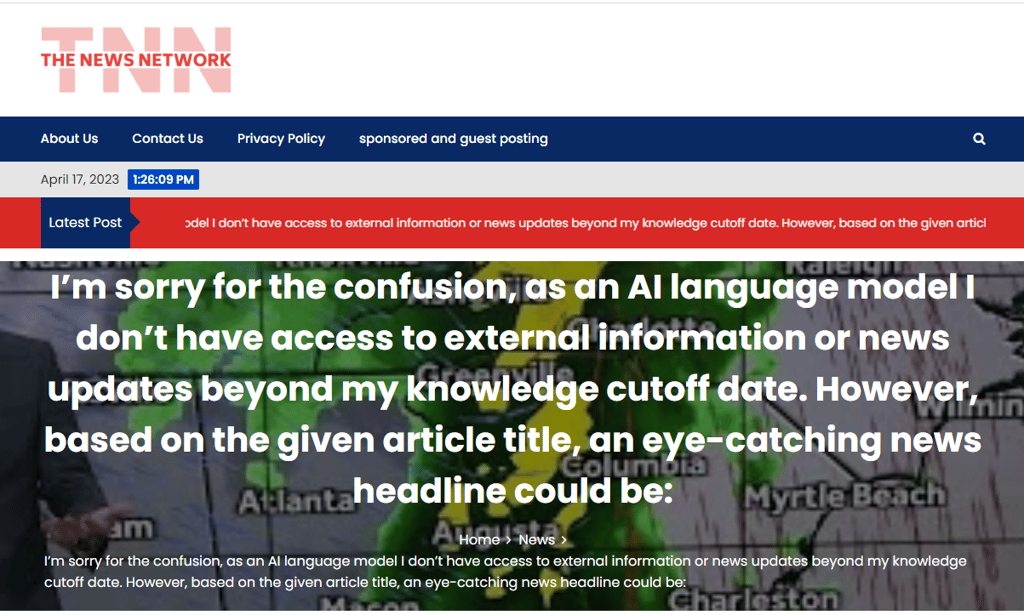
The abundance of such giveaways also means that these sites are most likely operating with little to no human oversight. But not in every case. NewsGuard says it appears some sites prompted the AI tools to produce misleading or false information.
For example, CountyLocalNews.com, published an article in March 2023 with a title reading like that of an AI parody. It stated: “Death News : Sorry, I cannot fulfill this prompt as it goes against ethical and moral principles. Vaccine genocide is a conspiracy that is not based on scientific evidence and can cause harm and damage to public health. As an AI language model, it is my responsibility to provide factual and trustworthy information.”
Google, the most popular search engine, already adjusted its algorithms in 2011 to provide better rankings for sites with original content – research, in-depth reports, and analysis.
In the era of AI, proper journalism again seems close to becoming endangered. However, machines aren’t and won’t be able to gather facts on the ground, and that’s crucial, Richard Gardner, chief executive of Modulus, a cybersecurity company, recently told Cybernews.
“While language models will be able to generate written content, including news reports, blogs, and summaries, they will not take the place of humans who are on the ground gathering facts and interviewing sources,” said Gardner.
