Why Microsoft just pulled the plug on Copilot integration
Microsoft has reportedly shelved plans to implement its Copilot AI integration, after almost two years of planning to position it at the forefront of Windows 11.
Thomas Trutschel via Getty Images

 Follow us
Microsoft has reportedly shelved plans to implement its Copilot AI integration, after almost two years of planning to position it at the forefront of Windows 11.
- Microsoft has shelved plans for deep, "ambient" Copilot integration across Windows 11 (Settings, File Explorer) in favor of a more selective, moderate approach.
- The shift allows users to disable certain AI features to reduce "AI bloat," reflecting Microsoft's claim that it is evolving products based on customer feedback.
- Rapid, excessive AI uptake proved unpopular, with the market not demanding the features and the online community coining the derogatory term "Microslop."
Key Takeaways by nexos.ai, reviewed by Cybernews staff.
The plan, mooted in 2024, was to integrate Copilot in Settings, Notifications, and File Explorer in Windows 11.
It was also called “ambient intelligence” by Microsoft, especially in niche cases like healthcare adoption, where AI agents handle a large share of administrative tasks.
Instead, Windows has gradually phased in moderate AI assistance, such as a semantic search feature in settings, to a lesser extent than the original, omnipresent AI plans.






However, as AI is now selectively integrated into the Windows 11 operating system, users can choose to disable features to reduce “AI bloat,” according to Windows Central.
Microsoft said in a statement shared with the publication that its approach to product development was “to preview with customers and evolve with feedback.” It said that “features may change, be removed, or replaced over time as we gather input from customers."
Research carried out last September by the UK’s Department of Business and Trade found AI to be lacking in the productivity stakes, particularly when it came to agentic tasks like scheduling meetings or designing presentations.
Even back then, some experts were forecasting the announcement to adversely boomerang back on Microsoft, which seems to largely be the case as it currently stands.
Has your password leaked?
Data leaks and enterprise nightmares
Microsoft has faced negative publicity recently, especially regarding confidentiality and privacy issues. In late January, it admitted that it had found a bug that allowed Copilot to access sensitive emails, both personal and corporate.
The firm's security fortress also came under scrutiny at the start of this year, as researchers at Varonis Threat Labs found that threat actors could penetrate a Copilot account via a single-click link, effectively hijacking a user's credentials.
The Cybernews community is talking about this. Be a part of the conversation.
There was also a harsh realization in June 2025 that speculatively, account crackers could extract under-the-hood information by simply sending an instructive email to the end-user's inbox, even if it remains unopened.
What are people saying?
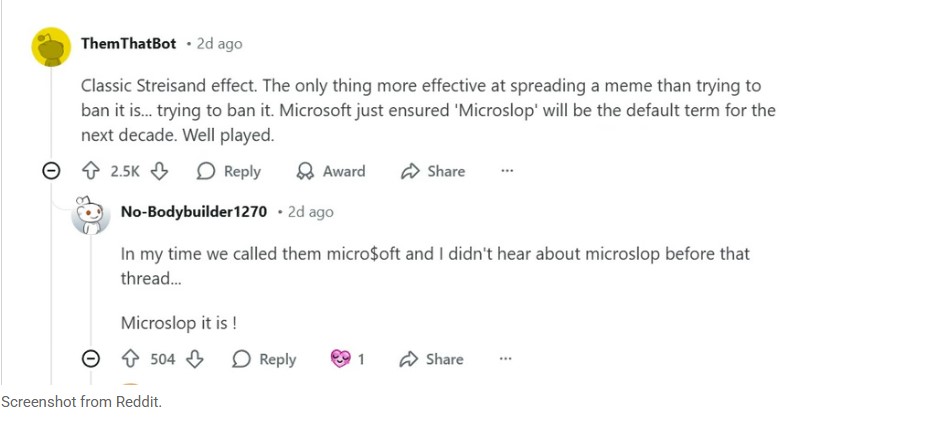
And to top it all off, the Reddit community dubbed Microsoft's bloated and messy AI strategy “Microslop,” though Microsoft has tried to reason with its customers not to use the term, and has also banned it from the official Pilot Discord server.
Also, over on X, Zac Bowden, the senior editor at Windows Central, opened up the debate on the bulky nature of AI agentic integration, with one reply declaring “Microslop, we appear to be winning. Return to the glory days of Windows XP and Windows 7.”
Microslop , we appear to be winning. Return to the glory days of Windows XP and Windows 7. @Microsoft @Windows No one wants your bloated mess of an OS, or your OS level AI.
undefined Street Guru (@LordStreetGuru) March 16, 2026
Large-scale Copilot integration has been put on ice because rapid, excessive AI uptake is clearly not what the market demands. Microsoft may be better suited to playing the long game.