Inside ICE’s surveillance arsenal - and the hackers resisting it
After the fatal shooting of an unarmed activist in Minnesota, fresh scrutiny is falling on ICE’s expanding surveillance arsenal – and the hackers working to undermine it.

Victor J. Blue/Bloomberg via Getty Images

 Follow us
After the fatal shooting of an unarmed activist in Minnesota, fresh scrutiny is falling on ICE’s expanding surveillance arsenal – and the hackers working to undermine it.
- ICE has dramatically expanded its surveillance capabilities, deploying tools that span phones, biometrics, social media, and location tracking.
- Billions in taxpayer dollars are flowing to private surveillance vendors, raising fresh questions about oversight, scope, and accountability.
- Hackers and technologists are increasingly pushing back, building tools to map, disrupt, or expose ICE surveillance operations.
Key Takeaways by nexos.ai, reviewed by Cybernews staff.
ICE has been quietly expanding its use of advanced surveillance tools in recent years, building a massive digital toolkit that now spans phones, social media, biometrics, and location tracking.
And while ICE and other US law enforcement agencies (think FBI, NSA) have long relied on intelligence-gathering tools, the shooting death of activist and mother Renee Good in Minneapolis on Wednesday has renewed scrutiny over how invasive these tools have become – and how much taxpayer money is being spent to deploy them.


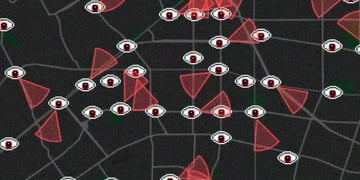




Digital privacy advocates the Electronic Frontier Foundation, in doing what it does best, has rounded up the most pervasive tools in use by the US Immigration and Customs Enforcement (ICE) agency and the myriad ways the hacking community is trying to circumvent them.
ICE’s expanding surveillance toolkit
ICE reportedly spent an estimated $2.8 billion between 2008 and 2021 on new surveillance, data collection, and data-sharing programs, according to the 2022 report, American Dragnet: Data-Driven Deportation in the 21st Century, by Georgetown Law’s Center for Privacy and Technology, which was rereleased in May.
In 2025, that figure jumped to $28.7 billion, and is expected to grow by another $56 billion by the end of the Trump administration, the report states.
To put it in perspective, ICE’s budget is now equivalent to “the 14th most well-funded military in the world, right between Ukraine and Israel,” the EFF states.
What's more, the clearly anti-ICE law center claims that the deportation-focused agency’s current “surveillance dragnet” was built by tapping data from not only private companies, but also state and local bureaucracies.
According to the 114-page document, the data-dragnet has given ICE the “ability to track nearly every person in the US, seemingly at any time,” providing the following numbers.
- ICE had scanned the driver’s license photos of 1 in 3 adults.
- ICE had access to the driver’s license data of 3 in 4 adults.
- ICE was tracking the movements of drivers in cities home to 3 in 4 adults.
- ICE could locate 3 in 4 adults through their utility records.
Now, one could ask which came first: Are surveillance budgets ballooning due to rapid advances in technology, or the result of an administration that has doubled down on its controversial agenda, or maybe even a little of both?
Either way, here are the latest surveillance technologies ICE agents are (or will be) pulling from their pro-expulsion arsenal, as reported by the EFF.
How ICE tracks phones, faces, and movement
In 2025, ICE entered or renewed contracts with a multitude of private companies to acquire a variety of surveillance tools and spyware, including phone, location, social media, and facial surveillance, the EFF found.
To gain access to private phone data once it is in its possession, ICE now has contracts with three separate companies totaling over $13 million.
"In April, ICE awarded Palantir a $30 million contract under which the company will provide the government with the ability to track people’s movements with 'near real-time visibility.'"- American Dragnet: Data-Driven Deportation in the 21st Century, Georgetown Law, Center on Privacy & Technology
The first is Cellebrite, a digital forensics company based in Israel known for its UFED data extraction device, which enables ICE to not only unlock a phone for examination, but also take a complete image of all the data on that phone, including apps, location history, photos, notes, call records, text messages, and even encrypted Signal and WhatsApp messages.”
It then performs a deep-dive analysis to understand the user's behavior, connections, and activities, the company states on its website.
Apparently not enough, ICE was also said to have signed contracts with Cellebrite's spyware competitors, Magnet Forensics in Canada and the US branch of Paragon Solutions, both of which also specialize in unlocking encrypted devices and harvesting data from encrypted messaging apps.

As for internet surveillance, ICE has acquired two social media surveillance tools from PenLink, a Nebraska-based intelligence-gathering and data analysis software provider, for a cool $5 million.
The tools – Webloc and Tangles – allow ICE to gather the locations of millions of phones without a warrant, and by scraping the web and public social media accounts, obtain and search “a person’s posts and posting history, comments containing specific keywords, location history, tags, and photos."
Gaining the ability to gather even more publicly available data for a targeted dossier, ICE also secured $4.2 million in contracts with surveillance specialists Fivecast and ShadowDragon, whose Open-Source Intelligence platforms (OSINT) give ICE the ability to search “100+ social networking sites,” the EFF states.

Finally, for biometrics and street-wise surveillance tools, ICE has “contracts with multiple automated license plate reader (ALPR) companies to follow the driving habits of a large percentage of Americans,” including via the widespread Flock Safety Network and Motorola Solutions.
ICE has also been known to use trucks with cell site simulators from a company called TechOps Specialty Vehicles. Also known as Stingrays or IMSI catchers, the simulators act as fake cell towers to intercept or monitor mobile communications.
Additionally, ICE uses facial recognition software called Mobile Fortify, which can cross-reference images against a database of 200 million photos, and now has contracts with BI2 Technologies, a Massachusetts-based iris-scanning company that also captures and matches Iris images against databases, and a $10 million contract with Clearview AI in New York, also for face recognition.
All of this harvested information is then funneled to Palantir Technologies, a company that links and analyzes data from various government agency databases under a $30 million contract with ICE, awarded by the Department of Homeland Security last April.
“Palantir makes it so that ICE has all the data they have acquired in one place, so it’s easy to search through,” EFF says.
Hackers pushing back
EFF says that besides undocumented immigrants and activists, government surveillance tools have been used to track green card holders, asylum seekers, naturalized citizens, and even citizens by birth.
This has led the like-minded hacker community to find ways to disrupt active ICE surveilling and even prevent targeted tracking in the first place.
Call it a reversal of fortune, but in the last few months, a bevy of apps designed to track the movements of ICE agents – instead of potential deportees – are proliferating on app stores.
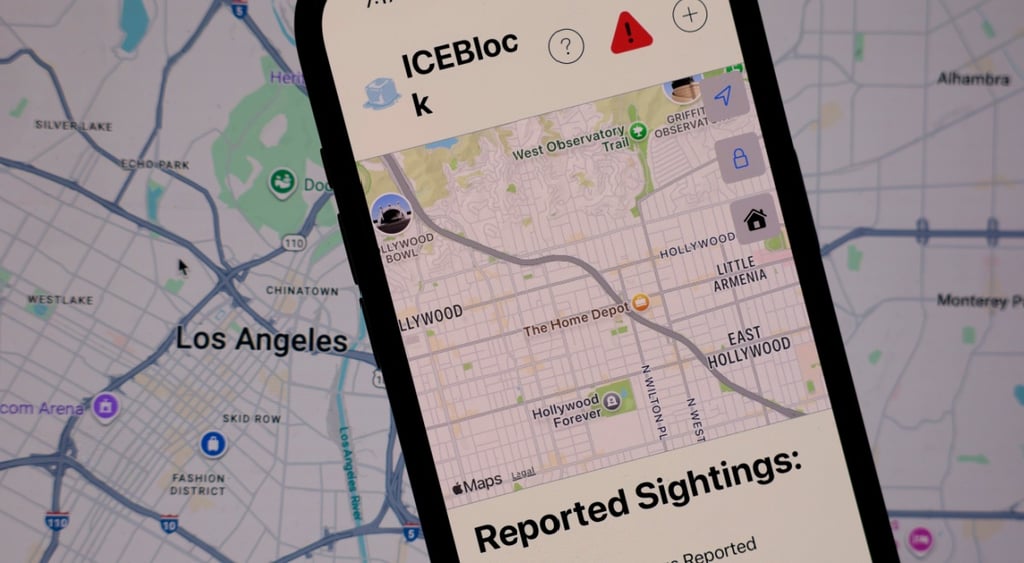
Apps such as Stop ICE Alerts and ICEOUT.org allow users to report ICE sightings in their local neighborhoods (most likely how Good and her wife were able to follow ICE’s movements on that fateful day).

However, with law enforcement catching wind, two of these apps – Eyes Up and ICEBlock – have since been delisted from the App Store at the request of the White House, with the EFF filing a lawsuit to reinstate the latter.
EFF presents another “interesting project,” ICE List Wiki, created by Crust News and aimed at journalists as well.
The Wiki is not just “a public, verifiable record of immigration enforcement activity across the US,” but “documents incidents, agencies, individuals, facilities, vehicles, and legal authorities involved in enforcement operations,” the website states.
EFF says users can also scour the site's open-source intelligence to glean information on the companies that are reported to have contracts with ICE.

Hackers helping local communties
Also of interest, many hackers have started hosting digital security trainings aimed at assisting local communities.
These initiatives have included building websites chock full of cybersecurity advice, how to remove private data from the web, and even what to do in the event of an ICE raid.
These White Hat hackers (or Black Hats, depending on how you view them) have also built several projects to help citizens map the locations of Flock Safety cameras across their local cities and towns.






One such project is OUI-SPY, an open-source hardware device that supports multiple programs, including one named "Flock You," for detecting Flock cameras and another called "Sky-Spy" for spotting overhead police drones.
Additional open-source tools such as deflock.me and alpr.watch offer crowdsourced maps identifying the exact locations of the tens of thousands of Automatic License Plate Recognition or ALPR cameras in use nationwide.
Keep in mind, many of these surveillance tools, for example, Flock Safety, also provide proactive crime deterrence and rapid evidence gathering, helping law enforcement catch criminals, locate missing persons or kidnapping victims, enhance neighborhood watch programs, and protect public and private property.
Unlock more exclusive Cybernews content on YouTube.