Russia breaks VPN defenses, fines Alphabet’s Google for app violations
Those who want out of Russia’s information space might be stuck. The country’s court has fined Alphabet's Google over 22 million roubles ($288,000) for distributing VPN (virtual private network) services on the Google Play app store, state news agency TASS reported on Wednesday.

By Cybernews.

 Follow us
Those who want out of Russia’s information space might be stuck. The country’s court has fined Alphabet's Google over 22 million roubles ($288,000) for distributing VPN (virtual private network) services on the Google Play app store, state news agency TASS reported on Wednesday.
VPNs are a resource that some Russians rely on to circumvent the country's strict content bans and restrictions.
Moscow’s Tagansky District Court announced the decision via Telegram, stating that it found “Microsoft Corporation administratively liable” and therefore issued “penalties in the form of fines” for six violations.
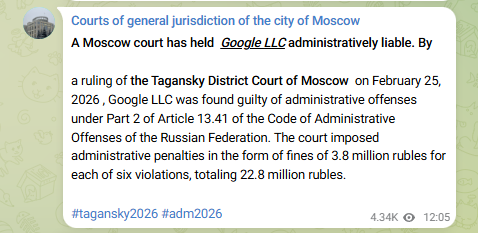
They are defined in Part 2 of Article 13.41 of the Code of Administrative Offenses of the Russian Federation.






In simple terms, the article states that if a website, social media platform, or internet service refuses to delete banned content or restrict it after being told to do so by Russian authorities, then the company can be fined.

Check if your data was exposed
Find out if your email and related personal information have appeared in known data breaches.
Russian authorities reserve the right to request bans on content deemed a violation of the country’s laws. Usually, they cover the grounds of information distribution about:
- Unauthorized protests
- Reporting on the ongoing war in Ukraine that doesn’t support the Russian narrative
- LGBTQ+ content that falls under the country’s propaganda law
- VPN services that allow users to bypass blocked websites
- “Extremist” materials
Not complying with these rules often becomes impossible.
“For tech companies operating in the Russian Federation, these enforcement actions and administrative penalties mean companies either have to agree with the censorship and content restrictions (and implement technical blocking within the Russian Federation) or step out of the Russian market altogether,” says Yelena Ambartsumian, Founder of AMBART LAW, a New York law firm that focuses on privacy, AI governance, IP, and commercial contracts.
There is past precedent for this. For example, in 2006, when Google launched in China, it agreed to self-censor search results in line with the country’s laws.
However, Google found a workaround and in 2010 began redirecting users in China to its Hong Kong site.

One of the latest examples is the full block on Meta-owned WhatsApp – Russia’s most popular messaging app. Meta had already been designated as an extremist organization inside Russia.
As of February 20th, Russia began partially restricting Telegram as authorities have already begun to slow it down. In that instance, Roskomnadzor – Russia’s Federal Service for Supervision of Communications, Information Technology and Mass Media, claimed that Telegram failed to protect personal data and had “no effective measures to combat fraud and the use of the messenger for criminal and terrorist purposes.”
Alex Shahrestani, Managing Partner at Promise Legal, a Texas law firm, views Russia's fines against Google for VPN distribution as a regulatory test and not a technical fix.
He believes Russia is trying to establish that its law carries the same compliance weight as Europe’s GDPR: “a cost-of-market-access calculation that foreign tech companies simply absorb.”






“The legal framework is precise and intentional," Shahrestani says.
“That procedural chain – law, warning, court, fine – is itself the point. Russia is building a record of sovereign enforcement, not resolving a content moderation dispute.”
Instead of using social media platforms that Russia considers noncompliant with state laws, authorities recommend using MAX. Although it’s often described as a surveillance app, Russia’s officials call it “an accessible alternative, a developing messenger, a national messenger.”
Unlock more exclusive Cybernews content on YouTube.