Critical FFmpeg flaw discovered: just watching a video can fully compromise your system
Open a sketchy video file in VLC, stream it using Jellyfin or Kodi, or don’t even open it at all – simply storing it can get you compromised when the Linux file manager generates a thumbnail. A critical bug in FFmpeg, a massively popular open-source video processing engine, allows attackers to crash systems with ease and, in the worst cases, run malicious code.
Image by Cybernews.

 Follow us
Open a sketchy video file in VLC, stream it using Jellyfin or Kodi, or don’t even open it at all – simply storing it can get you compromised when the Linux file manager generates a thumbnail. A critical bug in FFmpeg, a massively popular open-source video processing engine, allows attackers to crash systems with ease and, in the worst cases, run malicious code.
- FFmpeg vulnerability allows arbitrary code execution via malicious video files.
- Exploitation requires no user interaction and affects desktops, servers, and IoT devices.
- Update FFmpeg to 8.1.2 or disable MagicYUV decoder immediately to patch.
FFmpeg has released a new version, 8.1.2, with an urgent patch for a critical vulnerability in its MagicYUV lossless video codec decoder. The heap out-of-bounds write bug has a severity score of 8.8 out of 10 and is tracked as CVE-2026-8461.
This means hackers can use tampered video files to hack systems, and the potential implications are massive.
FFmpeg is the world’s most widely deployed media processing framework, used by most apps across all major OSes and embedded in countless devices, from security cameras to smart TVs. FFmpeg is used to decode, encode, transcode, stream, and play “pretty much anything that humans and machines have created,” as the maintainers themselves describe it.






Security researchers at JFrog, a software security firm that discovered the bug, say that processing a single malicious media file is all it takes to achieve remote execution.






“Users of FFmpeg are recommended to upgrade to the fixed version as soon as possible. If the MagicYUV decoder is not needed, it can be disabled at build time,” the researchers warn developers in the report.
The exploits can target both users and server-side systems, including embedded/IoT devices such as NAS and smart TVs. No authentication or special privileges are required – all the attacker needs is to deliver a media file.
In some cases, attacks will require zero user interaction – i.e., torrent download brings a malicious video file, that gets automatically ingested by media servers like Jellyfin, or processed by Nextcloud to generate a preview, or scanned by a Linux file manager to create a thumbnail. All without ever opening the actual file.
JFrog dubbed the bug “PixelSmash” and warned that the potential blast radius is enormous.
“FFmpeg’s libavcodec is the standard library for media decoding, embedded as a transitive dependency in virtually every application that touches video. The MagicYUV decoder ships enabled by default in every upstream build,” the report reads.

How does the bug work?
It is likely that you have multiple devices and apps with FFmpeg embedded already. FFmpeg includes a “libavcodec” library with decoders for hundreds of video and audio codecs.
Normally, decoders parse video data and write decoded pixels into dedicated memory space – heap-allocated frame buffers.
Researchers found that the decoder for MagicYUV, a codec used in high-performance video editing workflows, contains a rounding mismatch.
MagicYUV splits video frames into horizontal slices. Some video formats, like YUV420, store color information at half the resolution of the brightness component to save space, because the human eye is far more sensitive to brightness. The decoder has to divide the slice height by 2 when processing color data.

Check if your data was exposed
Find out if your email and related personal information have appeared in known data breaches.
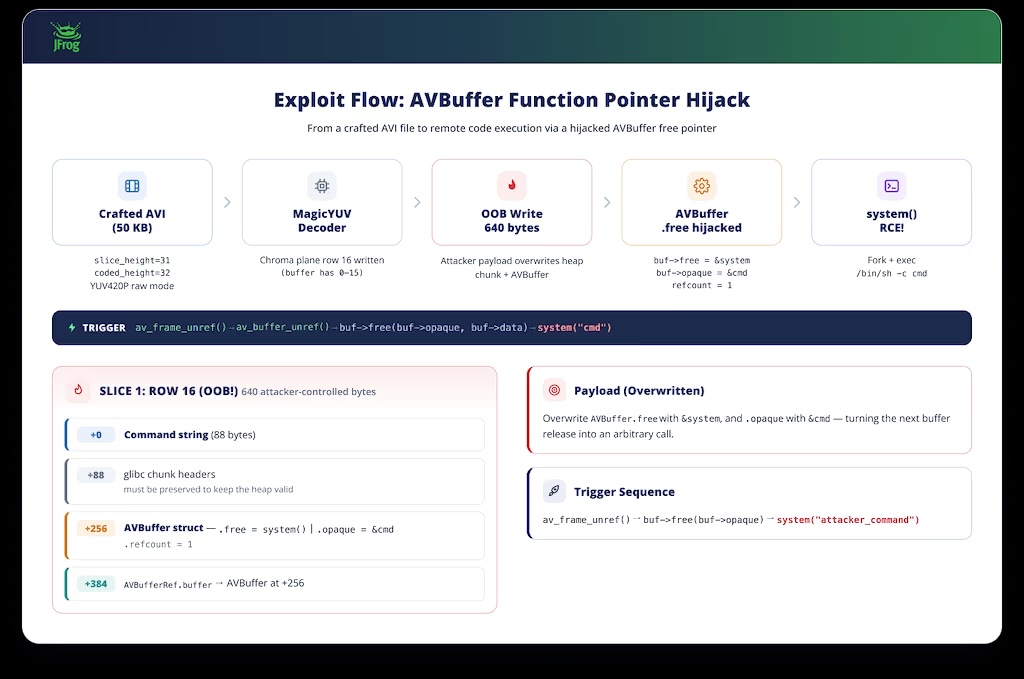
However, if the height is an odd number, dividing by 2 returns a fraction, which is treated differently in different parts of the code. When the decoder allocates a memory buffer, it rounds the number down, but when it writes data to the memory, it rounds up, leaving one extra row per slice with nowhere to go.
If the video frame width is 1280 pixels, 640 bytes will be written past the memory buffer.
The attackers can exploit this to fully control which bytes are written to memory that isn’t supposed to be accessed by the decoder.
The memory immediately after the decoder’s buffer is FFmpeg’s own AVBuffer struct – a data structure containing a pointer to a function FFmpeg calls during cleanup.
Attackers can overwrite this pointer with their own and execute arbitrary code from other parts of memory. Researchers demonstrated the exploit by spawning a shell running the attacker’s commands, leading to a fully compromised system.
Many ways to get hacked
The security researchers demonstrated several scenarios in which the bug can be abused to crash or completely compromise systems.
“We confirmed crashes against Kodi, mpv, ffmpegthumbnailer (used by GNOME, KDE, XFCE), Jellyfin, Emby, Nextcloud, Immich, PhotoPrism, and OBS Studio, among others – and demonstrated full remote code execution against Jellyfin,” explains Yuval Moravchick, Vulnerability Research Team Lead at JFrog.
Attackers can choose a popular video container, such as AVI, MKV, or MOV, and publish the crafted file disguised as a popular movie or clip to prey on victims.
- Desktop users: can be compromised by opening the malicious file in a video player, or simply browsing to a folder containing it (the file manager’s thumbnail generator triggers the vulnerability).
- Servers: can be compromised when a user uploads the file to a media server (Jellyfin, Emby, Nextcloud, Immich), chat platform (Slack, Discord, Telegram), or cloud transcoding service (AWS MediaConvert, Cloudflare Stream) – the server processes it automatically
- Embedded/IoT devices: can be hacked as well. NAS appliances (Synology, QNAP), smart TVs, or media appliances generate video thumbnails or previews.
“We achieved full remote code execution against a Jellyfin 10.11.9 media server – the second-most popular self-hosted media server (after Plex) – through its normal media library scan pipeline,” JFrog said in the report.
They also hacked a Nextcloud instance via Movie preview, invoking system ffmpeg for thumbnail generation.
“The exploitation is entirely silent. In the web interface, the only indicator is a generic file icon where a thumbnail should be. No errors or pop-up alerts the user, and the resulting crash is buried in server-side logs that typically go unmonitored by administrators,” the researchers said.
The report warns that PixelSmash enables achieving “the worst failure mode” – no logs tell the operator that the server is already under active exploitation.
The vulnerability extends well beyond traditional media applications into any software that uses FFmpeg, including AI frameworks, GPU-accelerated data-loading pipelines, and more.
Unlock more exclusive Cybernews content on YouTube.