Hacker groups claim 23TB Rosstat breach exposes Russia’s hidden war loss data
“We’re not just breaking their systems. We’re reading their secrets.”

Russian army helmet, captured in Ukraine

 Follow us
- Belarusian Cyber Partisans and Silent Crow claim they breached Rosstat and stole about 23 TB of data.
- The hackers say leaked records suggest up to 50,000 Russian soldiers die in Ukraine each month.
- Rosstat confirmed targeted cyberattacks but said its databases were not compromised.
- Moscow stopped publishing cause-of-death data in 2024, limiting public insight into war losses.
Key Takeaways by nexos.ai, reviewed by Cybernews staff.
Hacker groups Belarusian Cyber Partisans and Silent Crow claim to have hacked the Russian Federal State Statistics Service (Rosstat) and say the data shows true Russian wartime losses in Ukraine.
After claiming responsibility for the attack, the hacker groups said they had gained access to around 25,000 Rosstat computers and servers. They allegedly stole roughly 23 terabytes of data and destroyed part of the agency’s internal IT infrastructure.
The new haul includes data on Russian wartime losses marked “for official use only.”
A window into harsh reality?





Since 2024, Rosstat hasn’t published annual cause-of-death statistics, but the hackers are now sharing a new chart suggesting that as many as 50,000 Russian soldiers are killed in Ukraine every month.
The General Staff of the Armed Forces of Ukraine said today that Russia has lost 1,594,830 troops in Ukraine since the beginning of its full-scale invasion in February 2022.
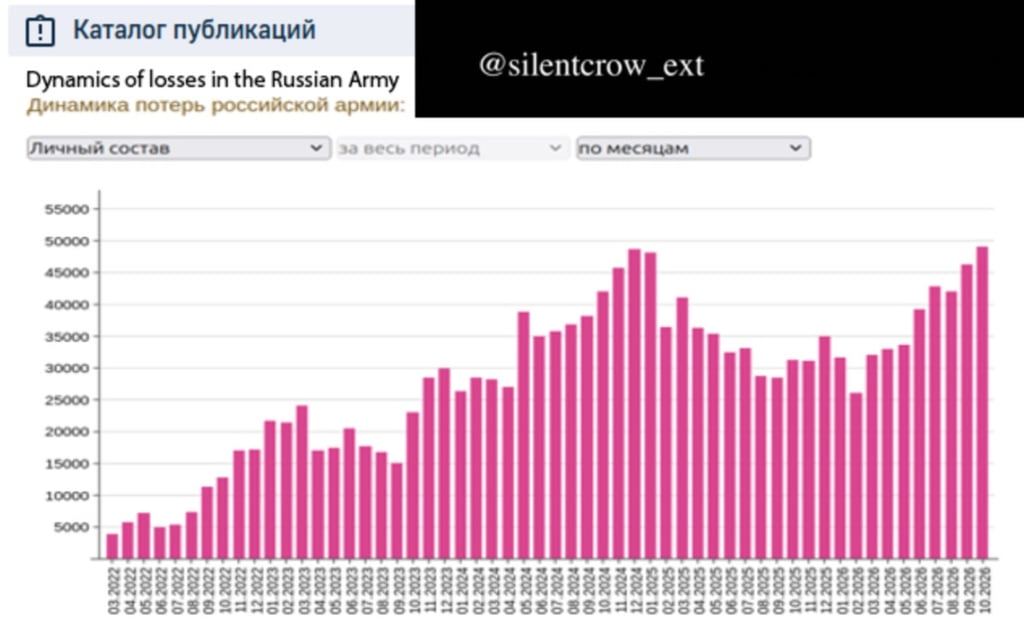
Rosstat processes mortality data, including deaths resulting from military operations. The listed causes of death include injuries resulting from military operations.
The war in Ukraine is costing Russia thousands of lives each month. However, to hide the true scale of its losses, Moscow stopped publishing statistics on causes of death in 2024.
Next year, as per The Insider, many Rosstat figures on births, deaths, marriages, divorces, social benefits, and recipients of state assistance will also disappear from public access.
All this data could be used to indirectly assess the consequences of the war in Ukraine, including the number of combat veterans and funeral payments, The Insider said.




Stay updated with our latest stories and follow us on social media
Be the first to discover new stories, ideas, and updates from our team.
“10+ TB exfiltrated. Documents. Databases. Everything – including material stamped with state secrecy classification. We’re not just breaking their systems. We’re reading their secrets,” Belarusian Cyber Partisans said on X.
Additionally, the logos of both hacker groups appeared on Rosstat’s federal website and on the sites of its regional offices on November 1st. The main Rosstat website was still “temporarily unavailable” at the time of writing.
The agency confirms cyberattack
Silent Crow – pro-Ukraine hacktivist group usually targeting Russia and its allies – said in a statement that they had gained access to the infrastructure of Rosstat’s central office, its regional branches, and its Main Interregional Center for the Processing and Dissemination of Statistical Information.
The group said it obtained access to domain controllers – systems managing user accounts and access permissions within a corporate network – as well as virtualization servers running VMware ESXi, oVirt, and zVirt.
“Systems destroyed: STATEK, CSOD, Demography, SED, ESSO, OFSN, internal employee surveillance, StatRegister, websites and more,” the Belarusian CyberPartisans added.
For its part, Rosstat confirmed the cyberattack to Kommersant, but said its databases had not been compromised.
Has your password leaked?
“From October 29th through November 1st, Rosstat’s information resources were subjected to targeted destructive cyberattacks. The infrastructure functioned as designed: Monitoring systems promptly detected suspicious activity, allowing specialists to begin responding quickly,” said the agency.
Belarusian Cyber Partisans and Silent Crow groups are both designated as extremist in Russia.
In 2025, they claimed responsibility for a major hack of Russia’s national airline Aeroflot. The cyberattack was so ambitious that the company’s entire infrastructure was on the verge of collapse, experts later said.