Viral GitHub project claims WiFi can "see through walls" – developers aren’t convinced
Wifi-DensePose claims to track human movement behind walls using ordinary wireless signals – triggering privacy concerns. Yet developers say at best it’s a proof of concept, at worst, “AI slop”.


 Follow us
WiFi-DensePose claims to track human movement behind walls using ordinary wireless signals – triggering privacy concerns. Yet developers say it’s at best a proof of concept and at worst “AI slop.”
The GitHub project, WiFi-DensePose, part of a broader concept called RuView, was published by the user ruvnet.
Ruvnet describes a system that could interpret wireless signals to estimate human body movement without using cameras.
The system aims to convert WiFi signals into a real-time sensor capable of estimating human motion and pose, potentially allowing devices to detect presence, movement, and, in theory, even breathing patterns.






The idea was inspired by academic research into wireless sensing. Researchers at universities, including Carnegie Mellon and MIT, have demonstrated systems that use radio signals to detect human movement or reconstruct rough skeletal models through walls.
When a person moves through a room, their body reflects and distorts WiFi signals. Machine-learning systems can analyze those distortions – often captured through data called Channel State Information (CSI) – to infer motion patterns.
However, those systems typically rely on multiple antennas or controlled lab setups.
The project claims that WiFi signals can be used to estimate a skeleton-like representation of people moving in nearby rooms, borrowing Meta’s “DensePose” name for computer vision systems that map human body pose in images.
Videos shared online appear to show body posture, movement, and breathing-related motion through walls in real time.
“RuView converts commodity WiFi signals into a real-time sensor for human motion and pose estimation,” the project description states.
The repository quickly began circulating on X, where users shared screenshots and summaries claiming the software could “see people through walls using WiFi routers.”
Posts linking to the project then spread widely across developer and AI communities.
Devs question whether the system works
Despite the hype, some reviewers of the code suggested that the repository appears to be more conceptual than functional.
In a discussion thread on Hacker News, developers reviewing the repository also noted that it appears to lack the signal-processing pipeline required to extract CSI from WiFi hardware – a critical component of real wireless sensing systems.
In one post, user Zambyte said: “The repo reads more like a framework/prototype rather than a functional WiFi-based detection system.”
The same poster also added: “The core functionality requiring WiFi signal processing and pose estimation is largely unimplemented," concluding that significant development would be required to turn it into a working system.
Another Hacker News user, luketaylor, chimed in that it looked vibe-coded.
“This whole repository is a bunch of vibe-coded boilerplate that doesn’t include almost any of the core things it claims to do,” he said.
Commercial iterations and safety standards
The idea behind DensePose, however, is not speculative and is based on real research.
This technology is starting to appear in some consumer routers and ISP-provided systems.
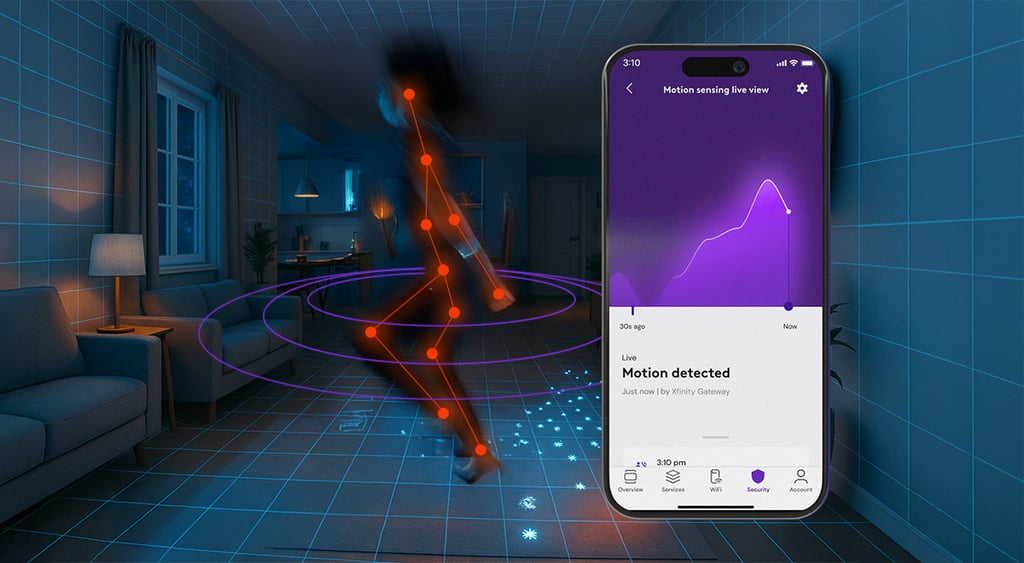
Last year, Comcast introduced a feature called Xfinity WiFi Motion that allows routers and connected devices to detect movement in a home by analyzing disruptions in wireless signals between devices.
The feature can trigger alerts when movement occurs across the network, though it does not identify individuals or generate images.
However, researchers and privacy advocates have warned that technologies capable of sensing motion through wireless signals could raise concerns if widely deployed.
Another report published last year by Germany’s Karlsruhe Institute of Technology from researchers studying WiFi sensing, suggested that WiFi signals could potentially be used to identify people based on how their bodies uniquely interact with radio waves, creating a form of passive tracking that does not rely on cameras or personal devices.
Researchers are now calling for regulators and developers to bake privacy protections into the next major WiFi standard, IEEE 802.11bf, before this kind of “radio vision” becomes mainstream.
Unlock more exclusive Cybernews content on YouTube.