This AI guide dog can talk to their owner – but can it replace a real thing?
While service dogs are allowed to accompany their owners almost anywhere, having one can still come with limitations. Would a robot dog be a better alternative?
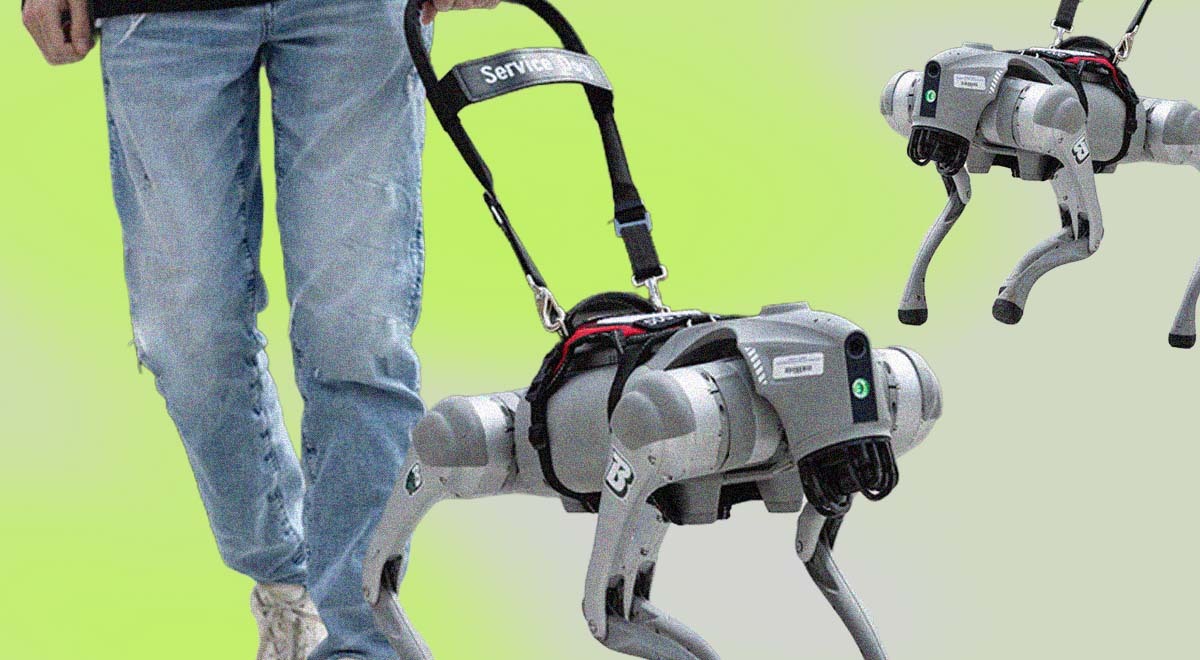
Image by Cybernews

 Follow us
While service dogs are allowed to accompany their owners almost anywhere, having one can still come with limitations. Would a robot dog be a better alternative?
Researchers at Binghamton University developed a robotic guide dog that could help visually impaired and blind people.
The robot that looks like a dog can provide its users with the best possible route and guide them to the destination safely, providing feedback along the way.
The idea behind creating such a robot was to extend the capabilities of a biological dog, according to Shiqi Zhang, an associate professor at Binghamton University's School of Computing.
While dogs can understand around 20 commands, a robotic dog equipped with GPT-4 will not only understand more but also keep up a conversation, researchers say.






The robot dog could also be seen as a continuation of the researchers’ previous project, in which they taught robot guide dogs to lead the visually impaired using a leash.
The current, updated system was tested by seven legally blind participants who used the dog to navigate a spacious office area.
The robot asks a user where they would like to go, then provides possible routes to a specific room and how long it would take to get there.
Once the user confirms the route, the robot dog would navigate them there, also telling all about what surrounds them to avoid obstacles.
While the researchers are still working on the system, they plan to conduct additional studies with participants to test the robot dog's capabilities, including longer routes and testing it both indoors and outdoors.
Robot guide dog vs. real service dog
This could be a possible way out for those who need a service dog but can’t have one because they’re allergic or have other limitations.
Nevertheless, the robot dog wasn’t created to replace real service or guide dogs, Zhang told Cybernews.
“People love dogs. Guide dogs are not only helpful, they are also loyal companions and often feel like part of the family,” Zhang said.
“However, many people cannot use a guide dog for various reasons. Some people cannot walk a dog miles a day, some have dog allergies, and others may be too young or too old to qualify,” he added.
Thus, the researchers wanted to create an alternative.






While the robot dog has some clear advantages, such as no need to feed, groom, walk, or vaccinate it, Zhang notes that a real service dog offers other benefits that no robot dog could.
“Real dogs provide emotional support and companionship in a way that robots cannot. Many handlers consider their guide dog a close friend or family member,” said the researcher.
Given that the robot dog is equipped with AI, which is prone to hallucinations and inaccurate data, how can users be protected in the event of faulty navigation or misinterpreted commands?
Despite the current achievements with the robot guide dog, the expert notes that there are a few challenges the team will need to overcome.
One of such is that “in new environments, the robot and the user may need to explore and learn together, and this is still very difficult for robots today. “
Has your password leaked?
Zhang also noted that battery life is limited, now running for only a few hours, which causes trouble for users who want to use the system for longer trips.
Another issue is noise. While real guide dogs are quiet, robots make mechanical sounds.
“This could interfere with echolocation or other listening-based strategies that many blind and visually impaired individuals use,” explained the expert.
Zhang, who has been working on various types of robots for more than 15 years, concluded that much more research is needed before these guide dogs can be used in daily life.
Unlock more exclusive Cybernews content on YouTube.