Canada and Europe are breaking away from US tech. Can they collaborate?
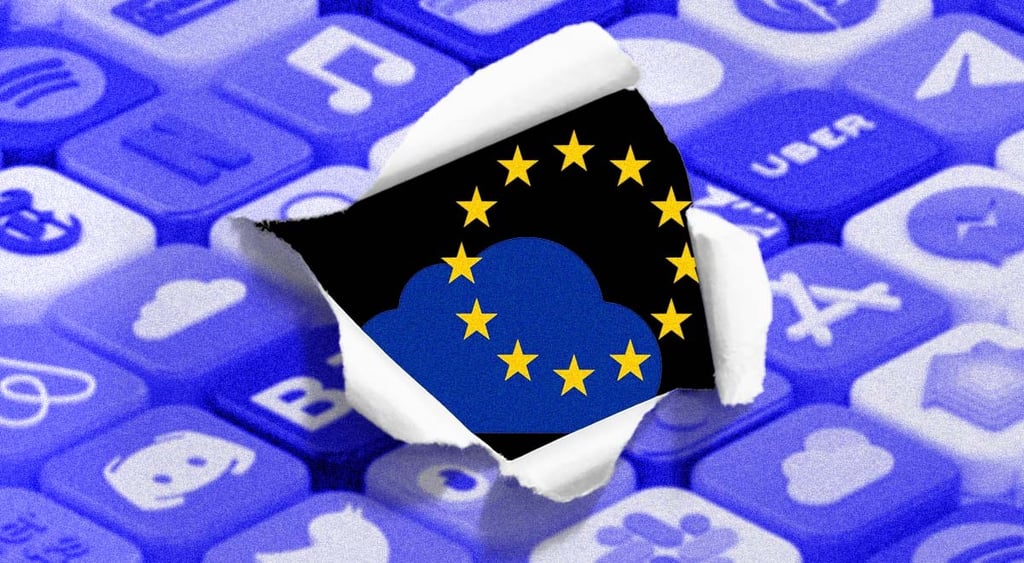
US President Donald Trump’s increasingly hostile policy has made its historically closest allies, Canada and the European Union (EU), rethink their dependence on American tech.

Image by Cybernews.

 Follow us
US President Donald Trump’s increasingly hostile policy has made its historically closest allies, Canada and the European Union (EU), rethink their dependence on American tech.
Canada and Germany announced the Digital Alliance in December 2025, which will focus on collaboration in areas of mutual interest, including artificial intelligence (AI), digital sovereignty, and digital infrastructure.
The partnership reflects a wider Canada and EU bid to break their technological dependence on the US amid Trump’s tariff wars, as well as hinting at annexation and the use of military force against America’s long-standing allies.
Although many experts agree that complete digital independence isn’t possible for either Europe or Canada, some say they can work together on building their tech stacks.












Sovereign clouds are not there (yet)
Canada’s Prime Minister Mark Carney announced in late 2025 that the government would support the development of a “Canadian sovereign cloud,” creating a cloud computing environment that stores and processes data exclusively in the country.
Over 60% of Canada’s cloud market is currently owned by American companies, sparking concerns about data privacy and the risk of being cut off from critical services.
Emily Osborne, a policy research associate at the Canadian SHIELD Institute, says one of the priority areas for making Canada more sovereign could involve cloud procurement from local and EU-based providers that don’t share the same vulnerabilities as American providers.

Meanwhile, publicly owned and operated cloud infrastructure could serve the most sensitive use cases, Osborne says.
However, the Canadian government currently procures only from one local cloud service provider, ThinkOn, with the rest coming from hyperscalers like Microsoft, Amazon Web Services (AWS), and Google.
“Canadian providers do not have the capacity to meet all of the government needs right now, but we could increase the capacity and think about how we could use procurement strategically as a lever to give them access to the kind of scale they need,” Osborne tells Cybernews.
The conversation on this topic is live. Join in the discussion.
The Canadian government is in talks with French cloud service provider OVHcloud, which recently found itself in an awkward position after a Canadian court ordered the company to hand over customer data stored in Europe as part of a criminal investigation.
French laws prohibit the transfer of data stored on European servers, but by refusing to comply, OVH also risks contempt-of-court charges in Canada.
Canada’s appetite for EU-based cloud providers is not surprising, given its warmer relations with the bloc, which also has some of the world's most stringent data protection regulations.
Europe, however, is itself highly dependent on the US, with the three American providers – Google, Amazon, and Microsoft – accounting for about 70% of the cloud market, while OVHcloud provides only a small fraction of services.

Nevertheless, even the prospect of Europeans and Canadians moving away from US tech has unnerved both American business and political leadership.
The US tech giants started what Osborne describes as “sovereignty-washing”, offering both Canadians and Europeans their “sovereign clouds,” even though the 2018 CLOUD Act would still enable US authorities to access data they hold elsewhere.
Trump also appears to be trying to stop US allies’ backlash against US tech, despite having played an important role in provoking it. According to Reuters, the president ordered diplomats to lobby against attempts to regulate US tech companies’ handling of foreigners’ data.
“Collaboration across software layers”
Johan Linåker, a senior researcher at RISE Research Institutes of Sweden, says Canada-EU’s collaboration can happen across software layers, such as creating alternatives and breaking dependencies in cloud stacks and standard applications.
He notes that governments across Europe are increasingly adopting the open-source model for collaboratively developing and freely sharing solutions.
For instance, France, Germany, and the Netherlands have created their own alternative to leading proprietary office productivity suites based on existing and newly developed building blocks.
Germany’s Schleswig-Holstein province has replaced 80% of its public-sector IT with open-source alternatives.
Linåker tells Cybernews, “These collaborations are not limited by borders, nor seas. If there is a mutual interest in collaborating, there is an opportunity for anyone to contribute.”
Meanwhile, the Canadian government heavily relies on Microsoft products and services, and spent nearly $300 million on them in 2021-2022 alone.
After the US imposed sanctions on the International Criminal Court (ICC) Chief Prosecutor Karim Khan in 2025, Microsoft reportedly blocked his email, allegations the American company denies.

The move prompted the ICC to ditch Microsoft for a European alternative, openDesk, and renewed concerns over dependence on the US across governments.
Trump officials are now trying to address the concerns of European governments, which oversee some of the most lucrative markets for US technology companies.
US National Cyber Director Sean Cairncross has recently called the idea that Trump could pull the plug on the internet “not a credible argument” and urged Europeans to choose US technology over that of China, saying that a clean tech stack is “primarily American.”
Increasing European providers’ capabilities
A recent poll reveals that 73% of Europeans believe their societies are far too dependent on US tech companies, and the majority are worried about such dependence.
Activists are creating the lists and maps of European alternatives to everyday apps and platforms. The social media platform W, aimed at replacing Elon Musk’s X, has attracted significant attention even before its formal launch.
The digital wallet Wero is emerging as a European alternative to payment processing networks such as Visa and Mastercard, and is supported by 16 European banks.
Linåker says Europe has many good vendors and service providers, but they are “too few and not capable of taking on the full load” if governments decide to switch to local alternatives or need to fall back in case of emergency.
He emphasizes the critical need for increased investment, risk-taking, and long-term demand to scale.
Meanwhile, buyers – especially public ones – need incentives and guidance to go beyond price, consider sovereignty requirements in tenders, and evaluate bidders accordingly.
However, there are positive signs coming from the EU level, Linåker says. The revised Public Procurement Directive, the Cloud and AI Development Act, and the EU-wide open source strategy indicate a push towards a more “buy European” approach.
“The recently released Cloud Sovereignty Framework provides guidance for buyers on how to evaluate the sovereignty of incoming bids, but it is yet to be fully tested, especially in cases of sovereignty-washing,” he explains.
Legal obstacles hinder sovereignty efforts
The obstacles to achieving digital sovereignty, however, are not limited to building a technological stack. There are legal issues that may hinder efforts to break away from US tech.
Osborne notes that the Canada-United States-Mexico Agreement (CUSMA), a trade treaty that entered into force in 2020, prohibits Canada from requiring data localization by American companies.
It also requires non-discriminatory treatment of American products and imposes restrictions on governments' access to digital companies’ source code.
Osborne tells Cybernews, “This potentially limits Canada’s ability to strategically promote Canadian cloud service providers, because the US would probably consider it to be a form of discrimination against their own companies.”
Unlock more exclusive Cybernews content on YouTube.