Another European country is pushing ban on smart glasses
Europeans are getting sick and tired of “pervert glasses.”
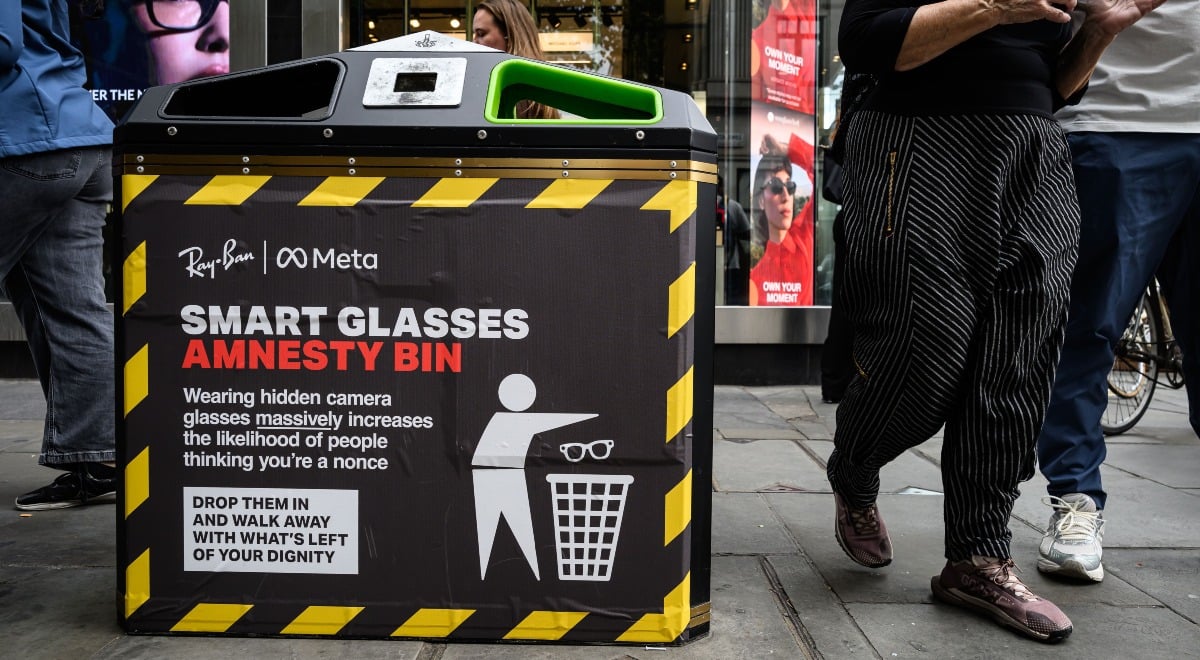
Image by Leon Neal via Getty Images

 Follow us
- A Dutch consumer group wants Meta Ray-Ban smart glasses banned over privacy concerns.
- The group says the recording light can be hard to see and easy to cover.
- It says Meta’s update did not stop recording when a sticker covered the light.
- Venues and governments in Europe are weighing or adopting limits on smart glasses.
Key Takeaways by nexos.ai, reviewed by Cybernews staff.
A Dutch consumer protection group has called for a ban on Meta Ray-Ban smart glasses over privacy concerns.
The Dutch Consumers’ Association is urging a ban on camera- and microphone-equipped Meta’s Ray-Ban smart glasses in their current form.
The advocacy emphasizes that, despite their recording capabilities, smart glasses look like standard software.
It argues that the Meta Ray-Bans’ capture LED, which lights up when the device is actively recording, isn’t sufficient to warn others that they’re being filmed.






A study conducted by the advocacy group suggests that the illuminating light is not always clearly visible, such as in sunlight or from a distance, but it’s still able to make sharp images from afar.




Stay updated with our latest stories and follow us on social media
Be the first to discover new stories, ideas, and updates from our team.
Moreover, low-cost solutions to hide the capture LED, such as stickers, are widely available online.
Meta claims that its privacy update, released on September 2nd 2026, disables glasses’ cameras if tampering with the recording light is detected.
However, the advocacy group was still able to record a video with a sticker covering the light after the update.
Sandra Molenaar, a director of the Consumers’ Association, said it was “particularly concerning” that all the videos and photos captured by smart glasses are sent to Meta, the company accused of a string of privacy violations.
It is unclear what Meta does with the information and data it receives via the glasses. To protect everyone’s privacy, we advocate for a ban on camera glasses,Sandra Molenaar, a director of the Dutch Consumers’ Association
A 2026 investigation by the Swedish newspaper Svenska Dagbladet suggests that outsourced Meta workers were able to watch sensitive content recorded with the company’s smart glasses, including footage of wearers using the toilet or engaging in intimate activity.
Meta then said subcontractors sometimes review the content captured by its smart glasses to improve the “experience.”
Growing calls for smart glasses bans
TivoliVredenburg, a cultural center in Utrecht, the Netherlands, announced a ban on smart glasses in 2025, after a man was caught using a device to film women in the bathroom at a music festival in Rotterdam a month earlier.
This was far from an isolated incident, as there is a growing number of cases where smart glasses are being used to film women without consent, earning the device a derogatory term, “pervert glasses.”
Male content creators often publish covertly recorded interactions online, using them to advise on how to pick up women.
Have thoughts about this topic? Others do, too. Join them in the discussion.
Norway’s Digitalization Minister, Karianne Tung, said the government is mulling restrictions on the use of smart glasses, while the country’s consumer advocacy group urged retailers to pause sales of these devices until legal uncertainty is resolved.
The parliament of Hamburg, Germany’s second-largest city, passed a motion in September 2026 that would ban smart glasses on public transport, as well as in pools and saunas.
Smart eyewear is now also prohibited across courts in New York State, England, and Wales.