When will singularity happen? Trust this engineer, who calculated it to the millisecond precision
Plot some AI trend graphs, most of which go up and to the right*, and it becomes clear as day when the singularity happens. It’s Tuesday, July 18, 2034, just as America is finishing a second cup of coffee.
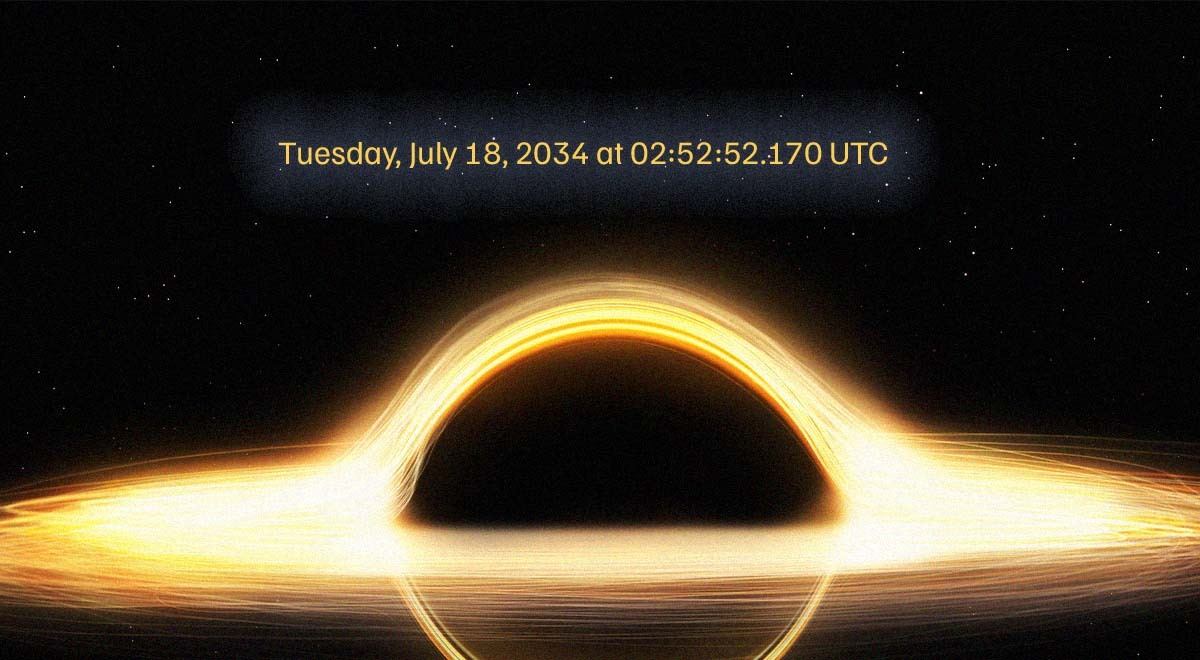
Image by Cybernews.

 Follow us
Plot some AI trend graphs, most of which go up and to the right*, and it becomes clear as day when the singularity happens. It’s Tuesday, July 18, 2034, just as America is finishing a second cup of coffee.
Cam Pedersen, an engineer, founder of Municipal Robotics, has just answered a seemingly impossible question: when will the singularity – the moment robots stop making sense to us – occur?
It’s Tuesday, July 18, 2034, at 02:52:52.170 UTC.
To come up with this answer, the author analyzed several AI metrics, but only one stood out as the clear predictor.
What you don’t want, Pederson argues, is a graph that accelerates at a constant rate or has a ceiling, like most of the familiar AI benchmarks.





“The data says: machines are improving at a constant rate,” Pedersen writes in a blog post, detailing the calculations.






“MMLU, tokens per dollar, release intervals. The actual capability and infrastructure metrics. All linear. No pole. No singularity signal.”
Even exponential growth is too slow. It only reaches infinity after an infinite amount of time. Hardly anyone is waiting that long.
If intelligence is to explode into further dimensions with a specific date, you need a hyperbolic curve – it becomes steeper, turns vertical and shoots past the event horizon.
So Pedersen found a graph just like that. It’s how many papers on arXiv, an online repository for scientific preprints, mention “emergent”.
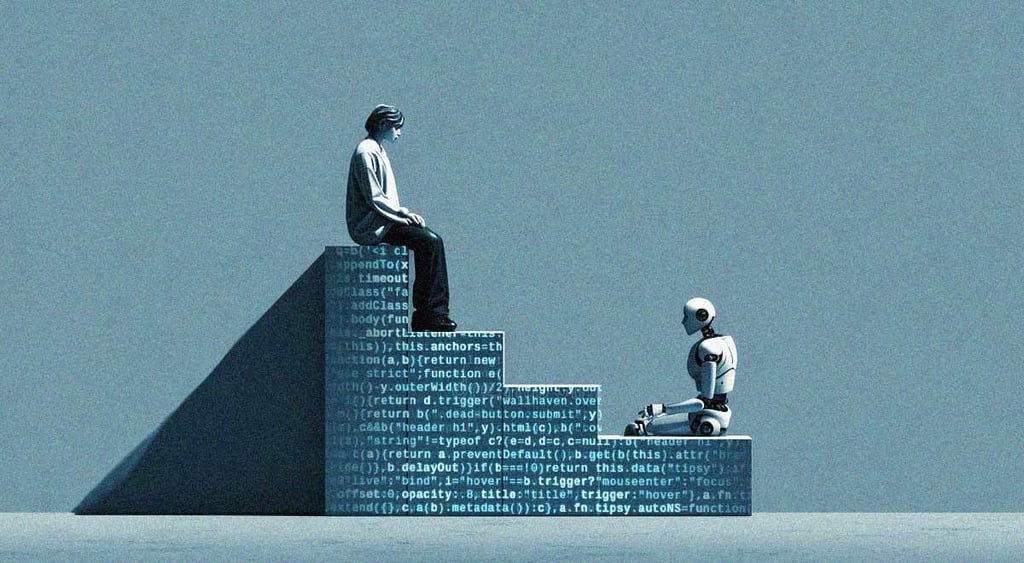
“Here’s the part that should unsettle you: the metric that’s actually going hyperbolic is human attention, not machine capability,” Pedersen said.
“Humans are freaking out about it at an accelerating rate that accelerates its own acceleration. That’s a very different singularity than the one people argue about.”
We expected an infinite number of paperclips produced by AI, but it’s the AI researchers who are churning out papers approaching infinity, in 2034.
On the specified Tuesday, a transition must happen, because the current trajectory will be impossible to sustain.
This interpretation, where humans’ attention accelerates at a faster rate than the actual technology, has serious social repercussions. It led to actual disruptions before any true technological breakthroughs.
“The social consequences of that acceleration (labor displacement, institutional failure, capital concentration, epistemic collapse, political realignment) are not predictions for 2034. They are descriptions of 2026,” Pedersen said.
However, the author still wants us to mark the date. The blog post includes a countdown timer, to make sure we don’t miss it, leaving a bit over 3,000 days.
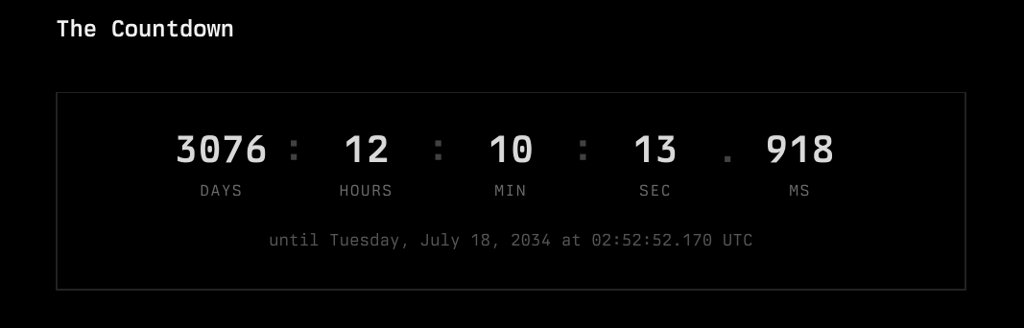
“I see no reason to let epistemological humility (the philosophical stance that you should admit you might be wrong) interfere with a perfectly good timer,” Pedersen concludes.
* phrase borrowed from Peter Girnus.
Unlock more exclusive Cybernews content on YouTube.