EC won’t save dying games despite 1.3M signatures, puts IP rights over players
Despite 1.3 million gamers’ signatures behind the “Stop Destroying Videogames” initiative, the European Commission (EC) ruled it “would not be proportionate” to require publishers to keep games playable after support ends, citing intellectual property rights as the main reason. Campaigners hope to find more support in the European Parliament (EP) instead.

Image by Rawpixel.com | Shutterstock

 Follow us
Despite 1.3 million gamers’ signatures behind the “Stop Destroying Videogames” initiative, the European Commission (EC) ruled it “would not be proportionate” to require publishers to keep games playable after support ends, citing intellectual property rights as the main reason. Campaigners hope to find more support in the European Parliament (EP) instead.
- The European Commission rejects mandatory game preservation legislation in response to the “Stop Destroying Videogames” initiative.
- Strict Intellectual property rights are cited as the primary reason, outweighing looser customer protection laws.
- Campaigners are now seeking support from the European Parliament.
The EC acknowledges that modern video game publishers may shut down supporting servers, leaving the games partially or entirely unplayable. However, the European executive body will not propose any legal changes to oblige publishers to keep games in a working state after they’re discontinued.
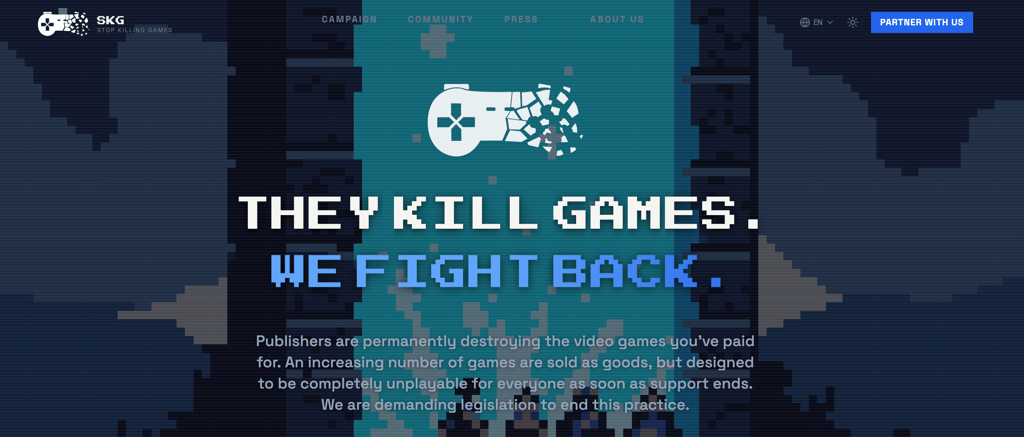
The conclusion follows a successful European Citizens’ Initiative proposing that publishers leave discontinued games “in a reasonably functional (playable) state,” which gathered 1,294,188 verified signatures in support. The initiative was part of the broader Stop Killing Games (SKG) campaign.
The EC, however, promises to engage with the video games industry to help bring about potential changes.






By the end of 2026, the Commission plans to bring together game industry and consumer groups to draw up an industry guidelines on how games' “end of life” should be handled. Also, the EC will work with consumer organizations to ensure players know their rights when buying games.
“I hope the industry will listen to player communities and agree on better sunsetting standards so communities can continue to meet and play together. We will take the necessary steps so a dialogue can take place with representatives from consumers,” said Henna Virkkunen, Executive Vice-President for Tech Sovereignty, Security and Democracy of the EC.
The Communication, a document EC released as a formal reply, is essentially another reminder that gamers do not own the games they purchase, but rather a license “to access content” – to play games on the publishers’ terms.
Consumer protection laws do not set requirements for how long the games must remain accessible. But intellectual property rules give owners exclusive rights over their creations. The publisher’s cost-benefit analysis often determines when the plug gets pulled.
“The traders’ intellectual property rights must also be respected. These rights would risk being adversely affected by a legal obligation to keep video games in a playable state after their commercial exploitation,” EC said in the document.
EC also said the obligation might interfere with the protection of confidential business information and generate costs for publishers.
Gamers pin hopes on EP
The Stop Killing Games (SKG) initiative says the EC’s decision “is not unexpected,” and they’ve been preparing for it.
“Hence, we’re pushing forward with the European Parliament amending #StopKillingGames to the Digital Fairness Act. We can move on without the Commission and their non-decision,” the post by the official account on X reads.
The campaigners previously expressed hope that they’re in a position to pass legislation without the EC's blessing.
The Stop Killing Games was founded by YouTuber Ross Scott (Accursed Farms) in 2024 after Ubisoft shuttered The Crew servers. The racing game required an internet connection even in single-player mode and could not be played with the connection severed, leaving game purchasers with nothing.
The GamesRadar reports that game lobby, including Ubisoft, two weeks ahead of EC’s response, attended an “invitation-only” meeting with the Commission, while the SKG initiative wasn’t invited.
It appears that the initiative has some support in EP – a few dozen Members of Parliament (MEPs) signed a call for legislative action on June 9th, 2026.
“This Citizen Initiative has broad cross-party support in the European Parliament. When consumers pay for a game, they invest more than just money. They spend their time on it, make memories, develop passions, and make real friends for life along the way. It is indefensible that publishers should have the right to simply pull the plug on these games at any time and destroy cultural heritage in the process. With this letter, we reiterate our position: It’s Game Over for this abusive practice,” Tiemo Wölken, the MEP leading the call, said to the campaigners previously.
While gathering support in the EP, the SKG initiative also moves forward with plans in other countries, including the US, where the team is pushing the Protect Our Games (POG) Act to become law.
In the UK, SKG plans to focus on building the new Stop Killing the Internet team, in coalition with Open Rights Group, Big Brother Watch, Index on Censorship, Progressive Victory, the Pirates, and other groups.






SKG argues that the video game industry, worth hundreds of billions of dollars, has been slowly eroding basic consumer rights and destroying the medium. Requirements such as an active internet connection usually mean that these video games will stop working once the support period ends and connections are severed.
“This effectively robs customers, destroys games as an art form, and is unnecessary. Our movement seeks to pass a new law in the EU to put an end to this practice,” the call to action reads.
“Videogames themselves are unique creative works. Like film or music, one cannot be simply substituted with another. By destroying them, it represents a creative loss for everyone involved and erases history in ways not possible in other mediums.”
Unlock more exclusive Cybernews content on YouTube.