Trump’s $100K fee on H-1B visas spreads panic and divides tech pros
The $100,000 H-1B visa fee is spreading panic and becoming a wedge driving America’s tech community apart. Some see foreign workers as essential for innovation, others as a threat to jobs. Both sides seem to agree that wages are stagnant and the economy isn’t benefiting workers. Immigrants have become a convenient scapegoat.

Image by Cybernews.

 Follow us
The $100,000 H-1B visa fee is spreading panic and becoming a wedge driving America’s tech community apart. Some see foreign workers as essential for innovation, others as a threat to jobs. Both sides seem to agree that wages are stagnant and the economy isn’t benefiting workers. Immigrants have become a convenient scapegoat.
US President Donald Trump introduced an earth-shaking executive order on Friday, imposing a $100,000 fee on H-1B visas.
The announcement, first understood as a yearly tax on every immigrant tech worker, prompted Microsoft, Google, Amazon, and other tech companies to issue memos urging their employees to return or stay in the US.
Leaked memo from Amazon that warns existing H1B holders to avoid travel back into the USA after the September 21st deadline - their lawyers evaluated the new executive order as not just affecting new applications https://t.co/cLmegSu1a9 pic.twitter.com/uaGUwVSKyP
undefined Simon Willison (@simonw) September 20, 2025
The quickly spreading panic in the tech communities seems to have contributed to the White House's quick clarification: the change only applies to new applicants, and current visa holders will not be affected.





To be clear:
undefined Karoline Leavitt (@PressSec) September 20, 2025
1.) This is NOT an annual fee. It’s a one-time fee that applies only to the petition.
2.) Those who already hold H-1B visas and are currently outside of the country right now will NOT be charged $100,000 to re-enter.
H-1B visa holders can leave and re-enter the…
Trump’s proclamation became the main news discussed on tech workers’ social networks.
Specialists on Team Blind, an anonymous social media community of tech workers, are divided into two camps. One camp claims that H1-Bs are extremely destructive to American jobs and communities, and another sees them as extremely valuable and beneficial.
The rollercoaster made visa holders feel miserable and unwelcome. However, while talent might prefer working in the US, India, which accounts for most H-1B visas, sees the US decision as an opportunity to supercharge its progress.
“By slamming the door on global talent, America pushes the next wave of labs, patents, innovation, and startups to Bangalore, Hyderabad, Pune, and Gurgaon,” Amitabh Kant, former bureaucrat and India’s G20 Sherpa, posted on X.
Tech pros split into two camps
Team Blind and other forums where tech people usually discuss career opportunities, industry trends, and company cultures, became hostile over the weekend.
“LinkedIn should have a ‘US Citizen’ checkmark,” one of the suggestions reads.
“Will make it easier for companies and recruiters to find good candidates.”
Many expressed anger that “H1Bs hire their own,” discriminating against Americans, and the visas aren’t used for specialized talent but rather for standard jobs that could be outsourced. The restrictions will supposedly help Americans get jobs.
“Stop pretending otherwise,” another user posted. “Fewer H-1Bs means more opportunities for US citizens. The “we can’t find talent” line has been milked dry.”
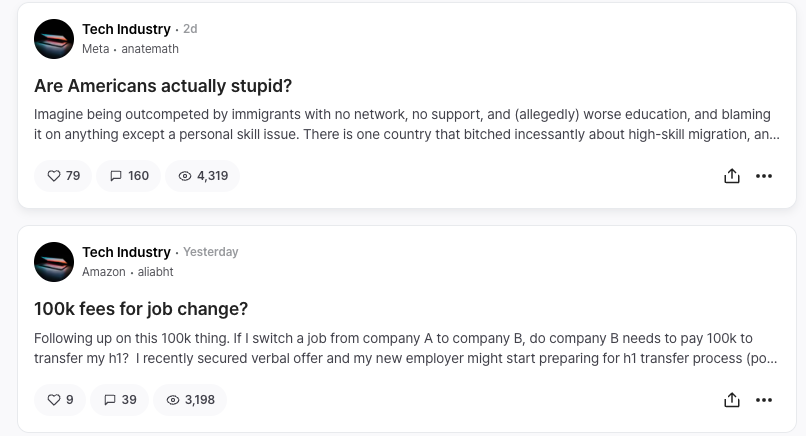
The backshots claimed that American workers get outcompeted in the same market due to skill issues.
Even empathy was divided. A suggestion to stop laughing at others’ misery was met with a retort: “How about some empathy for people who were forced to train their H-1B replacements?”
There were speculations about why Americans have only recently become so sensitive about immigration and visas, despite these having existed for decades.
“The economy. It’s that simple. If everyone were doing well, they wouldn’t care. But they need something or someone to blame,” one of the users concluded.
The US job market has been flashing some warning signs recently. In August, the economy lost jobs for the first time in nearly four years, and the jobless rate rose to 4.3%.
Tech companies were already reassessing their hiring strategies in light of other policies introduced by the White House.




Panic in India
CNN reports that a wave of panic and confusion has spread through Indian communities and the global tech industry, where the H-1B program has served as a gateway for some of India’s brightest minds to enter the US workforce. Indians are the largest beneficiaries of the H-1B visa program.
The H-1B program enables US employers to temporarily hire foreign workers in specialized occupations requiring at least a bachelor's degree. It is capped at 65,000 visas annually, with an additional 20,000 visas available for applicants holding advanced degrees from US institutions.
According to the US Citizenship and Immigration Services (USCIS), Amazon is the top recipient of H-1B visas this year. As of June 30th, 2025, 10,044 applications had been approved.
Tata Consultancy Services is second with 5,505 H-1B recipients, followed by Microsoft (5,189), Meta (5,123), Apple (4,202), and Google (4,181).

Historically, since 2009, the largest beneficiaries were Tata Consultancy, with 987,259 visas approved in total, Congizant Tech Solutions (92,435), and Infosys (87,654).
California has the highest number of H-1B workers, 78,683 in total, which is less than 0.2% of its total population if all H-1B workers remain in the state. It is followed by New York (52,178), and Texas (37,061).
The majority of visa holders work as software engineers, developers, or assistant professors, with salaries averaging between $100,000-$160,000, according to myvisajobs.com
The program has long been criticized as a government labor subsidy for tech companies that allows employers to pay less than similarly qualified American workers.