Investor FOMO drives SpaceX IPO, hailed by analysts as “the ultimate growth stock”
SpaceX has gone public in a $75 billion IPO, valuing the company at about $1.77 trillion. The stock will trade on the Nasdaq under SPCX, with strong investor FOMO driving demand for what some analysts call “the ultimate growth stock.” Despite the hype, SpaceX is still not profitable, and investors are betting on its long-term space and satellite ambitions.
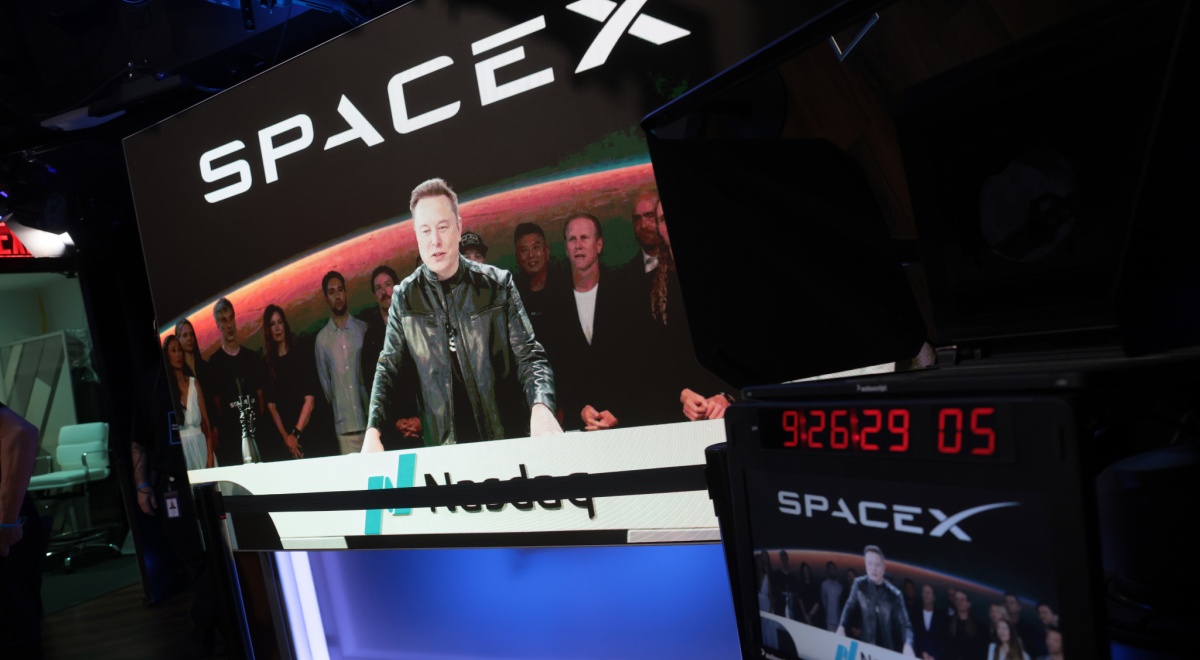
Elon Musk speaks via video before the Nasdaq opening bell. Photo by Spencer Platt/Getty.

 Follow us
SpaceX has gone public in a $75 billion IPO, valuing the company at about $1.77 trillion. The stock will trade on the Nasdaq under SPCX, with strong investor FOMO driving demand for what some analysts call “the ultimate growth stock.” Despite the hype, SpaceX is still not profitable, and investors are betting on its long-term space and satellite ambitions.
- SpaceX has raised $75 billion in its long-awaited IPO, pricing shares at $135 and valuing the company at about $1.77 trillion.
- Investor demand has surged far beyond supply, with bankers reportedly receiving about twice as many orders as available shares.
- Around 30% of shares (roughly $22.5 billion) have been set aside for retail investors, fueling what analysts describe as a major “FOMO trade.”
- Much of the excitement is driven by SpaceX’s growth narrative around Starlink, Starship, and future space-based infrastructure.
Key Takeaways by nexos.ai, reviewed by Cybernews staff.
Musk’s SpaceX is set to make history with its long-awaited initial public offering, raising $75 billion at a fixed price of $135 per share and valuing the rocket, satellite, and AI company at roughly $1.77 trillion.
The listing is expected to begin trading on the Nasdaq on Friday under the ticker SPCX and marks one of the largest IPOs ever. Will it cement SpaceX as one of the most valuable private companies to enter the public market?
The offering drew exceptional demand from both institutional and retail investors. Bankers had reportedly received twice as many orders as available shares.










According to Reuters reporting, SpaceX has earmarked as much as 30% of shares (about $22.5 billion) for retail investors, an unusually large allocation for a mega-cap IPO. This move has turned the listing into one of the year’s most prominent “FOMO trades.”
The enthusiasm for slicing at least a tiny slice from the SpaceX share cake emerges as the company remains unprofitable. In 2025, SpaceX generated 61% of its revenue from Starlink, its satellite internet service. It remains the only profitable business under the Elon Musk company wing.
Last year, SpaceX generated $18.7bn of profit, while recording an operating loss of $4.3bn
For comparison, social media giant Meta generated more than $200bn in revenue last year and reported net income of $60bn, according to the Guardian.
Analysts claim that SpaceX's IPO could be an important test for the bigger market.
"The IPO parade, which now looks like it's turning into a stampede, has been coming for a while. You could argue there were flickers of it as early as last year, but it never fully materialized into a broad wave of companies. SpaceX is going to be the bellwether," said Mark Klein, CEO of Suro Capital.

Check if your data was exposed
Find out if your email and related personal information have appeared in known data breaches.
However, other analysts focus on SpaceX’s long-term business mix. Nancy Tengler of Laffer Tengler Investments noted to Reuters that while SpaceX is increasingly viewed through an AI lens due to its ambitions around space-based infrastructure and data systems, the immediate commercial driver remains Starlink.
She emphasized that the satellite internet division could become a major profit engine, while future projects like fully reusable Starship rockets and orbital data centers (expected later in the decade) could significantly expand the company’s total addressable market if successful.
From a growth perspective, John Belton of Gabelli Funds called SpaceX “the ultimate growth stock.”
“I think this is a company with significant growth potential ahead of it. It's definitely going to be a long-term story, and I think it will take time for the stock to find its footing in the public markets. But there are a lot of exciting opportunities ahead," he told Reuters.
Unlock more exclusive Cybernews content on YouTube.