Are mass drivers possible? The race between Japan, China, and Elon Musk
Elon Musk has proposed using the technology to launch payloads from the moon, but there are significant hurdles to overcome.
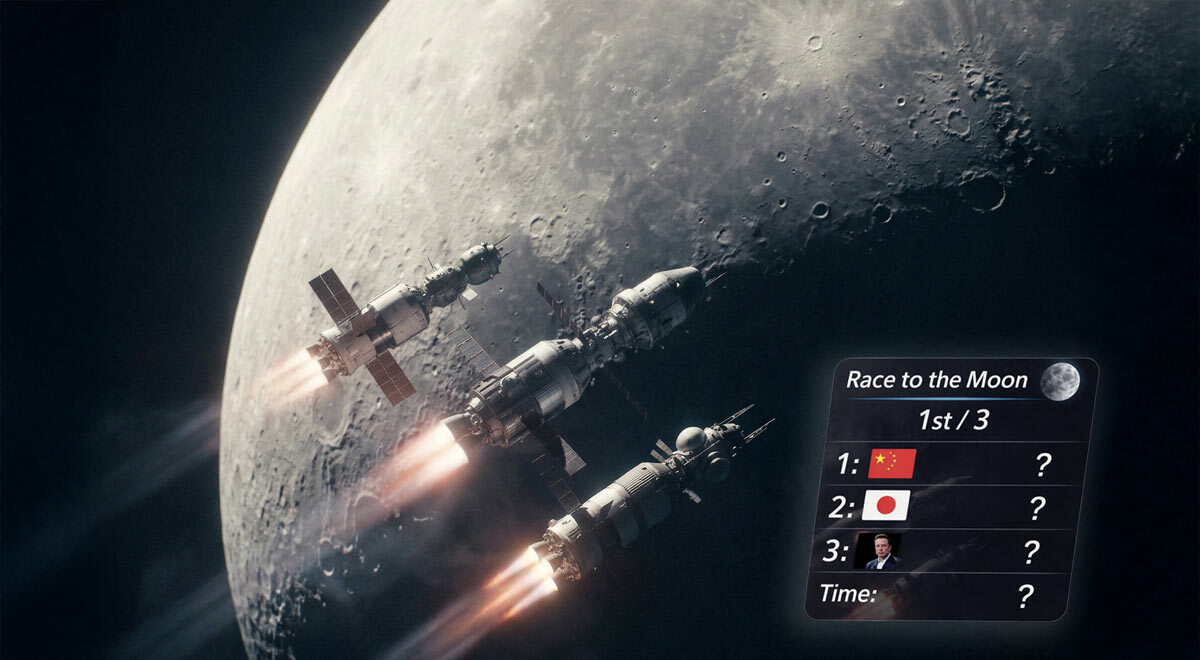
Three rockets racing to the Moon. Image by Cybernews.com

 Follow us
Elon Musk has proposed using the technology to launch payloads from the moon, but there are significant hurdles to overcome.
Fans of science fiction may already be familiar with the concept of the mass driver: it has appeared in Arthur C. Clarke's Earthlight, Robert A. Heinlein's The Moon is a Harsh Mistress, and numerous other tales.
A mass driver is essentially a catapult that uses linear motors and pulsed magnetic fields to accelerate payloads to high speeds along a track up and away from the planetary surface.
The track is lined with hundreds of electromagnetic coils, with the payload sitting inside what's known simply as a bucket. To move the bucket, the coils fire in sequence, each one taking over from the one before and then cutting out as the bucket passes.











Because the buckets never actually make contact with anything, wear and tear should, in theory, be negligible. Meanwhile, as the method of propulsion remains on the ground, it's theoretically much cheaper than using rockets.
And now, Elon Musk is on board.

"Factories on the Moon can take advantage of lunar resources to manufacture satellites and deploy them further into space," he writes on the SpaceX blog.
"By using an electromagnetic mass driver and lunar manufacturing, it is possible to put 500 to 1000 TW/year of AI satellites into deep space, meaningfully ascend the Kardashev scale and harness a non-trivial percentage of the Sun’s power."
Although the idea has been around for decades, mass drivers have never been tried in space. And while the concept is essentially the same as the rather smaller railgun, targeted mainly at military applications, these too remain fraught with technical difficulties.
Japanese railgun tests
Japan's Acquisition Technology & Logistics Agency (ATLA) has been working on a railgun for several years, conducting its first tests in October 2023.
The idea is to create a device that's “capable of firing projectiles at high muzzle velocity to improve the intercepting capability against various airborne threats," says ATLA.
Last summer, its railgun, installed on a 6,200-ton experimental vessel called the JS Asuka, achieved a muzzle velocity of 2,000 meters per second and a barrel life of 120 rounds. This allowed the stable firing of more than 120 rounds at a constant muzzle velocity, with shells reaching a speed of almost seven times the speed of sound.
"It’s the first time that a ship-mounted railgun was successfully fired at a real ship," ATLA said.
The use of advanced materials such as ceramic film capacitors and gallium oxide components, said ATLA, has enabled it to develop compact and efficient energy storage solutions that make the railgun small enough for use on a ship.
Technical mass driver issues remain
However, mass drivers and railguns suffer from two main technical problems. First, it's hard to keep the projectiles or payload stable at hypersonic speeds. Second, the process involves extremely powerful forces that can rapidly degrade the device's internal components.
These issues proved intractable for the US Navy, which canceled its railgun project in 2021 after spending more than $500 million over a 15-year program. The main problem was degradation of the barrel after fewer than 30 firings, combined with heavy power consumption, and the ability to fire only a few rounds.

Check if your data was exposed
Find out if your email and related personal information have appeared in known data breaches.
"Given fiscal constraints, combat system integration challenges, and the prospective technology maturation of other weapon concepts, the Navy decided to pause research and development of the Electromagnetic Railgun [EMRG] at the end of 2021," it said in a statement.
"The decision to pause the EMRG program is consistent with department-wide reform initiatives to free up resources in support of other Navy priorities [and] to include improving offensive and defensive capabilities such as directed energy, hypersonic missiles, and electronic warfare systems."
However, the idea is being resurfaced, with General Atomics now pushing its railgun technology once again. The company's been working on the concept for years, although it scaled back its efforts after the US Navy decision.
Recently, though, it has pitched its work as potentially useful for Donald Trump's Golden Dome missile defense system, combating missile and drone threats as well as ship-to-shore bombardment.
Chinese railgun research
Meanwhile, China is known to be working on railguns, although details are thin on the ground. Pictures first emerged in 2019, triggering speculation that the country had a functioning railgun, but little has been heard or seen since.
Unfortunately, power requirements for a moon-based mass driver would be astronomical, and hard to achieve even with solar power. Meanwhile, researcher Keith Sadlocha has calculated that a prototype could cost as much as $47 million, and a full lunar system could add up to billions.
Elon Musk's vision of a moon-based mass driver, while possible in theory, is unlikely to be realised any time soon – if ever.
Unlock more exclusive Cybernews content on YouTube.