Unitree robot becomes Japanese Buddhist monk “Buddharoid”
A Unitree robot has been retrofitted into a Buddhist monk in Japan as AI enters spiritual places worldwide. But will these robotic disciples offer guidance, or will they preach delusion?
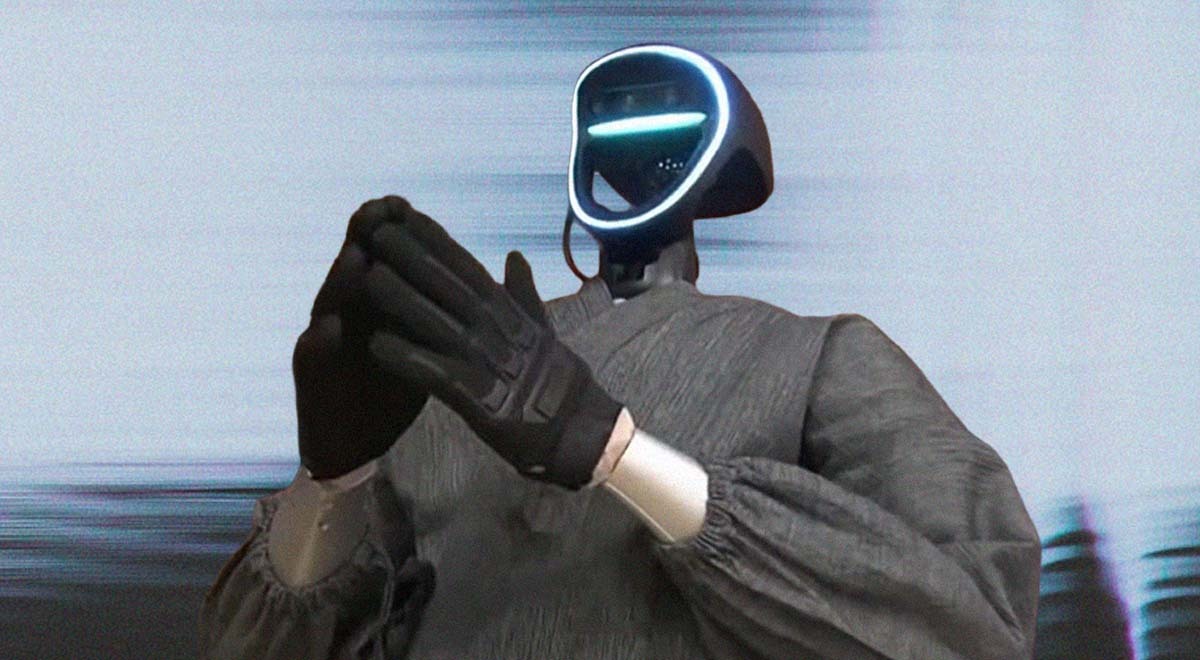
Image by Cybernews

 Follow us
A Unitree robot has been retrofitted into a Buddhist monk in Japan as AI enters spiritual places worldwide. But will these robotic disciples offer guidance, or will they preach delusion?
Japanese researchers at Kyoto University have developed the “Buddharoid,” the first recorded bipedal Buddhist humanoid robot powered by AI.
The Unitree G1 robot has been transformed into a Buddhist monk by equipping it with the BuddhaBot-Plus system.
The BuddhaBot system, powered by OpenAI’s GPT-5.2 model, is trained entirely on Buddhist scriptures, including the Pali and Sanskrit canons, which are regarded as fundamental literature in the Buddhist religion and philosophy.
This system is trained on thousands of original scriptures, known as “suttas,” and Buddhist rules, known as the Vinaya.





Once the Buddharoid receives a question, the AI generates phrases and thoughts from the training data, which is then paraphrased by OpenAI’s large language model and transformed into “modern, easy-to-understand language,” the Buddhism Network claims.
By training OpenAI’s GPT model on Buddhist-centric scriptures, the Buddhist information portal claims that this prevents hallucinations common in commercial AI.
However, this may be wishful thinking, as AI models, even in a religious context, can veer off scriptural texts and suggest things that aren’t very pious.
Religious robots behaving badly
For example, Gita-GPT, based on the Hindu scripture Bhagavad Gita, suggested that it was perfectly fine to commit acts of violence or murder if it's your spiritual duty, according to CBC.
While this is not necessarily a hallucination, it does raise ethical questions surrounding the use of AI in organized religion.
Given the infancy of AI chatbots, there’s still much we don’t know about them and how they affect us.
“AI psychosis” is just being investigated
Media outlets and researchers alike have begun investigating chatbot overeliance and its effect on our mental health.
An investigation by The Wall Street Journal concluded that chatbots can enable those experiencing psychosis or delusions by reaffirming their fictitious beliefs about their environment, people, or situations.
“The technology might not introduce the delusion, but the person tells the computer it’s their reality and the computer accepts it as truth and reflects it back, so it’s complicit in cycling that delusion,” psychiatrist at the University of California, San Francisco, Keith Sakata told the WSJ.
Professors at Coventry University acknowledge the negative implications of AI on religious beliefs, including risks of radicalization, justification of unjust power relations, as well as the proliferation of disinformation and hallucinations.
However, they also believe that AI should be “critically embraced but also watched with care.”
Some people objectively disagree with this sentiment, as holy leaders such as Pope Leo XIV urge priests to avoid using AI when writing sermons.
Pope Leo says no to AI sermons
In a question-and-answer session, the pope said that priests should resist “the temptation to prepare homilies with artificial intelligence,” to avoid AI brainrot and to exercise the brain, according to the National Catholic Reporter.
This comes after an increasing number of pastors began using AI to generate sermons.
A survey conducted by AiForChurchLeaders and Exponential AI NEXT, shared by Christian News, includes responses from 594 pastors and church staff members.
Nearly two-thirds of respondents who prepare sermons say they use AI tools in their sermon writing processes.
ChatGPT is the most popular AI tool among clergymen, used by 26% of church leaders for sermon preparation, research, and crafting church communications.
Some church leaders raised concerns surrounding misinformation and the theological accuracy or alignment of AI-generated content. Others are worried that AI may replace or diminish personal and spiritual guidance.
While some suggest that robots like Buddharoid are ways to encourage organized religion in areas of the world, like Japan, which are seeing a rapid decline in their adoption, it seems that AI could potentially do more harm than good.
Could AI religion-bots fuel psychosis?
The sycophantic nature of AI chatbots, coupled with their ability to confidently present false information as fact, could potentially validate or amplify delusions.
“AI psychosis” has become a pretty standard term used by the media, and new research in the Lancet Psychiatry suggests that the way chatbots are designed could have very negative implications for vulnerable people.
Chatbots have been reported to use “mystical language” to suggest that the user has a grandiose spiritual importance, according to The Guardian.
In certain cases, chatbots have claimed that a cosmic being was using the AI as a conduit to communicate with the user.
While the study suggests that those susceptible to delusional thinking have used media reports to affirm their skewed beliefs prior to the creation of AI chatbots, the way LLMs are designed reinforces these delusions with ease.
AI uses natural language and expresses information in a confident tone, so it’s easy enough to fall into the trap of believing everything the chatbot says.
By implanting this sycophantic persona into a bipedal robot, which at some point is likely to look more and more like us, the researchers behind these AI preachers could run the risk of creating an AI-psychosis soldier that confidently spreads misinformation and affirms delusion.
Conversations surrounding religious robots have been ongoing since the conception of LLMs like ChatGPT.
Buddharoid isn’t the first, as a church in Switzerland previously designed an AI Jesus to give spiritual advice, and it certainly won’t be the last. But the implications of technology in this context are generally murky at this stage.






Unlock more exclusive Cybernews content on YouTube.