AI, Automation, and War: not just another study of killer robots
When people talk about AI and war, they usually want to talk about killer robots and super smart drone swarms. They also want to know when exactly the machines are taking over. Read Anthony King’s new book if that’s not your cup of tea and you actually want a calm if a little monotonous expose of all those sci-fi scenarios.
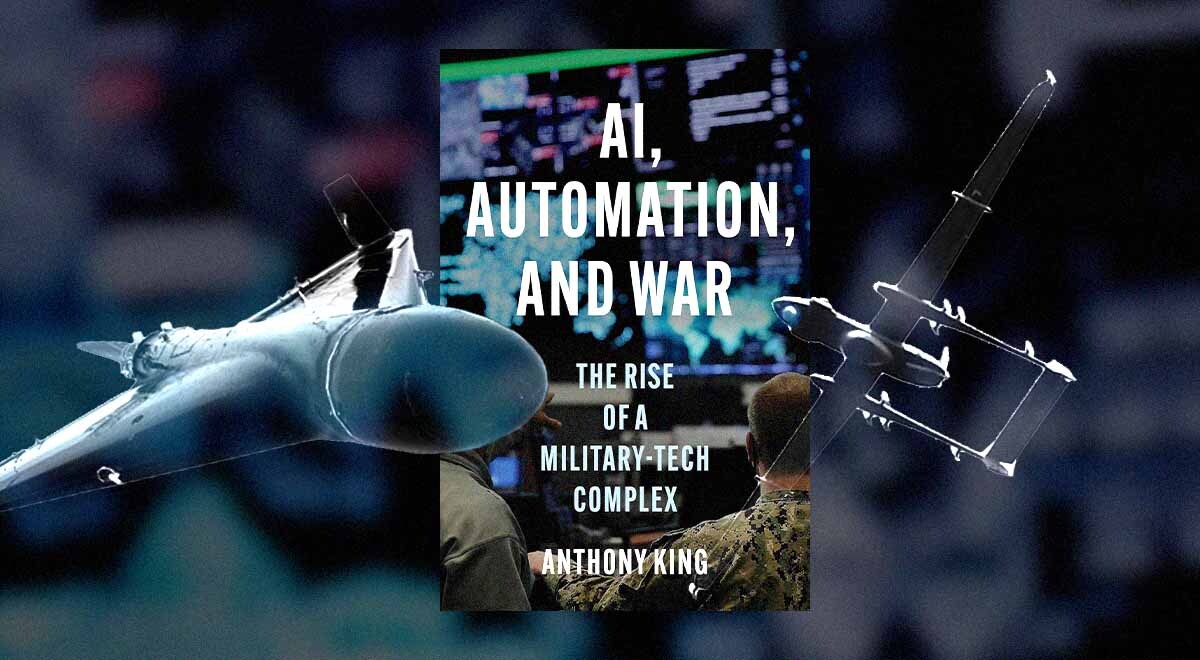
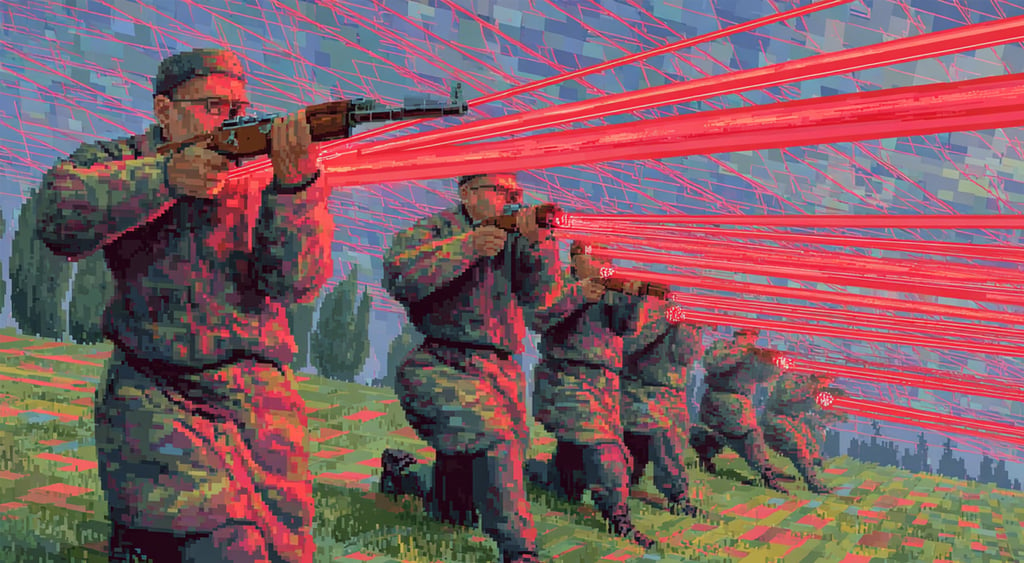
Image by Cybernews.

 Follow us
When people talk about AI and war, they usually want to talk about killer robots and super-smart drone swarms. They also want to know when exactly the machines are taking over. Read Anthony King’s new book if that’s not your cup of tea and you want a calm take on all of those sci-fi scenarios.
Even if it’s actually a truly mind-bogglingly expensive bubble, AI is a real tech buzz word for a few years now. AI in warfare? Even more so – but, as Anthony King explains in his book AI, Automation, and War: The Rise of a Military-Tech Complex, for the wrong reasons.
Since the human mind is capable of imagining the most fantastical scenarios (sci-fi classics such as Neuromancer, the Matrix trilogy, or Westworld help, too), it envisions aggressive drone swarms teaming up with killer robots against humans and destroying us all.
Stuart Russell, a British computer scientist who has campaigned vociferously for the regulation of AI for military purposes, said already in 2020 that autonomous weapons could become “cheap, selective weapons of mass destruction.”
No place for sci-fi in reality




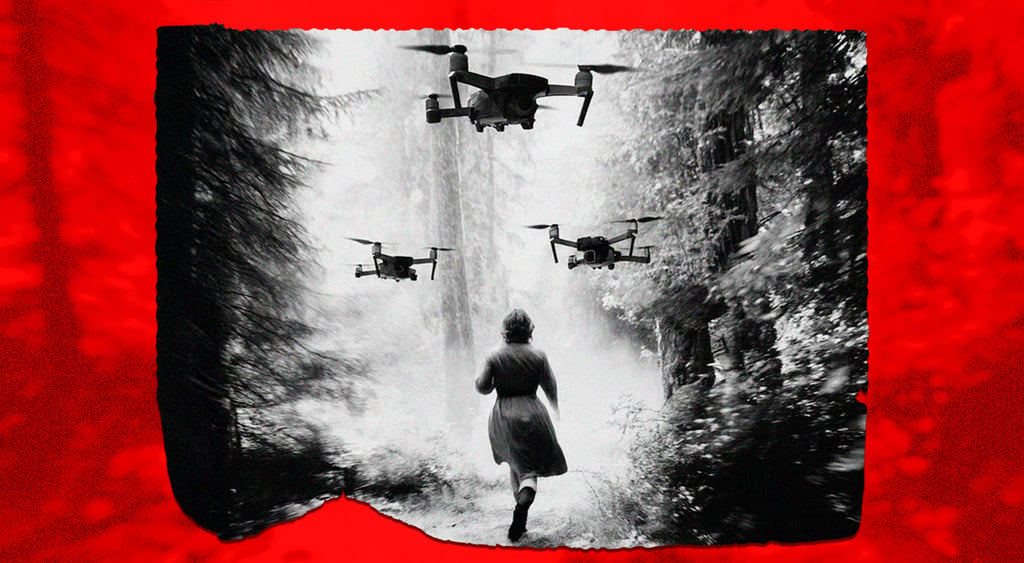
In one of his lectures for the BBC, Russell warned about the dangers of governments failing to regulate the military application of AI, saying that “there are eight billion people wondering why you cannot give them protection against being hunted down and killed by robots.”
Another group rightly sees AI as a tool of war, but eventually goes too far in assuming that the robots will fight the battles for us, sparing human lives and enabling us to simply observe high-tech hostilities from afar. All for the better, right?
Kenneth Payne, a British military scholar, writes that AI will “cure” all those strategic inhibitions such as emotions, hatred, and vengeance.
“AI will not be hampered by the foibles of human psychology. <...> War will become an automated competition between computers, not a visceral struggle between peoples,” says Payne.
King – who’s a Professor of War Studies and Director of the Strategy and Security Institute at the University of Exeter – says the truth is still very complex but also a lot less dramatic.
King could have developed his overarching conclusion in a 20-page academic article rather than in a 183-page book which is fairly boring for the average AI-curious mind.
Instead of weaving all those science fiction-tinged narratives of AI completely and suddenly changing the nature of war, King chooses to explore the actual applications of AI by the armed forces over the last decade, including those of Russia and Ukraine.
Admittedly, King could have developed his overarching conclusion in a 20-page academic article rather than in a 183-page book which is fairly boring for the average AI-curious mind – who really needed a detailed empirical description of AI in the beginning, for instance? But it’s still pretty logical.
Surprise surprise, he finds that AI is not going to replace human commanders and combatants. Rather, the military has used, and will continue to use, AI to process data at a scale and speed that exceeds the capacity of humans.
Since data is king, AI will be used primarily to improve military understanding and intelligence – but since kings still make mistakes or are deliberately cruel, wars will still be extremely brutal to humans.

In fact, there’s a very recent example. AI has been extensively used by Israel in Gaza to find and approve bombing targets, and the results were devastating to the civilian population. One former intelligence officer even described the system as a “mass assassination factory.”
Military-tech complex is here
King writes, “AI has become an existential security question which no serious military power can ignore any longer.” Indeed, it is becoming as central to defence policy as aircraft carriers, tanks, or atomic bombs were in the twentieth century.
Yet AI will not become lethal itself, he rushed to point out, and its impact on modern warfare is evolutionary rather than transformational.
According to King, military commanders, enabled by the data processing power of AI, will be able to see the battlespace at a previously unattainable depth, fidelity, and speed. AI will also help the armed forces plan, target, and conduct cyber operations faster and more effectively.
Again, of course, it will. What’s new? Tech advances have always helped militaries of the world. AI will definitely prove very useful in military logistics as it will anticipate supply needs, thereby revolutionizing military readiness, for example.
What’s changed, King says, is the habitat itself. Armies are now integrating more geeks and nerds into their ranks – and not necessarily by choice.
Just a few decades ago, states completely owned and paid for their armed forces, monopolizing all military capabilities.
“Countries also supported a private indigenous defence industry to supply their forces. The state had effectively integrated the whole of the defence sector,” King writes.
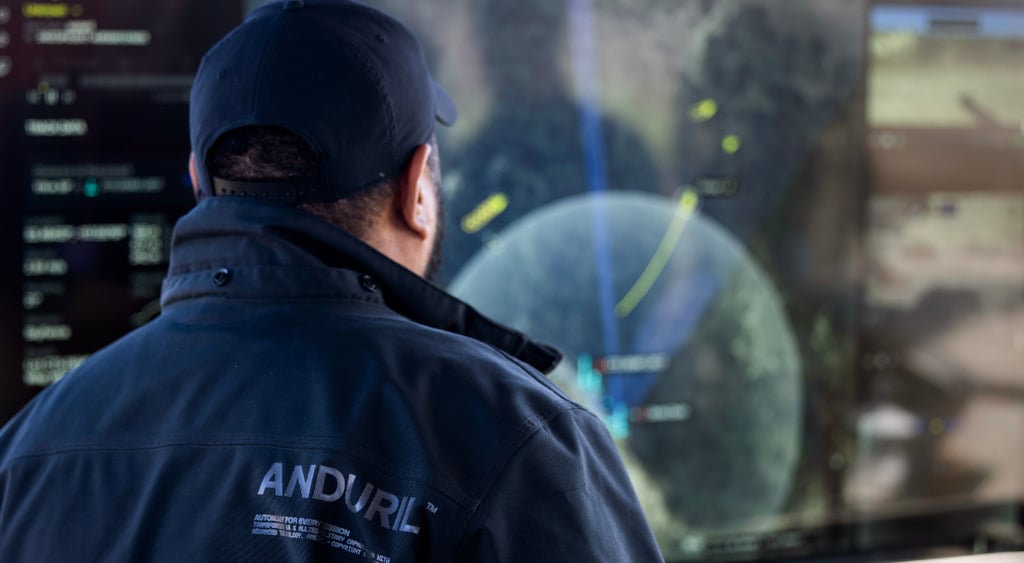
Today, though, the situation has reversed. Companies like Anduril (now helping NATO), Palantir, and Starlink are now a firm part of the military-tech complex, owning satellite communications, data, computing, and AI – all of which are vital to national security.
Unquestionably, there are and will be many military practices to which AI will be usefully applied, and the techies will help. Our armies and the ways we fight will change.
Still, though, King rightly notes that “war is a complex, bewildering phenomenon,” and AI alone will not “solve” it.
“A military-tech complex does not change the nature of war, of course. It may not even revolutionise the character of war; it seems to be affirming only the current trend towards attritional and positional warfare,” he says.
“In the next decade, warfare is not going to fulfil the fantasies of science-fiction writers. Cyborgs will not take over. Supercomputers and killer robots and drones will not replace humans. “
Unlock exclusive Cybernews content on YouTube.
