We talk to execs gone cold on AI – or pulling it into an even tighter embrace
The lesson from last year for most executives is that AI doesn’t automatically create value just because it’s there: too often, excitement leads to confusion.

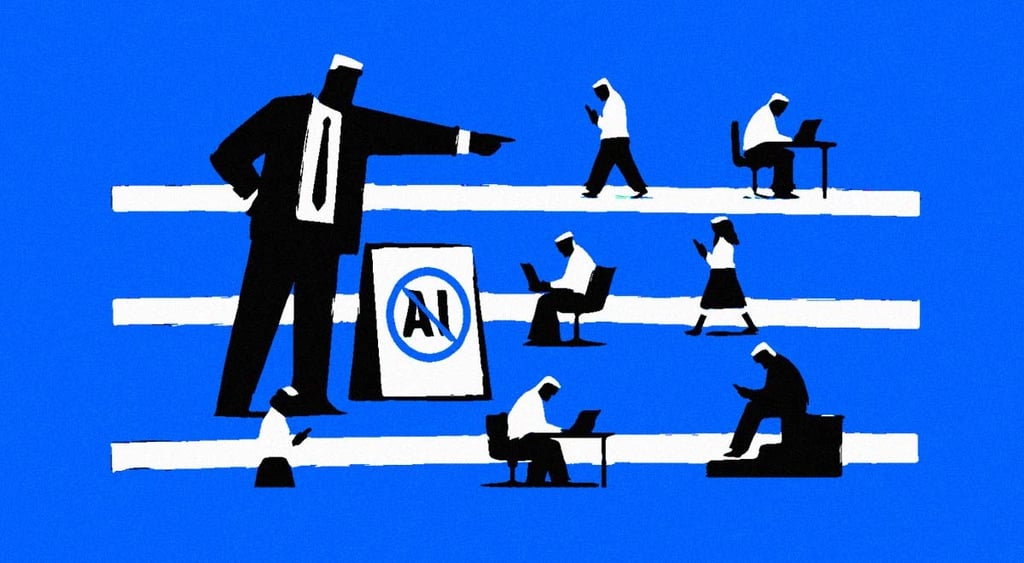
Image by Cybernews.

 Follow us
- Executives are reconsidering broad AI rollouts after high costs, weak returns, and employee resistance.
- Most leaders interviewed are not banning AI, but they want stricter controls, approved tools, and clearer policies.
- Companies report unexpected AI bills from token pricing, misconfigured systems, and agents that run up costs.
- Experts say workers resist AI when they fear layoffs, but accept it when it supports their jobs.
Key Takeaways by nexos.ai, reviewed by Cybernews staff.
Quite a few headlines are now telling us that executives – you know, the ones in charge – are beginning to shy away from extensive AI use in their organizations. What follows is absolutely nowhere close to a representative survey, but we’ve asked them whether they believe that’s true.
A Writer’s poll recently found that nearly half (48%) of executives now describe enterprise AI adoption as a “massive disappointment” and cite, among other things, missing measurable value and severe frontline resistance within their companies.
And tech commentator and AI consultant Joe Procopio told a story about a kind of entrepreneurial unhappiness with the use of the technology.
According to Procopio, he recently received an email from a tech company CEO who said he was banning all AI use across his organization – no exceptions, no limitations, absolute totality.






The anonymous executive actually called his move a complete cease-and-desist order: “Do not engage with LLMs at any time, for any reason, across the entire organization from sales and marketing to engineering and QA.”

Check if your data was exposed
Find out if your email and related personal information have appeared in known data breaches.
While Procopio’s story is just one example, executives seem to have begun seeing through the hype. The reality is that AI is a lot more expensive than humans, but doesn’t really help companies that much – if you’re losing money, maybe, just maybe, the old way was better?
We’ve decided to just ask around. Is there actually a sense that enterprise AI adoption is slowing down, or is this just a blip, a sort of pause before figuring out what kind of AI is needed the most?
Not a magic productivity button
With AI token costs overtaking human salaries as automation spending spirals, Boris Kolev, global head of technology at JA Worldwide, the world's largest educational non-profit organization serving entrepreneurship, financial literacy, and work readiness education, tells Cybernews he’s still optimistic about the promise of generative AI.
But he’s already shying away from “chaotic AI,” Kolev says. To him, the lesson from recent years is that AI doesn’t automatically create value just because it’s available.
A Worldwide is now limiting uncontrolled AI use, focusing on approved tools, clearing policies, human review, data protection, and use cases where AI genuinely improves the work rather than simply adding another layer of software.
“In many organizations, the first wave of AI adoption created excitement, but also confusion: employees were unsure when they were allowed to use it, managers expected productivity gains without redesigning workflows, and technology teams had to manage a lot of new risks around privacy, accuracy, cost, and governance,” says Kolev.
“The real problem is that many organizations and CEOs have treated AI like a magic productivity button. It is not. AI is more like electricity in a building: powerful, but only safe and useful when there is wiring, meters, grounding, and circuit breakers.”
That’s why at least JA Worldwide is now limiting uncontrolled AI use, focusing on approved tools, clearing policies, human review, data protection, and use cases where AI genuinely improves the work rather than simply adding another layer of software.
This might sound a bit bizarre, of course, but Compance.AI, a Dublin-based platform that builds compliance, governance, and authorization tooling for enterprise AI, has moved in the same direction.
“My company does not incorporate AI in its code. No vibecoding. Specific AI programs can be used as a research assistant in the course of finding the needed solution,” Kadan Stadelmann, co-founder of the platform, told Cybernews.
“But human judgment is superior and will remain so for the foreseeable future.”
Costs are shockingly high now
Indeed, most executives who spoke to us haven’t banned AI use in their organizations. They stress, though, that the key right now is to shape exactly how the practice should look – and, of course, to always know how much you’re spending.
Earlier this year, Uber CTO Praveen Neppalli Naga said that Uber burned through its annual AI budget within the first four months of 2026, and there are thousands of companies still in shock that AI firms such as Anthropic and OpenAI have shifted to token-based pricing.
For instance, Viktor Bulanek, who runs the AI company Penetrify, openly admits that “AI burned us properly.”
At one point, a configuration quietly routed Penetrify’s workloads to a much more expensive mode than intended, and nobody noticed for weeks.
Two years ago, executives bought the licenses, rolled out ChatGPT or Copilot company-wide, and waited for the productivity boom. For a lot of them, it never came.Sam Richter
“You find out from the invoice, which is the worst possible monitoring tool. We also had agents that looped and multiplied token spend in ways I never budgeted for. After the second incident, I understood very well why some executives just pull the plug. The instinct is real, I felt it too,” Bulanek told Cybernews.
“My engineers also complain about spending whole days reviewing code they didn’t write. That fatigue is real, and I don’t have a clean answer for it yet.”
Yet, Penetrify is, of course, still using AI. As Bulanek puts it, he quickly realized banning the tech wouldn’t have solved much “except hiding how unprepared we were.”
Sam Richter, a member of the National Speakers Association’s Speaker Hall of Fame and co-founder of an AI training and certification company, SBR Worldwide, agrees.




Stay updated with our latest stories and follow us on social media
Be the first to discover new stories, ideas, and updates from our team.
“Two years ago, executives bought the licenses, rolled out ChatGPT or Copilot company-wide, and waited for the productivity boom. For a lot of them, it never came. But the problem was never the tool. It was handing people a login and expecting magic,” said Richter.
“Leadership thinks they’ve enabled their people. Their people feel handed a tool and left alone.”
When employees disengage, they’re right to
That perception gap might actually be the story. According to Richter, when AI gets rolled out alongside talk of efficiency, employees hear one word – layoffs. Sure enough, just this week, Microsoft, a company pouring billions into AI, announced plans to lay off 4,800 people.
“Why would younger workers train the tool they've been told might replace them? They won’t. You can’t upskill a workforce that thinks the skill is a trap,” Richter told Cybernews.
If AI shows up as a productivity whip or a quiet redundancy plan, people disengage, and they’re right to.Oliver Huggins
“Companies seeing the highest returns are the ones using AI to amplify their people, not replace them. The happy executives trained their teams on real, job-specific use cases, separated AI from layoffs loudly and repeatedly, and treated AI fluency as a path to promotion rather than a pink slip.|
Oliver Huggins – running ExpertEdge, a training platform built specifically for software engineering and L&D teams – agrees.
“If AI shows up as a productivity whip or a quiet redundancy plan, people disengage, and they’re right to,” says Huggins.
According to Kolev, employees indeed become frustrated when AI is presented as a replacement for judgment or as a surveillance tool.

“They embrace it when it removes repetitive work, helps them think better, and respects their expertise. For me, the future is not less AI: it’s more disciplined AI,” Kolev thinks.
If organizations manage to shed the perception that AI is here to take their employees’ jobs, the situation may improve. A case in point: prosense.digital, a software development agency.
Its founder, Asia Solnyshkina, told Cybernews they used to think that “AI tools are pointless” but are now “absolute AI evangelists” who see the future as a “brave new world” where everything’s automated, and people only review what’s being done – they have one but extremely important job.
“I even rewrote the product managers’ job description: they no longer do dumb manual work like building spreadsheets or arranging tickets in Jira. A manager’s core competence now is to be the keeper of a single document – the bible of the product or feature they’re launching,” Solnyshkina said.