Palantir employees begin to ask themselves, “Are we the baddies?” and the CEO has a shocking answer
The shadowy Palantir Technologies continues to dominate our newsfeeds. Sometimes for the right reasons, but mostly for the wrong ones.
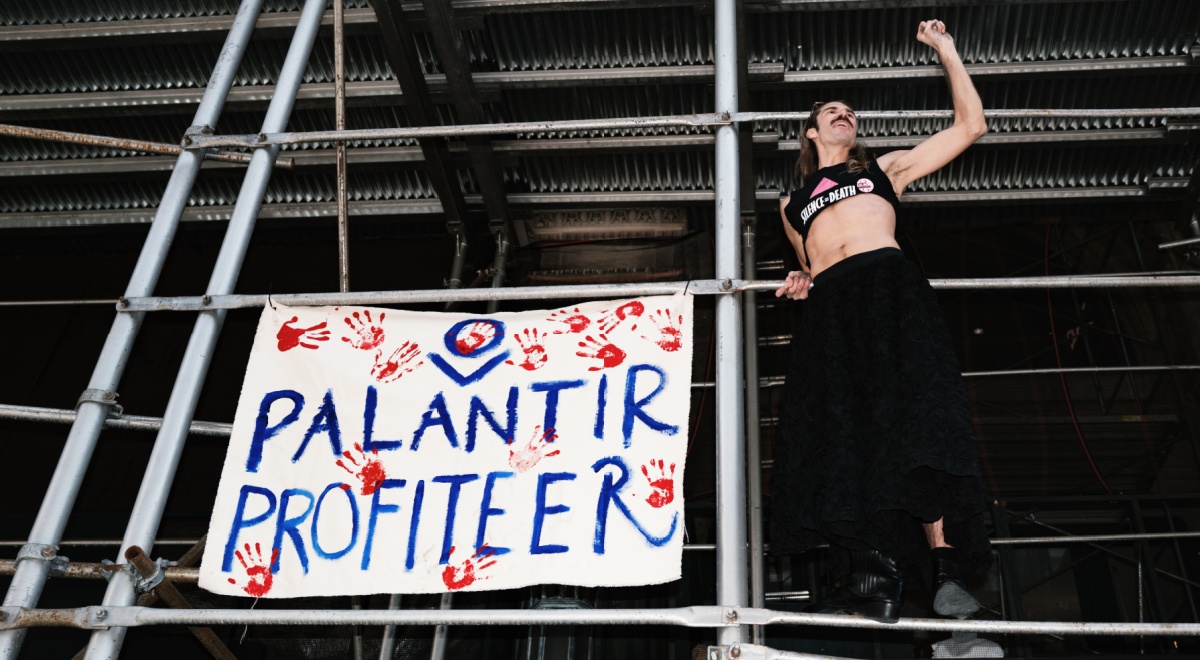
Photo by Jerome Gilles/NurPhoto via Getty Images.

 Follow us
The shadowy Palantir Technologies continues to dominate our newsfeeds. Sometimes for the right reasons, but mostly for the wrong ones.
The company’s infamous CEO, Alex Karp, continues to channel his Bond-villain-esque presence with the recent release of his 22-point manifesto, which critics labeled as an AI-driven threat to humanity's existence, or worse still, technofascism.
The concern is that the fusion of authoritarian politics with surveillance tech, AI, and data systems is, at best, leading to an overreach of state power.
The contradictions at the heart of Palantir






Palantir is best known for working with governments and corporations that hand over access to private data. But things quickly get complicated when it can be found on the front lines of battlefields and hospital wards.
Palantir's impact feels deeply contradictory, powering systems that have been linked to both killings and life-saving treatments.
The secretive Peter Thiel-co-founded company is also one of the biggest winners of Trump's proposed $1.5 trillion defense budget. Elsewhere, investors are chasing big gains after the 2026 Q1 earnings report sparked a bounce in its stock price. But its critics have accused it of implementing mass surveillance, algorithmic governance, and propaganda through digital tools that weaken democratic accountability.
Although Palantir's founding mission was built on "defending the West, " Amnesty International named Palantir as one of a growing number of companies enabling and/or profiting from genocide, occupation, and apartheid. Despite arguably starting with the best intentions, Palantir is difficult to defend when its CEO openly admits that "Our product is used on occasion to kill people."
Inside Palantir's paradox
Welcome to the paradoxical world where Palantir Technologies can point to its role in helping European agencies disrupt terror plots, while also supporting the National Health Service through a £330m deal aimed at improving patient outcomes, care coordination, and operational efficiency. But the same company signed a $30m agreement with ICE to power ImmigrationOS.
Many have accused employees of naively signing up for something that makes the world safer. But staff are beginning to question the contradictions they are witnessing and the role they are playing. If we learned anything from Star Wars, it's that we are supposed to bring balance to the Force, not leave it in darkness.
WIRED went further down this rabbit hole when it revealed leaked internal Slack conversations and interviews with both current and former staff. The article revealed how the workforce was grappling with their own idealistic beliefs that were now conflicting with how the technology was being applied in practice.
The sudden epiphany feels somewhat reminiscent of the classic Mitchell & Webb sketch, in which Nazis ask themselves, "Are we the baddies?"
In Palantir employees' defense, the ground appears to have shifted beneath them very quickly. At its core, Palantir solved one of the hardest problems in modern computing by unlocking the ability to make sense of vast, complex datasets.
Despite its best intentions, once the genie was out of the proverbial bottle and deployed into the real world, it quickly took shape according to the priorities of the institutions that use it. This is where the line between the greater good and potential harm starts to blur.
When the industry turns on its own
Standing up against the machine you helped create is not as simple as it sounds. Alex Bores found himself the target of attack ads funded by a super PAC backed by Joe Lonsdale, with critics pointing out the irony that his past employment at Palantir Technologies is now being used against him.
Bores originally co-sponsored the RAISE Act and is now campaigning for greater transparency, safety standards, and even an AI dividend. This one example represents a growing wave of insiders pushing for stronger oversight of the very industry they once helped build.
The fact that former affiliations are being weaponized in political messaging should raise more questions about whether the accused are facing legitimate scrutiny or just another transparent attempt to discredit any opposing voice.
A quick browse of Reddit reveals very little sympathy for employees who are just beginning to question their roles at companies like Palantir Technologies. The tone is largely unforgiving, with some asking how anyone could help build systems designed to analyze individuals at scale, sometimes framed around anticipating behavior, and still believe the work existed in a moral vacuum.
There is an argument that today's tech industry has more in common with earlier industrial eras than it might care to admit. Once again, innovation is racing ahead of regulation and leaving society to deal with the consequences later.
Tech companies are behaving like small children playing with very dangerous toys when they create products that can be used for good, but also kill people. These are just a few of the many reasons why the public has very little sympathy for Palantir employees who feel guilty about what they have created.






We are beginning to see a global conversation and personal reckoning about where accountability begins and where it ends. For every engineer and employee, that means deciding where their line sits and what happens when it is crossed.
Saying, "I was only doing what I was told," won't cut it, and if you find yourself thinking, "Are we the baddies?" then you probably already know.
Unlock more exclusive Cybernews content on YouTube.