Alabama city hack exposed financial data and citizens, hackers claim
The City of Gardendale has appeared on a dark web forum that hackers use to showcase their latest victims. The threat actors claim to have obtained tens of gigabytes of sensitive data.

Image by Cybernews.

 Follow us
The City of Gardendale has appeared on a dark web forum that hackers use to showcase their latest victims. The threat actors claim to have obtained tens of gigabytes of sensitive data.
The claim was made by a prominent ransomware cartel calling itself INC ransom. The attackers posted Gardendale on the gang's leak site, a common tactic employed to coax victims into meeting ransom demands.
INC claims that it accessed nearly 50GB of data, including the municipality’s contracts, financial data, customer data, human resources information, incident reports, and other confidential information.
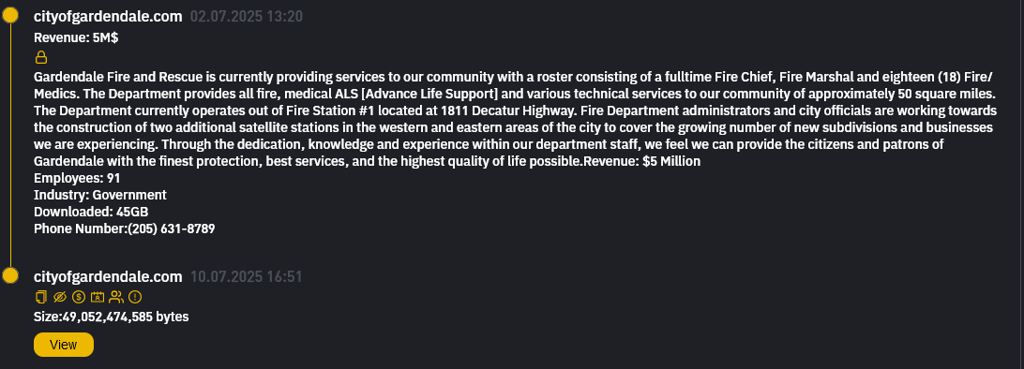
However, the threat actors did not provide a data sample or screenshots of the supposedly stolen data. We have reached out to the City of Gardendale for a comment regarding the data breach claims and will update the article once we receive a reply.






If confirmed, the data breach could cause several headaches across the city. For one, citizens would face elevated risks of identity theft. The municipality itself could become a more frequent target for attackers as they can build on stolen data to penetrate deeper into the city’s systems.
The city of Gardendale has a population of over 16,000 residents. The settlement serves as a northern suburb of Alabama’s second-largest city, Birmingham.
Who is the INC ransom gang?
INC Ransom is one of the most prominent ransomware cartels currently operating. First observed in July 2023, the cyber cartel has been inching towards the top, with victims like a DoD defense contractor, Stark AeroSpace, the San Francisco Ballet, the City of Leicester in England, the NHS Dumfries and Galloway Health Board of Scotland, and the Xerox Corporation on its list.
The gang is not too picky about its targets. For example, the gang even resorted to targeting places of burial, as it targeted the Catholic Cemeteries of the Diocese of Hamilton in Canada.
According to Cybernews’ dark web monitoring tool, Ransomlooker, INC Ransom has victimized at least 176 organizations over the past 12 months.




The gang is considered a multi-extortion operation – which means it not only encrypts and steals data but also threatens to publish it online if the victim doesn’t pay up. It appears to target a varied number of industry sectors at random, including attacks on the healthcare, education, and government sectors.
While it’s unclear where the gang members come from, the vast majority of their victims are based in Western countries. At the same time, the gang doesn’t target organizations from the Commonwealth of Independent States (CIS), a tactic shared by many Russia-based cybercriminals.
Some researchers believe that the Lynx ransomware cartel is an offshoot or a rebrand attempt of individuals related to the INC Ransom cartel.