Your smart TV is watching: Hackers leak 150,000 Samsung viewing records
Hackers dropped Samsung data on the dark web.
Image by Cybernews

 Follow us
- A ransomware gang claims it leaked 220MB of Samsung data on the dark web.
- Researchers found about 150,000 Samsung smart TV viewing events, including locations, timestamps, and device details.
- The leak also includes political advertising records and files linked to AI advertising model training.
- Samsung has not yet commented.
Key Takeaways by nexos.ai, reviewed by Cybernews staff.
Samsung Electronics may have been caught in a data breach allegedly exposing political advertising operations and smart TV viewing habits.
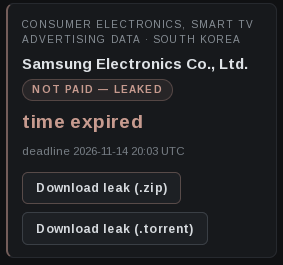
A ransomware gang has dumped 220MB of data it claims belongs to the South Korean tech giant.
Attackers known as n0n dumped the allegedly stolen dataset on their leak site on the dark web after their timer ran out.
The leaked files appear to confirm that Samsung smart TVs collect usage data and send it to Samsung's data centers.





What Samsung data has been breached?
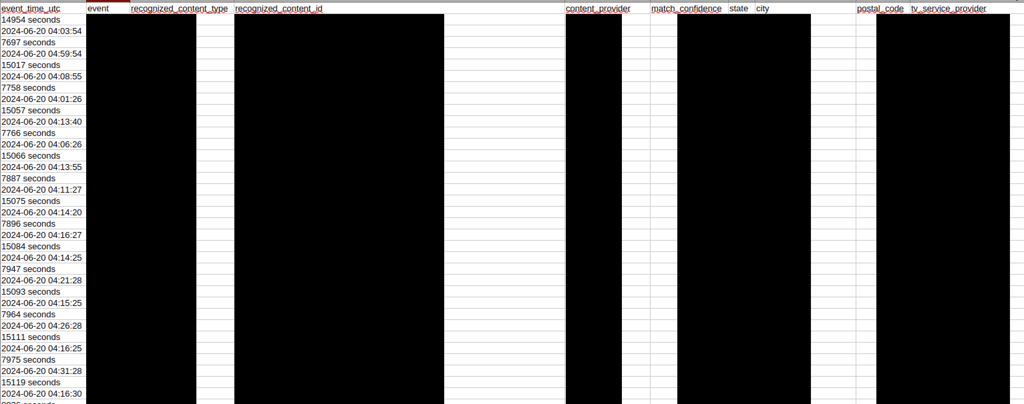
Cybernews researchers have investigated the exposed data. One of the largest leaked datasets contain around 150,000 smart TV viewing events.
The records reveal viewing activity on Samsung smart TVs in 2024, including timestamps, viewing durations, device information, cities, ZIP codes, and TV service provider names.
While the dataset does not expose what individual users watched, it shows the viewing patterns and usage data collected from Samsung devices.
Meanwhile, another dataset contains approximately 42,600 records related to political advertising aired between September and October 2026. It also includes a political advertisement video.
The records show political affiliations, issues discussed in advertisements, sponsors, estimated advertising costs, and timestamps.
Once exposed, such data could offer a closer look at political advertising spending and the issues different political groups are investing in.
Our team also found around 99,100 records associated with AI advertising model training from 2021. The dataset primarily consists of embedding vectors – mathematical representations of training data.
The exposed files also included two internal documents. One, dated September 2026, outlines an agreement governing the proper use of collected data and contains the full name and email address of a Samsung employee.
Another, an access questionnaire for what appears to be Samsung's Content Data Warehouse, reveals information about an individual employee and details about the company's infrastructure.
We reached out to Samsung for comment and will update the article once we receive a response.
This is not the first time attackers have claimed to leak Samsung data online. In 2025, roughly 270,000 of Samsung Germany's customer support tickets were dumped online, exposing names, emails, home addresses, and order details.
Cybersecurity firm Hudson Rock linked the breach to credentials stolen in 2021 that had not been rotated.
Samsung smart TVs under fire for tracking users
Samsung was previously sued in Texas for illegally collecting personal data through Automated Content Recognition (ACR). Proton, a Swiss privacy company, has also warned users of privacy issues related to smart TVs.
Samsung was also accused of using microphones and AI profiling to spy on users. Security researcher Log4j claimed Samsung designed its smart TVs with features that let the company spy on users.
Reportedly, the data is later shared with over 400 partners to deliver targeted advertising.
What do we know about n0n?
The n0n gang is relatively new to the ransomware scene, having caught the attention of the cybersecurity community in mid-September.
Cybersecurity firm SOCRadar found that n0n’s Python file server, associated with a location in Sweden, was left exposed on the open internet. The attackers heavily rely on AI tools to conduct hacking tasks.
The findings show that n0n invested in generative AI to assist in building common scripts for scanning and reconnaissance activities.
The gang has already listed a handful of high-profile victims, including Visa, Mastercard, Walmart, JPMorgan, and Starbucks. Recently, the gang also leaked over 500MB of Expedia customer data.