How a hacker turned AI slop into VoidLink, a powerful new Linux malware
Security researchers are warning about the rise of a powerful, sophisticated Linux malware framework known as VoidLink. It turns out that a solo developer with a team of AI agents is likely behind it.

Image by Cybernews.

 Follow us
Security researchers are warning about the rise of a powerful, sophisticated Linux malware framework known as VoidLink. It turns out that a solo developer with a team of AI agents is likely behind it.
VoidLink, first identified by Check Point Research, features powerful base functionality and dozens of on-demand modules for targeting cloud infrastructure, built with “a high level of sophistication and rapid evolution.”
“When we first encountered VoidLink, we were struck by its level of maturity, high functionality, efficient architecture, and flexible, dynamic operating model,” the researchers said.
The malware developer made Operational security (OPSEC) failures that shed light on how the framework spawned.
Initially believed to be a large project by an advanced threat actor, VoidLink was likely made by a single individual, and the first functional implant was made in less than a week.






It is now evident that the era of advanced AI-generated malware has begun. VoidLink is one of the earliest known samples of advanced malware that was largely generated by artificial intelligence.
“Until now, most confirmed examples of AI-written malware were either low-quality, linked to inexperienced attackers, or closely resembled open-source tools,” Check Point researchers said in a new report detailing how the malware was made.
“VoidLink breaks that pattern.”
So far, there is no evidence that this malware has been used in real-world cyberattacks.

Is a man with a dream enough to turn AI slop into a dangerous framework?
What sets the VoidLink project apart is the way the whole process was structured. Check Point researchers did not detail how they obtained the leaked internal materials, including documentation, source code, and project components, and only mentioned the hacker’s OPSEC failures.
“The opening directive was not to build VoidLink directly, but to design it around a thin skeleton and produce a concrete execution plan to turn it into a working platform,” the researchers said.
The malware developer used a methodology called Spec Driven Development (SDD). This means that instead of coding first, the work started with high-level documentation and specifications.
First, the vibe hacker tasked AI agents with generating a plan detailing three distinct agentic AI teams, structure, sprint schedules, specifications, and timelines. The generated structure resembles well-resourced organizations investing heavily in engineering.
From a high-level perspective, the build specifications are later followed by a plan, which is then broken into tasks, and only then are the AI agents allowed to implement them. These chunks included the core engine, persistence mechanisms, kernel tricks, cloud gestures, and dozens of modules.






“The development plan itself was generated and orchestrated by an AI model, and it was likely used as the blueprint to build, execute, and test the framework,” the Check Point Research report details.
The developer used TRAE (AI-centric IDE) and SOLO, an AI assistant embedded in it.
AI was very thorough with documentation. Earliest versions described a 20-week sprint plan across three AI teams: a Core Team (Zig), an Arsenal Team (C), and a Backend Team (Go).
In reality, the process was a lot faster, and after a mere week, the framework had grown to more than 88,000 lines of code.

AI demonstrated “a striking level of alignment” when producing source code in accordance with detailed instructions.
“Conventions, structure, and implementation patterns match so closely that it leaves little room for doubt: the codebase was written to those exact instructions,” the report reads.
The researchers even recreated this workflow to see TRAE SOLO building malware in action.
“At the end of each sprint, the developer has a point where code is working and can be committed to a version control repository, which can then act as the restore point if the AI messes up in a later sprint.”
If a chunk isn’t working, the developer can test it manually, refine its specs, and plan the next sprint.
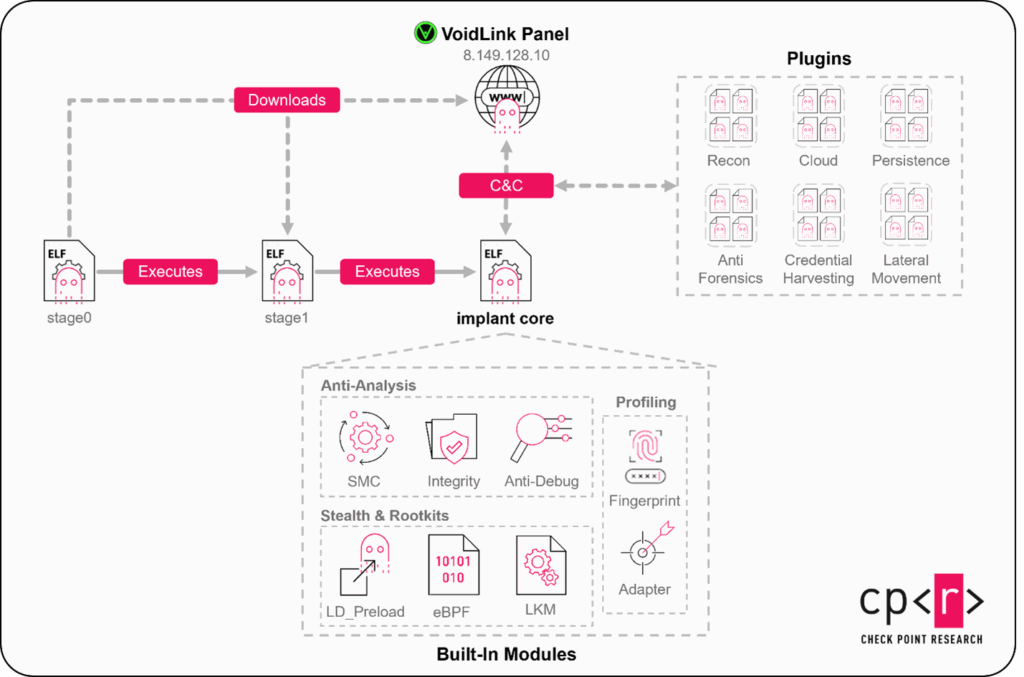
The earliest leaked VoidLink documents date back to November 27th, 2025, and the first functional malware was detected on December 4, 2025 – a compiled version of it was already submitted to VirusTotal.
How many more?
Security researchers are ringing alarm bells. VoidLink is the first example of how AI-generated malware can be highly sophisticated, produced quickly and at scale, with devastating offensive capabilities.
Solo hackers with AI are building stealthy malware frameworks that resemble those created by highly resourced, experienced threat actor groups.
The Cybernews community is talking about this. Be a part of the conversation.
“We only uncovered its true development story because we had a rare glimpse into the developer’s environment, a visibility we almost never get. Which begs the question: how many other sophisticated malware frameworks out there were built using AI, but left no artifacts to tell?” Check Point researchers concluded.
“The long-awaited era of sophisticated AI-generated malware has likely begun.”
Unlock more exclusive Cybernews content on YouTube.