UK government’s benefits system taken offline after cyber incident
“Contain first, investigate second.”
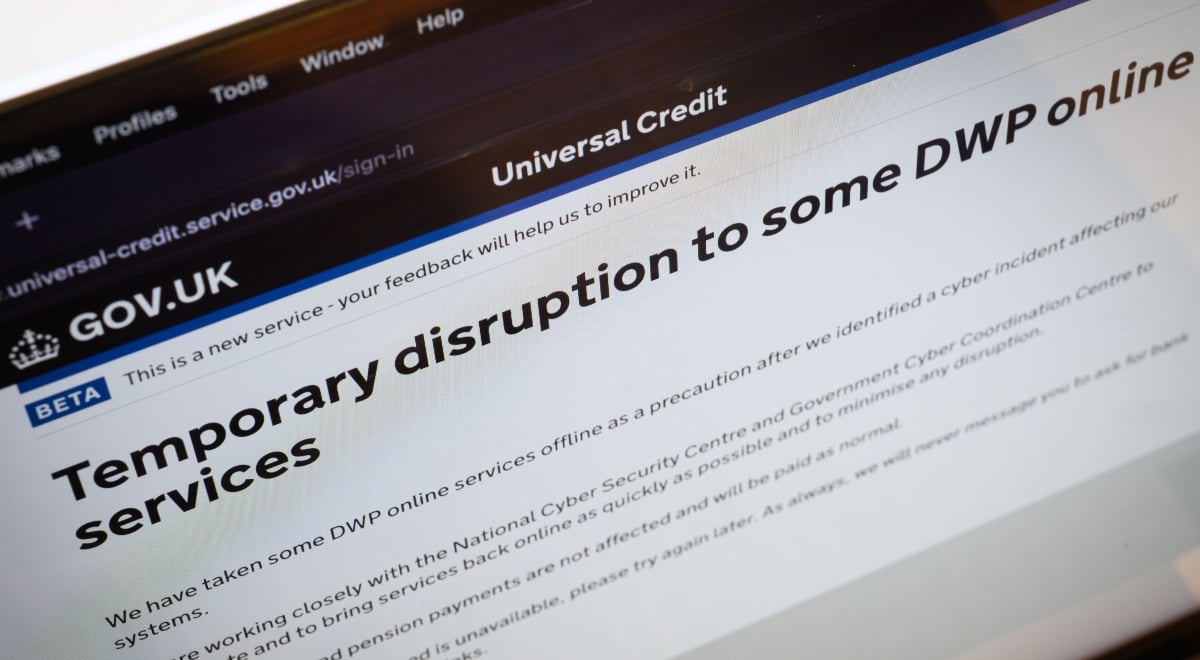
Some DWP services were taken offline By Getty Images.

 Follow us
- The DWP took benefits systems offline after a cyber incident, blocking new Universal Credit and PIP claims.
- Regular benefit and pension payments are still expected to continue as normal, the department said.
- Officials said the incident was not ransomware and did not involve money being moved.
- Cybersecurity experts warn scammers may exploit the disruption with phishing messages asking for bank details or suspicious links.
Key Takeaways by nexos.ai, reviewed by Cybernews staff.
The UK government’s benefits system was taken offline after the Department for Work and Pensions said it was hit by a cyber incident on Thursday night. No new claims for Universal Credit or Personal Independence Payment could be made on Friday. Cyber professionals are calling the incident “extremely concerning.”
The Department for Work and Pensions (DWP) said people would still receive their regular benefit and pension payments as normal and added it hoped to reinstate services soon. They were taken offline at 9 p.m. on Thursday as a “precaution.”
"We are working closely with the National Cyber Security Centre and Government Cyber Coordination Centre to investigate and to bring services back online as quickly as possible and to minimise any disruption," it said in a statement.
DWP did not disclose the nature of the activity, but it didn’t involve a “ransomware” attack or money being moved.





Regular benefit and pension payments are not affected and will be paid as normal,DWP said in a brief statement on its website.
According to reporting in The Times, the incident has also affected the “tell us once” government service, which is used to inform multiple government departments at the same time when someone dies.
Universal Credit and Personal Independence Payments are the two main sickness and disability benefits in the UK, so the episode is “extremely concerning” given the millions of vulnerable people who rely on DWP services, said Jamie Akhtar, CEO and co-founder of Cybersmart.
“The department also holds vast amounts of sensitive personal and financial information, making it a particularly concerning target,” Akhtar also pointed out, urging DWP claimants to remain vigilant against phishing emails or text messages attempting to exploit the disruption.


Stay updated with our latest stories and follow us on social media
Be the first to discover new stories, ideas, and updates from our team.
Scammers could typically request bank details or encourage people to click suspicious links. In its statement, DWP stressed it “will never message you to ask for bank details or ask you to click on links.”
More sensitive data than ever
Other cyber pros think the government is doing the right thing – which is taking platforms offline as a precaution. The move usually isolates systems and limits any further access.
“Even where ransomware and stolen funds are ruled out, investigators still need to verify that sensitive personal data has not been exposed,” said Dray Agha, senior manager of Tactical Response at cybersecurity firm Huntress.
Muhammad Yahya Patel, vCISO and cybersecurity advisor for EMEA at the same company, agreed: “Taking DWP’s benefits systems offline was the right call. Contain first, investigate second.
Has your password leaked?
However, Patel also cautioned: “The human consequence needs naming. Universal Credit and PIP aren’t convenience services. They’re the financial lifeline for millions of the most vulnerable people in the country.”
Every hour those systems are down has real consequences for people who cannot afford to wait. The technical response has been handled correctly. The communications response to claimants needs to match it,said Muhammad Yahya Patel, vCISO and cybersecurity advisor for EMEA at Huntress.
British companies and institutions have been increasingly targeted by aggressive, regular cyberattacks in recent years, with some suffering months of disruption, including the British Library, a blood testing service, the London Underground, Marks & Spencer, the Co-op, and Jaguar Land Rover.
The incident at DWP could be especially significant because the department currently holds more sensitive data than at almost any point in its history, following the expansion of digital benefit administration and the migration of records from legacy systems, Patel said.
“That data estate, combined with the vulnerability profile that government legacy infrastructure consistently carries, makes the DWP a high-value target,” he added.