Hackers leak Visa cardholders' data after company confirms cyber incident
Earlier this week, Visa confirmed it was aware of the claims and pointed to a third-party attack.
Cybernews / Shutterstock image rakibhbrand / Lummi image Nika)

 Follow us
- Hackers leaked data tied to Visa premium dining and loyalty programs in Asia-Pacific.
- Cybernews researchers found more than 6,000 premium Visa customers affected by the exposed dataset.
- Visa said no card numbers or payment data were affected in the third-party incident.
- The exposed details could help attackers target wealthy cardholders with phishing and social engineering.
Key Takeaways by nexos.ai, reviewed by Cybernews staff.
A list of Visa’s luxury cardholders just went public, as hackers claim millions of premium card interactions.
If you booked a restaurant through Visa, hackers may know what you ate, where, and when.This week, hackers targeted Visa, a global digital payments technology company that processes hundreds of billions of transactions around the globe every year.
A ransomware gang named n0n has claimed that over 1.5 million cardholders' interactions linked to loyalty programs have been leaked. Visa has previously confirmed to Cybernews a cyber incident involving a third party.
Attackers revealed a stolen dataset today, suggesting that extortion negotiations with the company may have failed.


Our research team has examined the exposed data and found that over 6,000 premium Visa customers have been affected by the data breach.
Visa said no card numbers or payment data were affected. However, the exposed personal data, such as the dining habits and travel patterns of wealthy cardholders, is a goldmine for targeted phishing and social engineering attacks.
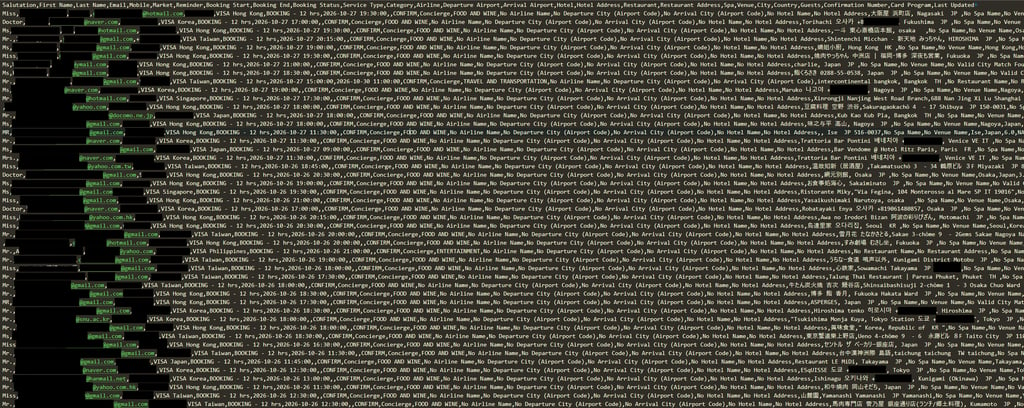
What Visa customer data was exposed?
- Names
- Email addresses
- Phone numbers
- Messaging apps used
- Booking details, including dates and addresses
Visa loyalty programs have been targeted
Visa runs a range of loyalty and lifestyle programs for holders of its premium bank cards, including Visa Infinite and Visa Reserve.
These programs give eligible customers access to restaurant reservations, dining discounts, exclusive culinary events, and concierge services.
The leaked data almost certainly came from one such marketing platform that tracks engagement with Visa's premium dining programs in Asia-Pacific.
Visa uses email campaigns to promote offers and reach cardholders in individual markets. It is likely that hackers attacked the CRM or email marketing infrastructure.
The exfiltrated data includes a file called “campaign_directory.csv”. There are rows named “campaign name,” “event count,” “first seen,” and “last seen.” Additionally, campaigns repeat by month and by product.
Files mention “Visa LTE,” “Visa Elite Dining,” “Visa Dining Reminder,” “Elite Dining,” and “Dining Reminder.”The leaked records also point to South Korea, India, Singapore, Malaysia, the Philippines, Australia, Thailand, and Vietnam.
Across Asia-Pacific, Visa operates several loyalty programs, including “Elite Dining”, “Infinite Tastes: Beyond the Menu”, and “Dine and Save.”


Stay updated with our latest stories and follow us on social media
Be the first to discover new stories, ideas, and updates from our team.
What do we know about n0n?
The gang is relatively new to the ransomware scene, having caught the attention of the cybersecurity community in mid-September.
Cybersecurity firm SOCRadar found that n0n’s Python file server, associated with a location in Sweden, was left exposed on the open internet. The attackers heavily rely on AI tools to conduct hacking tasks.
The findings show that n0n invested in generative AI to assist in building common scripts for scanning and reconnaissance activities.
The gang has already listed a handful of high-profile victims, including Samsung, Mastercard, Walmart, JPMorgan, and Starbucks. Recently, the gang also leaked over 500MB of Expedia customer data.