Google Project Genie review 2026: testing AI-generated game worlds
Being behind major reports like The Mother of All Breaches and RockYou2024, our in-house cybersecurity experts and journalists provide unbiased, real-world testing and in-depth analysis.
We maintain complete transparency by openly sharing our testing methodologies with our audience.
Learn more

I’ve joined forces with the Cybernews research team to test Google’s latest AI experiment – Project Genie. This innovative research project aims to generate interactive 2D platformer games directly from images or text prompts.
For this Project Genie Review, we analyzed available demos, technical papers, and expert discussions to assess its practicality and future potential, and to determine how close Project Genie is to real-world readiness and developer usability.
Overview
- Best for: rapid prototyping of interactive 2D environments from text or image prompts
- Great for: AI agent training, research experiments, and early-stage creative exploration
- Not ideal for: commercial game production or simulations requiring precise, physics-accurate control
Suggested rating: 4.2
What is Google Project Genie, exactly?
Project Genie is an experimental interactive AI tool developed by Google and powered by Genie 3, a foundation world model created at Google DeepMind. Initially announced in August 2025 and launched publicly in January 2026, it emerged from DeepMind’s broader effort to advance AGI through dynamic, simulated environments.
Instead of functioning as a traditional game engine, Genie 3 learned how worlds behave by training on over 30,000 hours of gameplay footage. The result is a system that can generate and animate responsive 3D environments from simple text, image, or sketch inputs.
Unlike video generation models, such as Google Veo or OpenAI Sora, which produce fixed, watch-only clips, Project Genie creates interactive environments that evolve based on user actions. When you move, jump, or alter the camera, Genie 3 predicts what happens next in real time, offering an entirely new way to create and explore AI-generated worlds.
How Project Genie works (simplified explanation)
At its core, Project Genie works by teaching an AI model to understand how worlds behave, rather than by programming specific game rules. The foundation model, Genie 3, was trained on tens of thousands of hours of gameplay videos. By studying these diverse examples, it learned the visual logic and physics that make interactive worlds believable – how characters move, how objects respond to forces, and how environments update with each new frame.
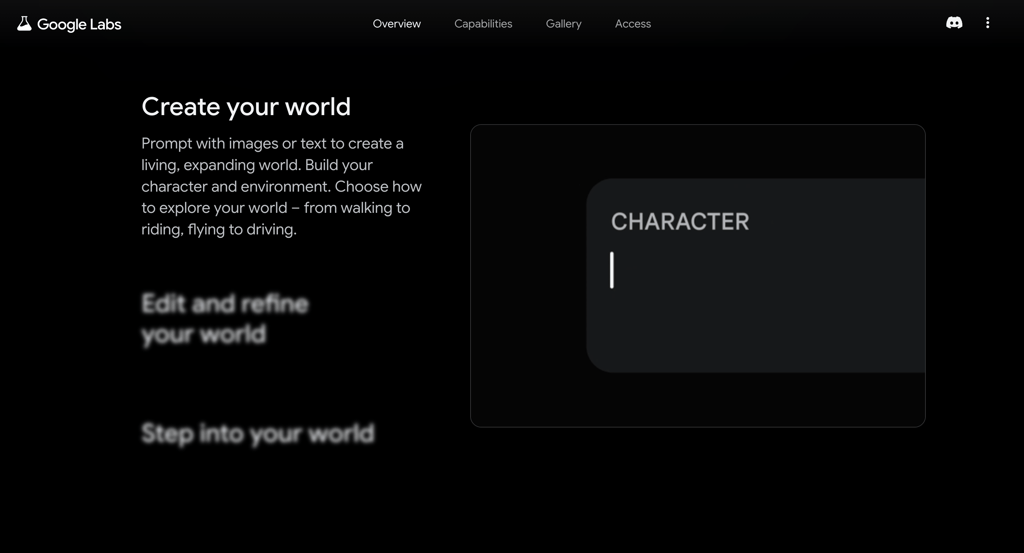
When you use Project Genie, you don’t need to build a game from scratch. Instead, you describe or sketch an idea, and Genie translates it into a dynamic, playable space through a trio of tools: World Sketching, World Exploration, and World Remixing. During exploration, the system predicts what should happen next in real time, generating terrain, animations, and lighting based on your actions. This interactivity comes from continuous frame prediction, meaning the world evolves as you move, rather than following a pre-set sequence.
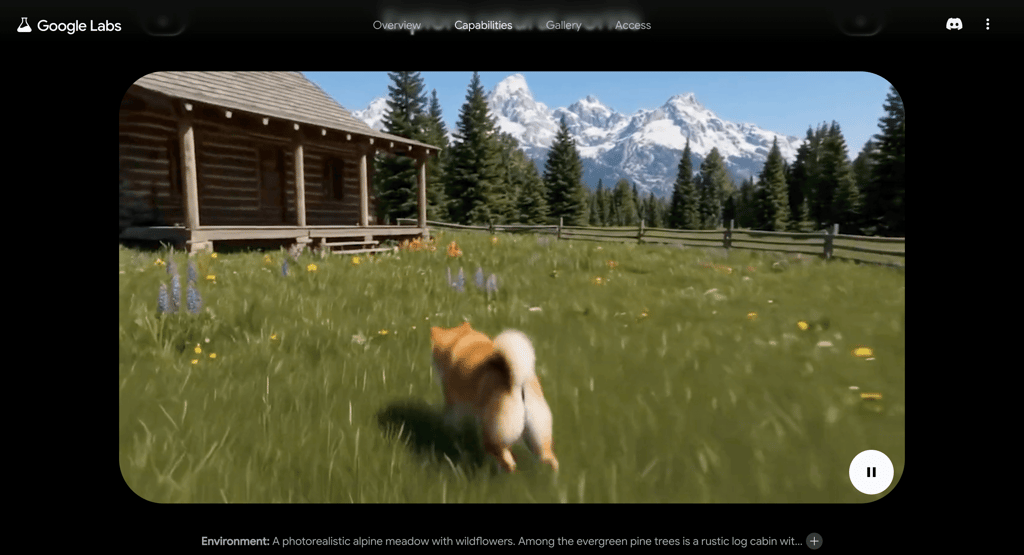
Thanks to components like Nano Banana Pro for physics simulation and Gemini for multimodal understanding, Genie integrates motion, texture, and context into one smooth experience. The result is a living environment that feels less like a video and more like stepping into your own AI-created world.
What makes Project Genie different from other AI creative tools
Project Genie redefines AI creativity by shifting from passive generation to interactive world creation. Instead of producing static videos or images, it builds dynamic spaces that respond to users in real time. The key distinctions include:
- Interactive vs passive output. Most AI systems – like OpenAI Sora or Google Veo 3 – focus on passive content, producing visually rich but predetermined videos. Once they start playing, users can’t influence the result. Genie, by contrast, generates interactive environments that respond to what you do. Every movement, jump, or camera adjustment triggers new frame predictions, allowing real-time participation rather than simple observation.
- Real-time responsiveness. Powered by Genie 3, it runs at around 20–24 frames per second in 720p. It continuously predicts future frames based on player behavior and the environment’s evolving context, creating a game-like experience within an AI framework.
- Autonomous environment construction. Unlike procedural generation, which assembles pre-defined assets and follows static rules, Genie generates everything dynamically – textures, shapes, physics, and even unseen terrain. Turn a corner, and the world materializes from scratch.
Compared with other creative tools, Project Genie stands out as a general-purpose, AI-driven world model capable of weaving cohesive, explorable spaces. Here’s a quick comparison.
| Tool | Output type | Interactivity | Generation method | Key limitation |
| Project Genie | Interactive 3D worlds | Full control | AI frame prediction | Session length and resolution |
| OpenAI Sora/Google Veo 3 | Video clips | None | Text-to-video generation | Non-interactive |
| Luma Genie | 3D models | None | Asset generation | No world-building |
| Oasis | AI game sandbox | Limited | Procedural + AI | Narrow scope |
As such, Project Genie isn’t just a tool to watch – it’s a world to use, marking a key step toward AI-driven, fully interactive experiences.
What Project Genie can realistically do today
Right now, Project Genie remains more of a research prototype than a full-fledged creative suite. Despite its impressive promise, its current capabilities are confined to relatively simple 2D-style environments, not full 3D worlds or complex game-level structures. Each generation session lasts only about 60 seconds, meaning you can explore briefly before the simulation resets. This short “interaction horizon” makes it better suited for demonstrations and experiments than for producing playable experiences.
Interactivity is limited as well. Movement and camera control work smoothly in short bursts, but the range of actions is still narrow – players can move and look around, yet can’t perform intricate maneuvers or manipulate objects freely. I also found that early testers have reported noticeable input latency – a delay between pressing a control and seeing the corresponding on-screen response, which can disrupt the immersive flow.
From an access standpoint, Project Genie is region-locked to US-based Google AI Ultra subscribers who are 18 years or older and using personal Google accounts. There’s currently no commercial or developer API available, nor any export option for integrating generated environments elsewhere.
In short, Genie’s potential is clear, but for now, it remains a fascinating glimpse into what generative world models might one day achieve, rather than a consumer-ready tool.
Potential use cases: who could benefit if it matures?
If Project Genie develops further, I can see it becoming an incredibly versatile tool across creative, research, and educational fields.
For one, indie developers could use Genie for rapid prototyping – sketching or describing a level and seeing it come to life without touching code or assets. It makes early experimentation feel intuitive and fast, perfect for exploring gameplay concepts.
From a research standpoint, our team and I noticed strong potential for AI training and simulation. Since Project Genie can produce countless unique, interactive worlds with consistent physics, it could become a valuable tool for reinforcement learning, simulation, and reasoning experiments. Game designers and visual artists could also use Genie for AI-assisted level design, sketching environments that evolve and adapt in real time, inspiring creative directions that manual design might not reveal.
Beyond development, educators and students in computer science, design, or even physics could use Genie as an interactive learning platform. It can show how AI understands motion, cause and effect, and environmental logic – making abstract concepts tangible and engaging.
Finally, simulation and testing teams could use future iterations for safe, rapid scenario modeling. While it’s not there yet, if extended to 3D physics and longer sessions, I can see Genie one day serving as an accessible sandbox engine for experimenting, learning, or creating interactive worlds from pure imagination.
What is the pricing?
At the moment, Project Genie isn’t a commercial product – it’s still classified as an experimental research prototype within Google’s ecosystem. There’s no standalone pricing or public API access, and the system isn’t available through the regular Google Workspace or developer tool lineup. Instead, access is restricted to Google AI Ultra subscribers in the United States, who effectively fund Genie’s compute-heavy research through their subscription tier.
The Google AI Ultra plan currently costs $249.99/month, though Google periodically offers a discounted rate of $124.99/month. This price reflects the enormous computational demand required to render interactive environments in real time at 20–24 frames per second.
If Project Genie eventually moves beyond the research phase, it could emerge either as a separate creative platform or a premium add-on for game design, simulation, or AI development workflows.
Final verdict
Project Genie is one of the most exciting – but also most limited – AI experiments you can try right now. It delivers a genuine breakthrough: controllable 3D worlds at 720p and around 24FPS from simple prompts, with physics, consistent layouts, and even promptable events like weather changes. However, 60‑second sessions, US-only availability, input latency, and the steep Google AI Ultra price tag make it hard to justify purely for casual creativity today.
In my view, its current impact is mostly experimental: it’s a preview of how generative “world models” could reshape game prototyping, simulation, and AI research in the next few years. Google has signaled plans for a phased expansion, so a broader commercial rollout is likely, but the timing and pricing remain unclear.
If you’re an early adopter or researcher with a real use for cutting‑edge interactive environments, it’s worth exploring. However, everyone else should watch its progress with measured expectations.
FAQ
What is Google Project Genie?
Google Project Genie is an experimental AI tool from Google DeepMind that turns text, images, or sketches into short, playable 2D-style platformer environments. It’s powered by the Genie 3 world model, which predicts how the world should evolve frame by frame in real time based on your actions.
Can Project Genie generate full games?
No, Project Genie cannot yet generate full games. It creates brief, sandbox-like interactive environments with simple movement and camera control, limited to short sessions. You don’t get full game systems like progression, complex mechanics, narrative structure, or production-ready assets suitable for commercial release.
Is Project Genie publicly available?
Yes, but it’s only available in a limited research-style preview. Access is restricted to users who meet specific criteria, including location and subscription tier. There’s no standalone app, open developer API, or broadly accessible consumer version that regular players or small studios can freely use yet.
Will Project Genie replace game developers?
No, Project Genie is far more likely to assist developers than replace them. It can speed up ideation, prototyping, and experimentation, but it doesn’t handle full game design, storytelling, UX, monetization, or polish. Human creativity, taste, and problem-solving remain essential for shipping successful, commercially viable games.