How Do AI Detectors Work: Comparing AI and Human-Written Content
Being behind major reports like The Mother of All Breaches and RockYou2024, our in-house cybersecurity experts and journalists provide unbiased, real-world testing and in-depth analysis.
We maintain complete transparency by openly sharing our testing methodologies with our audience.
Learn more

Time and efficiency are becoming the most valuable resources, and with that, AI content – produced in seconds – is everywhere. Some warn about plagiarism risks, others raise concerns about authenticity and academic integrity, but none of that has slowed down the rise of AI in writing tasks. That’s where AI detectors step in: tools designed to tell human writing apart from machine-generated text, though their accuracy isn’t always guaranteed.
In this article, I want to dig deeper into how AI detectors work, the technology behind them, and just how reliable they are. I start with the basic definition and then move to real-world tests to see whether we can genuinely trust their verdicts.
AI detectors: definition
AI detectors are tools built to sniff out text likely generated by artificial intelligence. They can be applied for different purposes: educators use them to catch AI-assisted assignments, publishers and platforms rely on them to ensure content authenticity, and SEO or content teams leverage them to maintain quality and search credibility.
Of course, these tools have limits. They don’t check for truth, accuracy, or creativity, and they can mislabel carefully written human content as AI – or miss AI content that’s been polished. In short, AI detectors flag patterns, not facts, meaning, or style.
How does AI detection work
AI detectors don’t read the text the way we, humans, do. Instead, they analyze patterns and statistical markets to estimate whether content is likely crafted by a human or a machine. While every tool is slightly different, most detection systems rely on a few core principles: sentence structure, repetition, metadata traces, and comparison with known AI outputs.
To see how AI-generated and human-written texts differ in these principles, I put ChatGPT and myself to the test. For each case, I wrote a version of the text and then asked the AI model to produce its own take on the same idea. Here’s how it went.
Sentence structure and predictability
AI models, especially older ones, often produce text with similar sentence lengths and predictable structures. Sometimes, this quality is called low burstiness. Human writing, in contrast, is more chaotic – with a mix of long, complex sentences and short, punchy ones. This varied sentence structure and rhythm have high burstiness. For better visualization, you can look at two examples. Here, the same paragraph is produced in two ways: one is written by me, a human, and the other is generated by AI:
Human-written: “There's a reason why Paris is always at the top of the list of most visited cities in the world. It's a place where you can leave early in the morning, spend all day discovering unique little streets, and then stumble home because your feet "just can't" anymore. The food is rich and delicious, so make sure to wear those stretchy pants so you have nothing holding you back.”
AI-generated: “The city of Paris is the capital of France. It is famous for its beautiful architecture. The Eiffel Tower is a major landmark. Many tourists visit Paris every year. They enjoy the museums and the cafes.”
It's clear from this example that AI-generated simple text has similar sentence lengths, while my writing has a more varied structure, with shorter and longer sentences.
Repetition and uniformity
AIs tend to overuse specific keywords or phrases and maintain a perfectly consistent tone, which isn’t very common for humans. We naturally use a wider range of vocabulary and synonyms to enrich our language. Sometimes, our tone might even slightly shift while writing a piece. Here’s another example showing how human-written and AI-generated texts differ in this aspect:
Human-written: “Learning to code can develop problem-solving and critical thinking abilities, which are highly sought after in today's job market. When you learn to code, you cultivate a logical and analytical mindset that helps you break down complex problems into smaller, manageable parts. This approach can be applied to any job, enabling you to identify patterns, devise innovative solutions, and make data-driven decisions.”
AI-generated: “Learning coding is important because coding helps people learn problem-solving, and learning problem-solving with coding is one of the best ways to learn problem-solving. Coding is useful to learn because coding is simple to start and coding is powerful to apply. Many people choose coding to start learning skills because coding makes learning skills easier, and coding is useful for skills in many areas where coding is applied.”
This example illustrates how AI fixates on specific phrases like problem-solving and learning skills. My writing presented the same idea with a wide range of phrases.
Metadata traces
AI systems often leave digital footprints during content creation that aren’t visible in the final text. Detectors can analyze these traces – or the lack of them – most commonly in document files rather than plain text blocks. This is how human vs AI writing testing results compare:
Human-written: “A document created by a person carries an editing history. A file's metadata might show the author's name, the software version used, and a log of creation and modification dates. An analysis might reveal text copied from a web browser, different sections written days apart, or comments and revisions from collaborators. These digital artifacts create a story of human interaction that is completely missing from a text generated instantly by an AI.”
AI-generated: “There are no direct "metadata traces" to show in a block of text itself. The key indicator is the absence of human metadata. An AI generates text in a single, continuous process. There are no drafts, no "Track Changes" history in a Word document, no evidence of text being copied and pasted from different sources, and no record of multiple editing sessions over time. Some platforms are also developing invisible watermarks, embedding subtle patterns in word choice or punctuation that are statistically identifiable as AI-generated.”
In short, human writing often carries a digital paper trail, while AI text typically appears spotless. This absence of metadata can be just as telling as its presence.
Comparison with known AI outputs
AI detectors are trained on massive databases, which carry both human and AI text models. They learn to recognize the characteristic patterns, styles, and tells of specific LLMs. Here’s how a human and AI compare in this regard:
Human written: “Our solar system is a wondrous place. Countless worlds lie spread across billions of kilometers of space, each dragged around the galaxy by our Sun like an elaborate clockwork. The smaller, inner planets are rocky, and at least one has life on it. The giant outer planets are shrouded in gas and ice; miniature solar systems in their own right that boast intricate rings and moons.”
AI-generated: “In conclusion, the solar system is a fascinating and complex system. It is composed of the Sun, eight planets, numerous moons, and countless asteroids and comets. Each celestial body plays a unique role in the intricate dance of the cosmos. Further research is needed to fully understand all its mysteries.”
All in all, the AI’s conclusion clearly states that it’s machine-made: formal, balanced, and just overall generic. Phrases like “fascinating and complex system” and “intricate dance of the cosmos” are classic AI giveaways. Human writing, on the other hand, feels more informal and personal, with a distinct voice that’s harder for detectors to pin to a known AI pattern.
Perplexity and burstiness
AI detectors also often rely on two key metrics – perplexity and burstiness – to determine whether a piece of text is likely machine-generated. They analyze both how predictable the language is and how much variation there is in sentence structure and style:
- Perplexity. It measures how predictable a piece of text is. Low perplexity means the text follows standard patterns, which is common in AI-generated writing. High perplexity signals more variation, like human creativity or unpredictability.
- Burstiness. It looks at variation in sentence length and structure. Humans naturally mix short, long, and fragmented sentences, while AI tends to produce uniform, evenly structured text.
In the table below, you can compare how writing can sound more robotic or more human based on perplexity and burstiness:
| Metric | Low (AI-like) example | High (human-like) example |
| Perplexity | “The cat sat on the mat. The dog lay on the rug. The bird was in the cage.” | “The cat sprawled lazily across the mat while the dog, bored out of its mind, circled the rug before collapsing.” |
| Burstiness | “AI tools are useful. They save time. They increase efficiency. Many people use them.” | “AI tools are useful for all sorts of reasons – they save time, boost efficiency, and, honestly, they’ve become a must-have for anyone trying to stay ahead.” |
Limitations of AI content checkers
AI content checkers seem impressive in theory, but in practice, they’re not perfect. There are actually a few key issues why you should trust their judgement with a grain of salt:
- False positives: human-written text can be mistakenly flagged as AI-generated, especially formal or structured writing like academic papers or business reports
- False negatives: AI-generated content may slip through undetected, particularly if it’s lightly edited or rephrased
- Bias in detection: tools trained on limited datasets can misjudge certain writing styles, dialects, or non-English content, flagging some legitimate work while missing others
- Difficulty detecting advanced AI models: newer AI systems produce highly varied, natural-sounding text that mimics human quirks, making detection less effective
In short, these tools can offer a rough estimate, but they can’t completely verify authorship or authenticity. Relying solely on them can be misleading and even risky.
Popular AI detection tools compared
Every AI detector promises accuracy, but not all of them deliver. Here’s how the most popular tools performed when I put them to the test. We also covered an in-depth AI detectors review if you’d like to learn more about these content checkers.
1. Humalingo – fast and reliable AI content detector

| Starting price: | From $9.99/month |
| Free version: | ✅ Yes |
| Top features: | Sentence-level analysis, specialized scanning modes, simplistic dashboard |
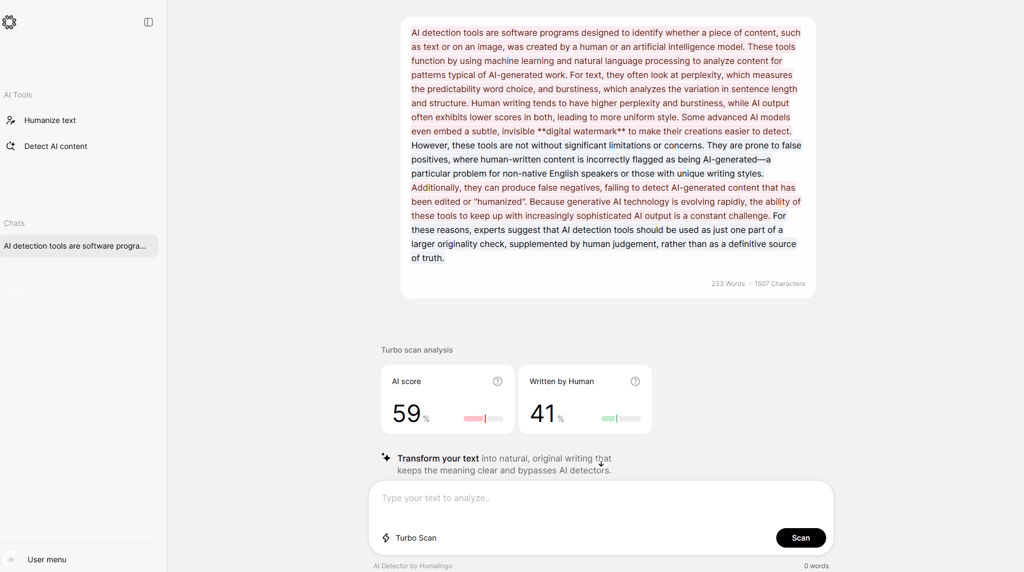
Humalingo is the best tool I’ve tested. It’s easy to navigate, while it performs AI detection incredibly fast. It also impressed me with the results – it was really close to the accuracy of the text composition I used to test it.
During my test, Humalingo flagged a technically written sample with an AI score of 59%. It marked all sentences that showed signs of AI-generated writing. The result suggests that the tool can detect structured, formal patterns often associated with AI writing, but may overestimate AI involvement in more complex or technical content. While not the most precise detector on the market, it still provides a solid baseline for quick evaluations.
2. QuillBot – most accurate AI content checker

| Starting price: | From $8.33/month |
| Free version: | ✅ Yes |
| Top features: | AI-powered text analysis, continuously updated dataset, suspicious text highlighting |
Out of all the tools I tested, QuillBot proved to be the most accurate. It looks at signals like perplexity (how predictable the text is), burstiness (how much sentence length varies), and structural tells such as repetition, generic language, and flat tone.
This particular test flagged the AI-generated sample as 38% machine-written, which made sense given the textbook-like phrasing and technical definitions I fed it. Another section got flagged for its overly formal, neatly structured tone – exactly what gives away AI writing.
Even though QuillBot didn’t hit a perfect score here, it had performed flawlessly in our previous QuillBot testing. The difference could be due to the AI model used in this sample, which produced slightly more varied and human-like phrasing, making detection trickier. Compared to other detectors, QuillBot still felt sharper at spotting subtle machine patterns without overreacting to human quirks.

3. Copyleaks – advanced AI content verification tool

| Starting price: | From $13.99/month |
| Free version: | ✅ Yes |
| Top features: | AI insights, source code detection, LMS and API integrations |
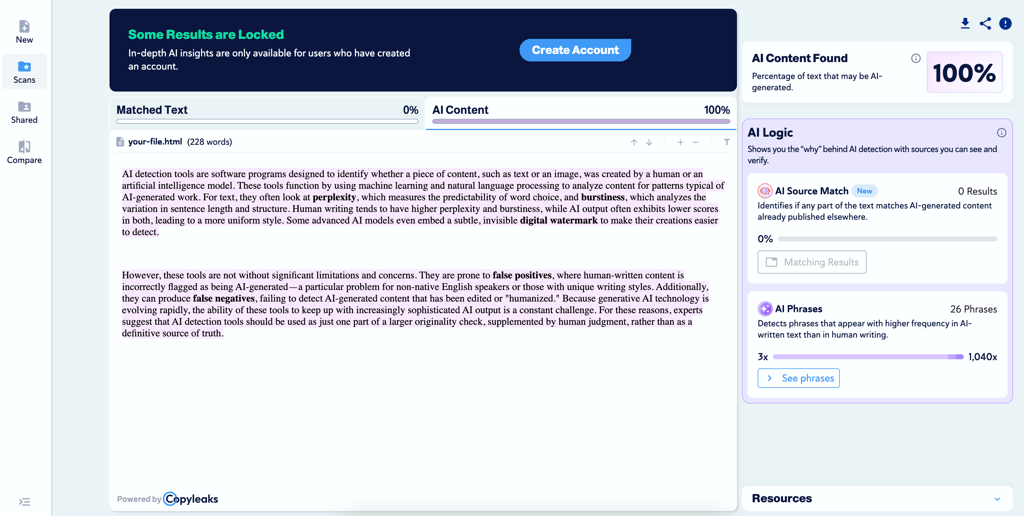
I also tested Copyleaks, a smart AI tool for content verification that impressed me with its thoroughness. While the company doesn’t reveal the exact detection methods, it’s clear that the engine is trained on massive amounts of user-submitted text and other sources, picking up language patterns typical of AI-generated content. The tool uses a heatmap analysis, highlighting phrases that appear more frequently in its internal AI dataset.
During testing, it flagged technical explanatory sentences, especially those discussing perplexity, burstiness, and false positives. These kinds of sentences are distinctive to AI writing. To me, Copyleaks felt precise, breaking down problem areas visually so you can see exactly why certain sections raised red flags. Although it performed flawlessly in my recent testing, it didn’t perform as well in our previous Copyleaks tests, which is why I gave it second place.
4. Undetectable AI – AI detector for multi-detector analysis

| Starting price: | From $5.00/month |
| Free version: | ✅ Yes |
| Top features: | Multi-detector comparison, real-time AI analysis, detailed probability scoring, support for 50+ languages |
Undetectable AI is a tool designed specifically for multi-detector analysis. It combines several free and paid AI detection engines, expanding its ability to catch machine-written text. According to the platform, it’s powered by TruthScan, which looks at linguistic patterns, writing styles, and statistical markers, which are basically the fingerprints of AI-generated content.
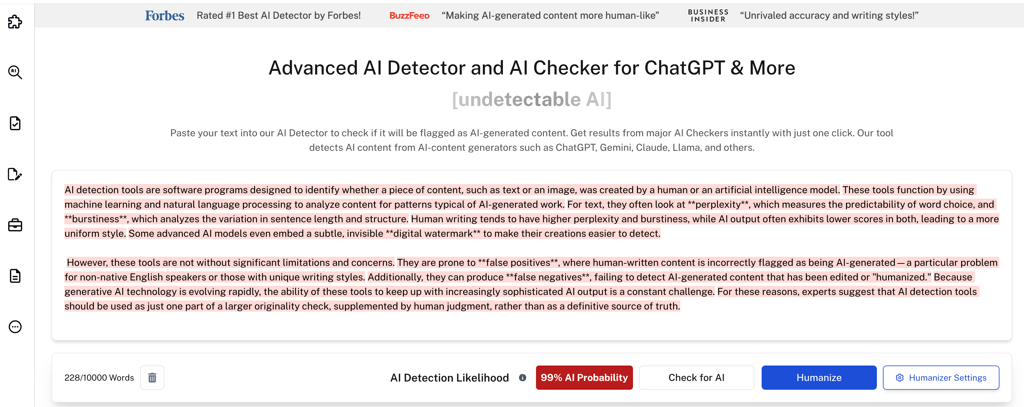
In my testing, Undetectable AI flagged everything as AI-written, which was both impressive and a bit frustrating. Unfortunately, the platform doesn’t reveal exactly how its algorithms reach these conclusions, so I can’t dig deeper into the specifics. Still, if you want a tool that casts the widest net across multiple detectors, this one is worth a look. You can also read about this AI tool in our in-depth Undetectable AI review.
5. GPTZero – AI content checker with detailed insights

| Starting price: | From $8.33/month |
| Free version: | ✅ Yes |
| Top features: | Multi-detector comparison, advanced AI scans, numerous integrations |
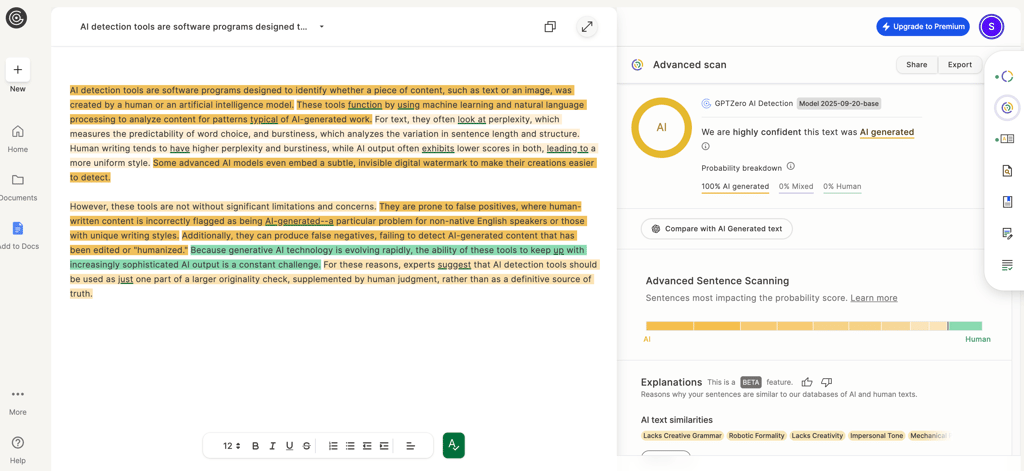
What I like about GPTZero is that it delivers detailed insights into why it flags text as machine-generated. The platform uses a proprietary detection model that evaluates hundreds of factors when analyzing content.
When I tested it, GPTZero highlighted the classic signs of AI writing like robotic formality, an impersonal tone, and a noticeable lack of creativity. The text felt like a mix of a textbook and a scientific paper. That’s not surprising considering that those are exactly the kinds of sources AI models often train on. You can also delve a little deeper into this AI tool in our full GPTZero review.
6. Ahrefs’ AI Content Detector – AI detector built for SEO professionals

| Starting price: | From $119.00/month |
| Free version: | ✅ Yes |
| Top features: | SEO-aligned context, integrated with Ahrefs Site Explorer |
Ahrefs’ AI Content Detector is a tool that is built for SEO professionals. It scans text for AI-generated patterns and can automatically rewrite sections to sound more human. From what I found, the detector relies on a language model trained on vast amounts of text to spot patterns in grammar, vocabulary, and style.
While the tool doesn’t explain which parts triggered AI flags, I analyzed the rewritten text myself. The original was flagged for being highly formal, structured, and low in burstiness and perplexity. The rewritten version loosened up the phrasing, broke up sentences, and added varied verbs, making it feel more human and easier to read.

7. Winston AI – AI detector with content certification

| Starting price: | From $10.00/month |
| Free version: | ❌ No |
| Top features: | HUMN-1 certification, API integration, advanced AI, plagiarism detection |
Winston A comes with content certification for added credibility. The tool uses linguistic analysis to check meaning and repetitiveness. It also compares text against known AI-generated samples. These fall under standard perplexity and burstiness checks.
In my test, Winston flagged all content as 100% AI-generated. However, it didn’t explain which sections triggered the detection, so I couldn’t draw meaningful insights from the results. Still, the certification feature could be useful for verifying content authenticity in clearer cases. If you’d like to learn more about this tool, you can also take a look at our Winston AI review.
8. Grammarly – AI detection solution with built-in writing tools

| Starting price: | From $12.00/month |
| Free version: | ✅ Yes |
| Top features: | AI percentage scoring, citation formatting, integrated grammar tools |
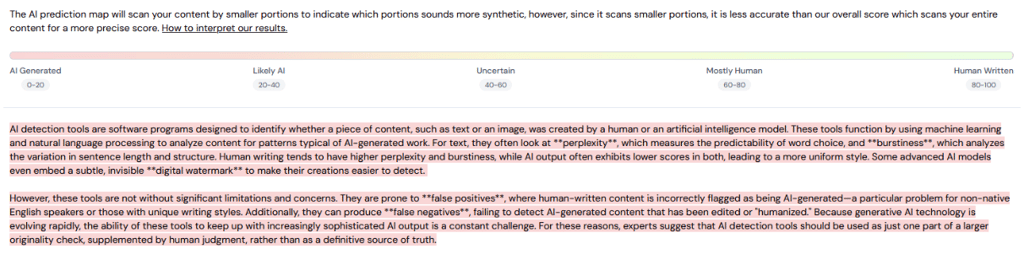
Grammarly has an AI detection solution, including built-in writing tools. The platform relies on a model trained on massive amounts of human and AI-generated text. It breaks content into smaller sections and analyzes each for patterns typical of AI.
During my testing, it flagged two sections as AI-written. The first had precise, academic language and technical explanations – textbook-style phrasing common in AI training data. The second was slightly repetitive and predictable, which likely triggered lower perplexity scores. Overall, Grammarly’s approach felt intuitive, combining detection with editing tools to help polish content while spotting machine-generated signals. For a more detailed analysis, you can check out our Grammarly review.

How to write to avoid AI detection
As you already know, AI content checkers can be useful, but you can’t trust them blindly. Understanding how to approach their use and how to craft content that avoids false flags is key for different professionals working with content creation.
For content creators:
- Vary your voice and style. Mix sentence lengths, tones, and structures to mimic natural human writing. Avoid overly formal or repetitive phrasing that resembles AI patterns.
- Use original examples and anecdotes. Personal insights, stories, or case studies make text distinct and harder to classify as AI.
- Cite sources and references naturally. Adding real citations or linking to credible research reinforces human authorship.
- Edit strategically. Small revisions, rewording, and intentional stylistic quirks reduce the predictability that detectors look for.
For educators and institutions:
- Interpret results carefully. Detection scores are probabilistic, not definitive proof of AI use.
- Avoid over-reliance. Use checkers as one of multiple indicators, alongside teacher knowledge, writing style familiarity, and assessment context.
- Promote transparency. Encourage students to disclose AI assistance where appropriate, fostering trust instead of punishment.
For companies and publishers:
- Develop clear policies. Define acceptable AI use in content creation and set guidelines for editing, attribution, and review.
- Balance detector scores with performance metrics. SEO, engagement, and audience feedback are as important as AI detection results.
- Regularly review tools and processes. Advanced AI models evolve quickly, so monitoring and updating detection and editorial standards is essential.
Conclusion
AI detection tools are improving fast, but none are perfect. Some, like QuillBot and Copyleaks, provide detailed insights into their evaluations, while others, like Undetectable AI or Winston AI, cast a wider net but offer less transparency. And factors like perplexity, burstiness, sentence structure, and tone all play a role, yet false positives and false negatives are still common.
The key takeaway is to use these tools as guides, not verdicts. Always think critically when interpreting results, and focus on originality and authenticity in your content. After all, no AI detector can replace thoughtful, human-driven writing.
FAQ
Are AI checker tools always accurate?
No, AI checker tools are far from foolproof. While they can flag suspicious patterns, they often misclassify human writing as machine-generated and miss AI-produced text that’s been lightly edited. This makes them unreliable as definitive proof.
How to humanize content to avoid AI detector flagging?
Focus on adding natural variability. You can use idioms, personal insights, and varied sentence lengths to mimic authentic human writing. Also, inject subtle errors or unique stylistic choices that AI rarely replicates to add a more human feel to the text.
Should I always check content with an AI detection tool?
No, AI detection tools are helpful as a rough check, but shouldn't be relied on entirely. That's because they can produce false positives or miss sophisticated AI-generated content. Instead, use them as one layer of review alongside human editing and critical evaluation.