Regret in the making: how we deploy disruptive technology in war
We’ve become so inclusive that we tolerate stupidity, perversion, and laziness, not knowing what is and what’s not in vogue these days. Some are brave enough to draw the line between what’s no longer acceptable, risking being seen as old-fashioned or even extremist.
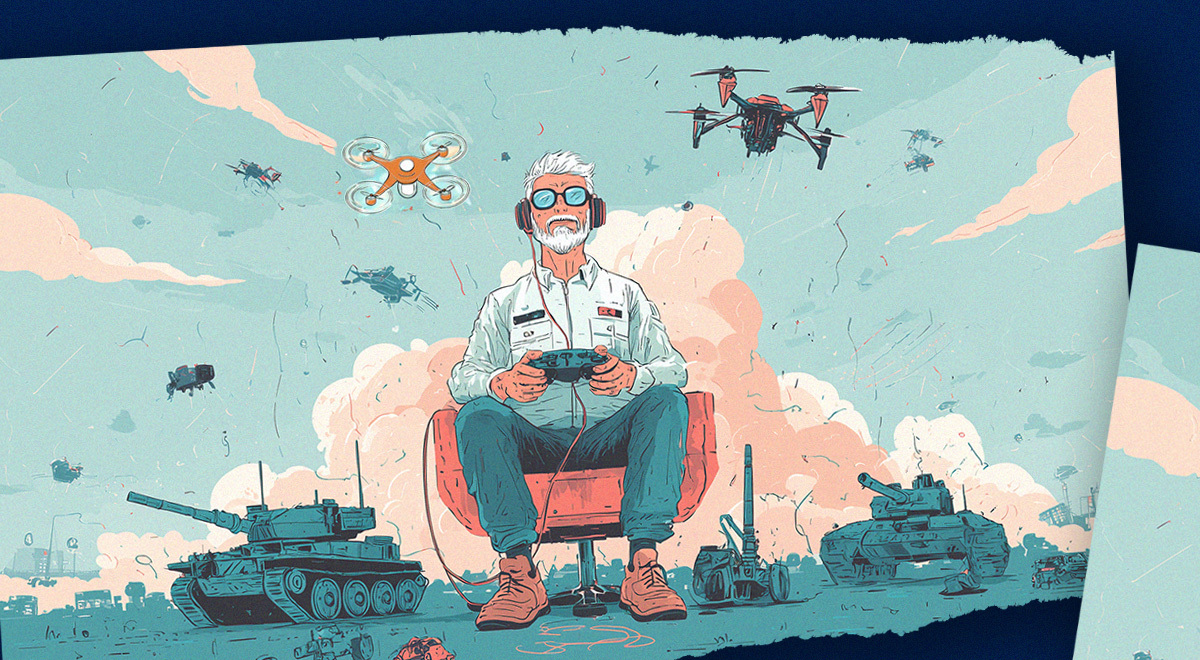
Image by Cybernews.

 Follow us
We’ve become so inclusive that we tolerate stupidity, perversion, and laziness, not knowing what is and what’s not in vogue these days. Some are brave enough to draw the line between what’s no longer acceptable, risking being seen as old-fashioned or even extremist.
In more extreme cases, people are spending thousands of dollars on their AI girlfriends, claiming, among other benefits, that they’re simply cheaper than taking a real person on a date.
There’s already a term, although not widely recognized – wiresexuals. Should they be recognized as a part of LGBT+? Is it a queer identity or is it something that could be controlled, like, let’s say, addiction to gaming?

As opposed to digisexual, a term coined in 2017 that refers to a technology-mediated connection, wiresexuality doesn’t require any human contact at all. Psychological problems aside, wiresexuality also raises privacy concerns and gives shady businesses an opportunity to manipulate their users, much like in Black Mirror’s Common People.






Do we call it out here, or do we loosen up a bit?
Follow us on LinkedIn to unlock the conversation
My friend used to complain that his daughter no longer speaks proper Lithuanian since she lives in the States and doesn’t really need the language. I would just shrug, thinking that as long as we understand each other, it doesn’t matter which language we speak.
But I’ve changed my mind. I often get “vogue” messages from professionals in the field of communications that have missing punctuation, are full of borrowed words that could easily be translated, and contain many misused terms.
There might be a genius buried beneath that poor language. However, we’re approaching a tipping point: we no longer understand each other because we lack a common language for communication and a shared ethical or moral foundation.

But it’s okay to take our sweet time figuring this out. There are more pressing issues where drawing a line is absolutely necessary, as human life is at stake.
I’m talking about how we deploy disruptive technology such as AI in war. The Pentagon wants to deploy AI-powered drones to deter China.
The conversation on this topic is live. Join in the discussion.
While progress is slow, there seems to be only little pushback against the US building autonomous drone swarms, which involve groups of unmanned aerial vehicles that operate as a single, coordinated unit to achieve complex tasks, using swarm intelligence and AI to communicate, make collective decisions, and adapt in real-time.
Soon, a machine will become somewhat responsible for a human life. If that isn’t scary enough, think about trusting AI with all the sensitive information that the Pentagon has. As Politico aptly pointed out, feeding information into AI tools makes it more vulnerable. Also, an AI agent could end up simply escalating a conflict.

But if the adversary is using all technology available to make advances in the geopolitical arena, you don’t really have the luxury to neglect doing the same. So it’s safe to say that AI drones and disruptive technology in general will change the character of war.
“These questions define not only the future of war but also the future of all human autonomy in an era where algorithms will determine the difference between life and death,” our longtime contributor Neil Hughes writes.






And speaking of war, I have two book recommendations for you, both by C. J. Sansom.

Dominion is an alternative history novel set in 1952. Britain has fallen to Nazi Germany, which is still waging the war with Russia in the East. While the premise of Germany winning the war and how terrible that would be is nothing new, the human drama is captivating.
Another page-turner by Sansom is Winter in Madrid, set in 1940 just after the Spanish Civil War. I didn’t care much for the storyline, but the way the author leads the reader through a starving Madrid makes you feel as if you were there.
More from Cybernews:
- In the shadow of war, technology is rewriting grief. AI is bringing the dead back to life for $30, a growing phenomenon in Russia where grief is being turned into state-crafted propaganda.
- Rapid adoption of DeepSeek models from China is unnerving to US policymakers. A new study from NIST highlights significant security vulnerabilities, alignment with the Chinese Communist Party (CCP), and a notable performance gap compared to superior US models.
- As the 996 work model spreads from China to Silicon Valley, the toll on mental health is becoming impossible to ignore. In California, a tech employee brought his employer to court over unpaid overtime and unsafe schedules, highlighting how extreme work hours can backfire on both workers and companies.
- The race toward artificial general intelligence (AGI) is heating up. Today’s AI is already impressive with its immense capabilities, but AGI aims to go further – with machines that can think, learn, and solve problems across many areas, just like humans. Experts disagree on when AGI will arrive, making tests and benchmarks crucial to know whether AI is truly becoming general intelligence or is just very clever at narrow tasks.
- AI chatbots like ChatGPT are being used by more people every day, but they haven’t yet become a regular source of news for most Americans, a new survey has found. In fact, there’s a long way to go.