Apple teaches its AI to prolong your iPhone’s battery life: here’s how
However, you might want to check if your smartphone is adapted for this feature.

Image by Cybernews

 Follow us
However, you might want to check if your smartphone is adapted for this feature.
When Apple introduced its latest products during this week's "Awe-Dropping" event, the company also revealed fresh features with the new devices.
All devices will feature the company’s revamped operating system, iOS 26, which was first introduced during Apple’s Worldwide Developers Conference (WWDC) 2025.
While users have already been introduced to some of the upgraded and new iOS 26 features, the latest Apple event revealed more details.
Many were mostly interested in the release of the new iPhone 17 series and its latest addition, the iPhone 17 Air. While presenting its hardware capabilities, the company also revealed that the smartphone will come with Adaptive Power Mode (APM), which should help extend its battery life.






With that in mind, what do we know about this new power-saving mode feature, and does it mean that it will replace the good old Low Power Mode (LPM)?




How does Adaptive Power Mode work?
Many of us know and have used Low Power Mode to save power when our smartphone battery starts to run low. But how does Adaptive Power Mode work in this case?
According to Apple, the APM “gets to know a user’s typical battery consumption and anticipates when they might run low, intelligently conserving power to help get them through the day.”
It provides iPhone users with “a more intelligent, less invasive method for managing their battery's lifespan. Rather than depending on a fixed set of guidelines, it utilizes Apple Intelligence to observe phone usage in real time,” explains Jeremy Rambarran, IT professional and professor at Touro University Graduate School of Technology.
For example, if a user is editing a video or playing a game, the system may recognize that and decrease some background tasks or lower display performance.
“These modifications are usually subtle enough for the user to overlook, but together, they assist in lowering power consumption during times of high demand,” notes Rambarran.
Considering that the initial idea of Adaptive Power Mode is similar to the already existing Low Power Mode, how is it different?
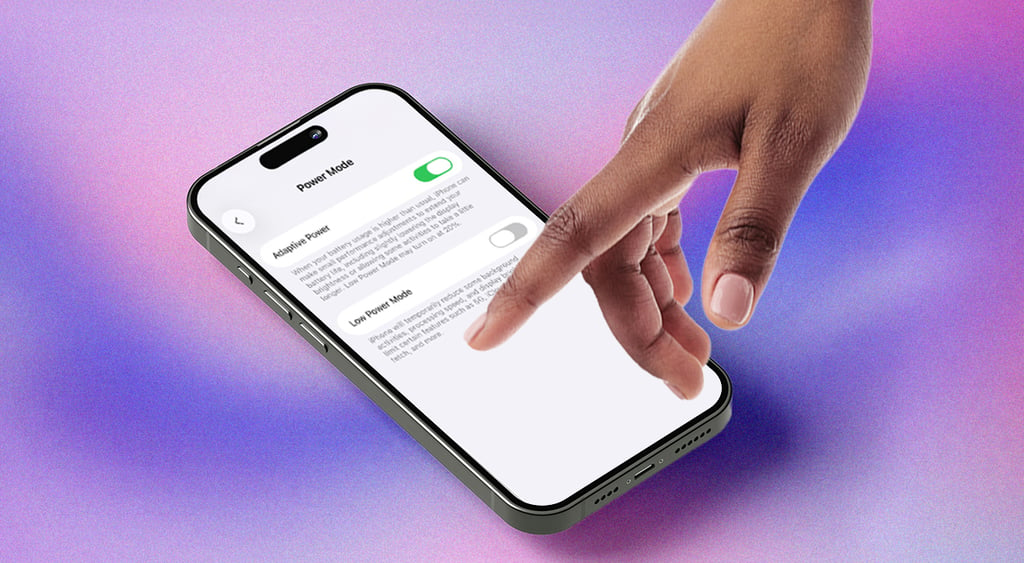
Adaptive Power Mode vs Low Power Mode
The difference between APM and LPM is how they manage the optimization.
“Low Power Mode is aggressive – it immediately limits most activities and resources, noticeably slowing down your device to save as much battery as possible right away,” shares Valerii Mykhailenko, a software engineer at MacPaw.
Meanwhile, APM works smarter and “subtly optimizes usage based on your habits, so you can keep getting great performance while having enough battery to last much longer,” explains the expert.
While LPM has been used for years, it was originally created for “emergencies” or when the smartphone’s battery reaches 20% or below.
“Only then does it reduce performance, limit background refresh, turn off mail fetch, and more,” notes Rambarran.
He also notes that APM is for everyday use, and doesn’t wait for the battery to be on the verge of dying. Instead, it shifts its focus to what the user is currently doing, saving the battery throughout the day.
“If the battery reaches a critically low level, it can automatically activate Low Power Mode as a safeguard. The two modes collectively offer strategies for power management that are both proactive and reactive,” concludes the expert.
APM is where Apple Intelligence proves to be useful?
What makes APM so intuitive is that it’s powered by Apple Intelligence. While some Apple users admitted not being big fans of its AI, the company finds new ways to make it helpful.
“Most criticism of Apple Intelligence focuses on how its capabilities compare to competitors, not on the features themselves,” notes the software engineer at MacPaw.
He reminds users that Apple Intelligence processes data on-device, meaning it keeps things private.
“Apple Intelligence analyzes usage behaviors like CPU load, screen-on duration, and active applications, all while not transmitting that data to the cloud. This guarantees that battery optimizations are customized to your individual habits while staying confidential,” adds Rambarran.
What’s Apple’s Adaptive Power Mode (APM)?
Adaptive Power Mode is a feature available on iOS 26 that extends iPhone battery life by adjusting smartphone performance.
Is Adaptive Power Mode the same as Low Power Mode?
While Adaptive Power Mode and Low Power Mode both aim to expand the iPhone’s battery life, they’re not the same. Low Power Mode radically restricts features and performance, while Adaptive Power Mode uses AI to make minor adjustments when battery usage is higher than normal.
How does Adaptive Power Mode work?
Adaptive Power Mode uses artificial intelligence to analyze how a user uses their device to reduce background activity and display brightness when the device is using more battery power than usual.
How to turn Adaptive Power Mode on?
Adaptive Power Mode can be turned on by going to iPhone Settings, clicking on Battery, and selecting Power Mode. To enable the Adaptive Power feature, toggle the switch to “On.”
Which iPhone models include Adaptive Power Mode?
Adaptive Power Mode runs on iOS 26 and devices that include Apple Intelligence: the iPhone 15 Pro, iPhone 15 Pro Max, iPhone 16 series (iPhone 16, 16 Plus, 16 Pro, 16 Pro Max, and 16e), and iPhone 17 series (iPhone 17, iPhone 17 Pro, iPhone 17 Pro Max, and iPhone Air).
Unlock more exclusive Cybernews content on YouTube.