Superbloom review: modern tech exploits humanity by giving us what we want
“Superbloom” made me almost wholeheartedly agree with some rebel scholars and programmers who believe that the existing technological system simply needs to be dismantled and rebuilt. But Nicholas Carr is right: it’s probably too late to rethink the system. We might try to change ourselves, though.
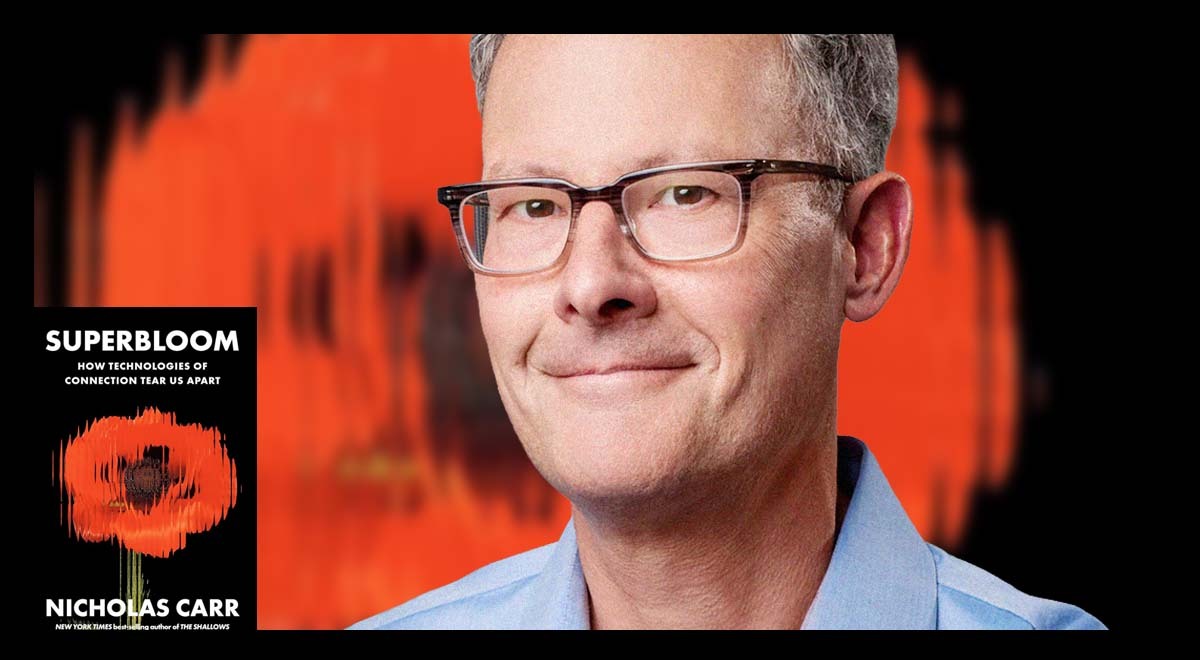
Image by Cybernews.

 Follow us
“Superbloom” made me almost wholeheartedly agree with some rebel scholars and programmers who believe that the existing technological system simply needs to be dismantled and rebuilt. But Nicholas Carr is right: it’s probably too late to rethink the system. We might try to change ourselves, though.
It wasn’t my first encounter with Carr, a well-known American tech critic. A few years ago, after my workmate's daily nagging about how I should give Carr a go, I devoured “Utopia is Creepy,” a collection of his best essays, blog posts, and other writings.
I enjoyed the book a lot. Growing up with technology and social media, I could feel something going quite wrong: I could sense that I and those around me were growing ever more dependent on technology.
Carr voiced this concern perfectly, describing the dystopia in sharp, staccato-like essays. So when “Superbloom” was released last year, I was expecting something similar: deep skepticism, exposes of ridiculous tech visionaries, and dry sense of humour.












I wasn’t wrong but I also wasn’t right. That’s because “Superbloom: How Technologies of Connection Tear Us Apart” impressively reads like a slow but ruthless speech by a lawyer in a courtroom.
They’re scraping and squeezing us
Carr patiently dissects the flaws of the attention economy, refusing to succumb to the thrilling tempo of the digital age.
As the judge, you cannot help but remain unconvinced. We live in a strange world where Google waves away the privacy of communication – a concern as old as civilization – and opens our mail, where our digital lives are endlessly scraped and monetized, and where the very concept of ownership over one’s speech or image has grown hazy.
What’s probably best about “Superbloom” is that Carr is not alarmist at all. He offers a calm, careful gaze into what went wrong, right, or probably was just inevitable.
Someone called this book a reckoning, not a polemic. Carr slowly walks through the labyrinth that brought us to the age of the infinite scroll, feeds, platforms, and ambient digital noise.
He quotes early thinkers like Walter Lippmann, who died in 1974 but already felt that mass media would create a public of spectators, overwhelmed by unverifiable information, passively but happily absorbing every possible signal.
Interestingly, the author isn’t really looking for people or organizations to blame. True, he acknowledges that Big Tech manipulates us through their algorithms, and that we’ve indeed been captured by the overlords of surveillance capitalism.
That’s all too familiar because blaming the machines and their masters is fashionable these days.
We’ve already welcomed voice assistants like Siri and Alexa into our homes, and AI chatbots simply push the trend to its logical conclusion.
And indeed, it’s quite infuriating to read Mark Zuckerberg’s explanation of Facebook’s decision to curate the News Feed: “A squirrel dying in front of your house may be more relevant to your interests right now than people dying in Africa.” A grotesque comparison if there ever was one.
With AI now in the mix, social media platforms have even more to gain. To them, the prospect of a machine automatically generating messages is an attractive one.
They always need enormous amounts of new content, and AI produces unlimited quantities of it. Chatbots also help to squeeze out new personalized data.
Wait, it’s not real, it’s not human, right? Carr reminds us: we’ve already welcomed voice assistants like Siri and Alexa into our homes, and AI chatbots simply push the trend to its logical conclusion.
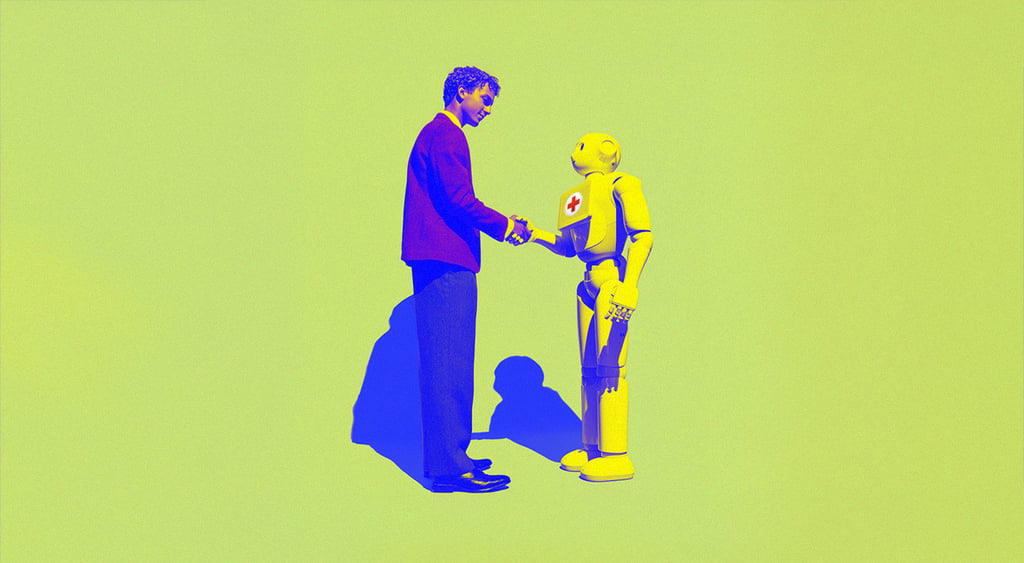
Still, in the age of AI, it may become terribly easy to start to “doubt reality itself.” According to Carr, it’s highly likely we’ll go “from a world where our bias was to take everything as evidence to one where our bias is to take nothing as evidence.” Just ask Benjamin Netanyahu.
“As deep fakes become widespread,” the law professors Bobby Chesney and Danielle Citron caution in a California Law Review article, “the public may have difficulty believing what their eyes or ears are telling them— even when the information is real.”
The genie, once out, is rarely put back in the bottle
So yeah, one could easily blame the billionaire tecchies. But Carr, once again, doesn’t: instead, he shifts the lens back onto us, making it all even more unsettling.
He interrogates our willing participation in treating – and that’s a very nice metaphor – the internet as a kind of overgrown, boundaryless suburbia with infinite nosy neighbors and no zoning laws.

Check if your data was exposed
Find out if your email and related personal information have appeared in known data breaches.
According to Carr, we as humans are primed to seek out new information but were never and probably won’t ever be ready for the infinite scroll of the information age.
It’s probably still exploitative but we indeed choose to indulge in this digital equivalent of junk food. As Carr puts it, “social media is not successful because it goes against our instincts and desires: it’s successful because it gives us what we want.”
“The writers of feed algorithms are nothing if not code-wielding Machiavels but it’s important to be honest about our own complicity. We’re not being manipulated to act in opposition to our desires. We’re not hostages with Stockholm syndrome,” writes Carr.
“We’re being given what we want, in quantities so generous we can’t resist gorging ourselves. The manipulation is secondary to and dependent on the pleasure.”

It’s one of the strongest arguments in “Superbloom.” I constantly beg for more regulation of the broligarchs but even that, Carr says, could only do so much because blaming the tech industry simply lets us off the hook.
The genie, once out, is rarely put back in the bottle. True, recent successes in suing Meta and Google for designing platforms that are harmful to young people signal that some are still fighting.
But, disconcertingly, to millions, the simulated online world is already more fun than the real world where things dare to feel boring sometimes.
“We become, whether we realize it or not, simulated beings experiencing simulated events in a simulated environment,” said Jean Baudrillard ages ago. Finally, the hyperreality is here, and it’s never felt this empty.
Disconcertingly, to millions, the simulated online world is already more fun than the real world where things dare to feel boring sometimes.
What is to be done? There’s no easy way to escape our current predicament. But a truly interesting plan hatched by a small group of rebel scholars and programmers is called frictional design.
Like true Luddites, the rebels believe the existing technological system needs to be dismantled and rebuilt in a more humanistic form. They seek to sabotage existing social media platforms by reintroducing friction into their operations – throwing virtual sand into the virtual works.
But, again, too many would instantly object if any government took similar action and would rebel against what they’d see as “patriarchal overreach or nanny-state meddling,” Carr says.
“Changing the system in any far-reaching way causes too many disruptions for too many people. Society shapes itself to the system rather than the other way around,” he concludes.
Unlock more exclusive Cybernews content on YouTube.