Study shows Pay‑or‑Okay schemes drive 99.9% consent – but most users never really wanted tracking
The Pay-or-Okay model, adopted in Europe by the online news industry and platforms like Facebook and Instagram, nudges 99.9% of users to consent to ad tracking. But a new survey has found that most of us actually prefer a third option.

Image by Cybernews.

 Follow us
The Pay-or-Okay model, adopted in Europe by the online news industry and platforms like Facebook and Instagram, nudges 99.9% of users to consent to ad tracking. But a new survey has found that most of us actually prefer a third option.
Instead of giving users a choice to either accept or reject ad tracking, Pay or Okay systems require a payment if you want to refuse to give your “consent.”
In Europe, they’re on the rise, and earlier this year, noyb, a Vienna, Austria-based non-profit, found that platforms such as Facebook and Instagram have increased user consent rates up to 99.9%. All good?
Well, publishers claim they need Pay or Okay for economic reasons. But do users really choose freely? According to a new academic study commissioned by that very same noyb, most don’t actually want to consent to anything but feel forced to do so since they don’t want to pay.
When asked openly, only about two out of ten people agree with companies collecting and analyzing their data, the study found.












However, when they faced “pay” and a “consent” option, about 9 out of 10 people chose “consent.” The high consent rate seems to be caused by the lack of a reasonable alternative.
Finally, when there’s a “pay,” a “consent,” and an “advertising, but no tracking” option, most users switch to the latter. Seven out of 10 people then choose the “advertising, but no tracking” option.
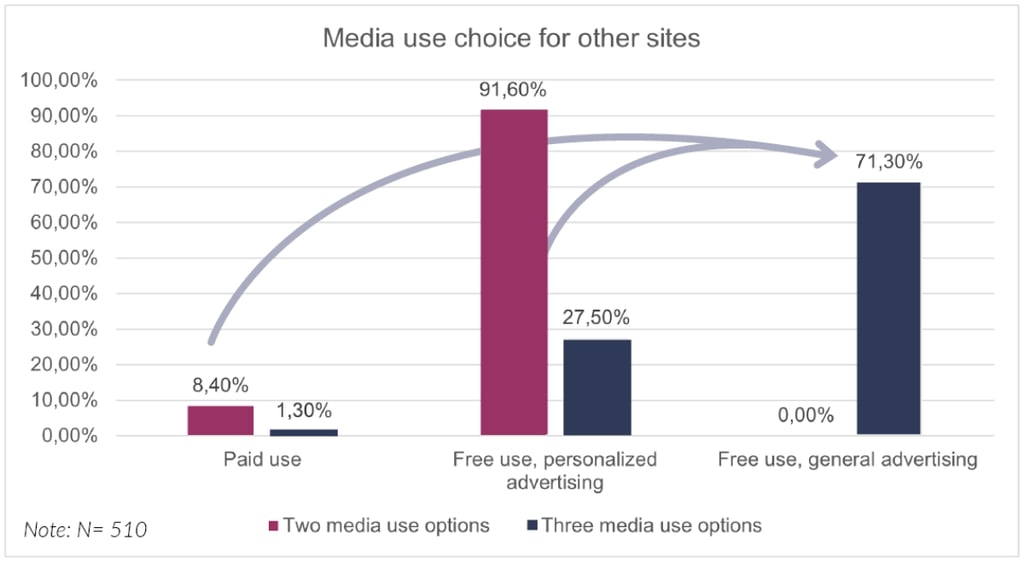
This shows that the “third option” (as suggested by the EDPB) is supported by objective evidence. Users accept funding of websites via advertising – but not online tracking, noyb said.
“We find that avoiding advertising and not wanting to be tracked seem to be the most important motivating factors,” wrote Dr. Brigitte Naderer, a post-doc at the Public Mental Health Research Unit, Center for Public Health, Medical University of Vienna.
“There is still no great general willingness to pay for data privacy in any media context. However, this does not mean that online users do not value their personal data and are willing to accept that their personal data is tracked when accessing media content.”
In April 2024, the European Data Protection Board published its first opinion (non-binding) on Pay or Okay and suggested that users should not only have two (“pay” or “consent”) but three options (“pay,” “consent,” or “advertising, but no tracking”).
Unlock exclusive Cybernews content on YouTube.