Your next BMW could be built by a humanoid robot
BMW will start using humanoid robots on production lines at its Leipzig factory in Germany this summer.
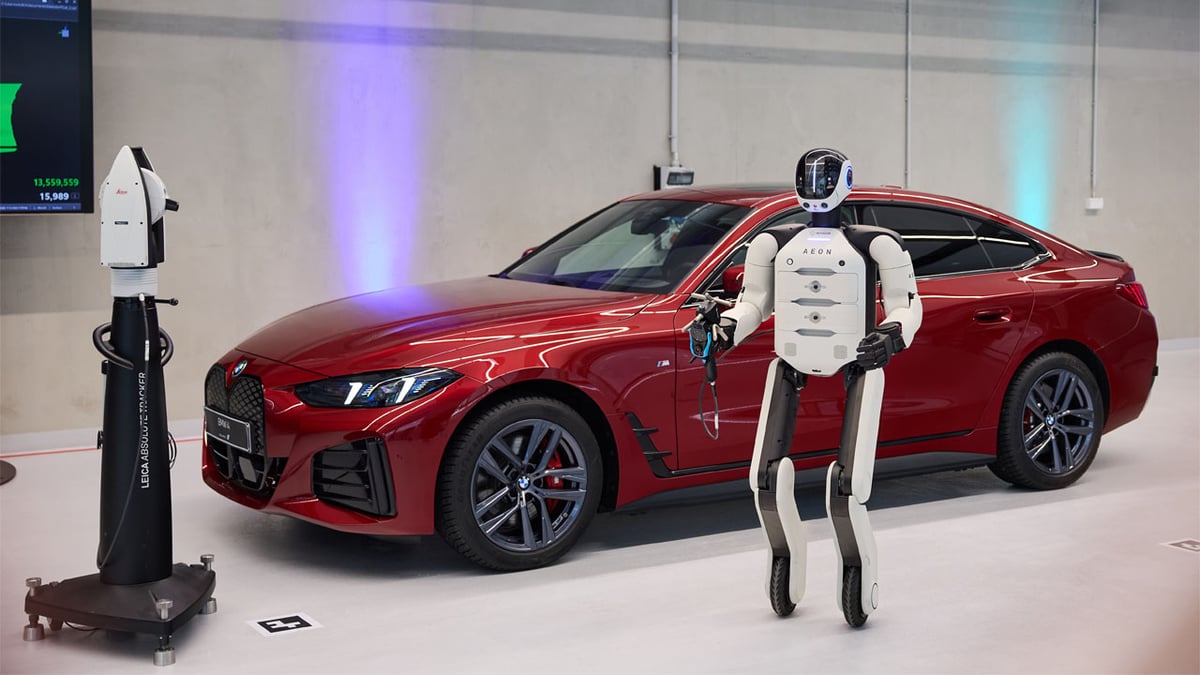
Aeon via BMW


 Follow us
- BMW will start using humanoid robots at its Leipzig factory this summer.
- The Aeon robot stands 1.65m tall, weighs 60kg, and is equipped with cameras, radar, microphones, and other sensors.
- Automakers increasingly see humanoid robots as the future of the industry.
BMW will start using humanoid robots on production lines at its Leipzig factory in Germany this summer.
The company is planning to use two robots made by Hexagon Robotics – a division of Hexagon AB, a Swedish industrial tech company that specializes in digital reality, measurement, and autonomous solutions. The robots are currently in a test deployment at the Leipzig factory.
Michael Nikolaides, Head of BMW Group Production Network and Logistics, told the BBC that this will become the future of automotive production. He explained that a humanoid design allows robots to smoothly integrate into work environments that were built for humans.
"If you have a humanoid form, you can pretty much set it to any workplace where a human is working today because it has the same size and the same capabilities," he said.






The conversation on this topic is live. Join in the discussion.
BMW started testing humanoid robots in Germany earlier this year after a successful 2024 trial in Spartanburg, South Carolina. During the major US trial, the Figure O2 robot contributed to the production of 30,000 BMW X3 cars for three months, working a 10-hour shift and handling 90,000+ parts, according to Figure AI.
However, the Figure robots used in the US trial were different. The current Hexagon robot, named Aeon, has wheels instead of feet.
"It makes more sense on a shop floor [to have wheels] because Aeon can roll around from one place to the other," said Nikolaides.
Aeon is a human-shaped robot equipped with cameras, radar, microphones, and other sensors. It stands 1.65m tall and weighs 60kg, moving through the hall at speeds of up to 2.5 metres per second, BMW says.
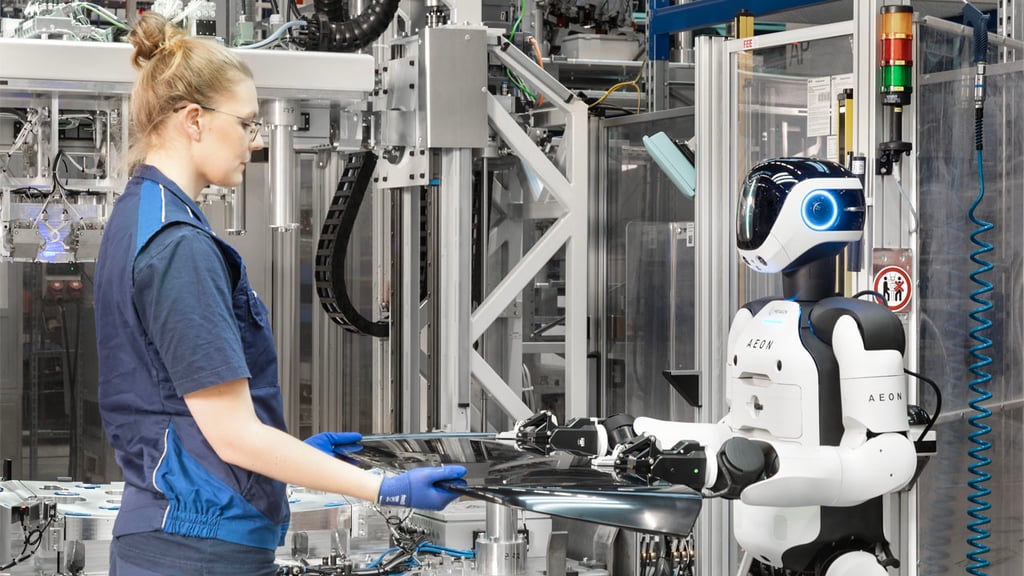
Robots were trained through a combination of sensors on humans and virtual factory simulations in a digital replica of the factory powered by Nvidia’s software. The robot in a simulation repeatedly practiced tasks using “reinforcement learning” – an approach that involves learning through trial and error.
When the pilot project begins in Europe, Aeon will be “used in the assembly of high-voltage batteries and in component manufacturing”. It has a battery life of three hours, but it’s designed to be able to swap its own battery in roughly three minutes, which includes the travelling time to and from the charging station.
According to Nikolaides, robots will not eliminate jobs – to the contrary, he told the BBC that “there were new jobs created by this new technology, and that's the way we look at [humanoid robots].”
The majority of mainstream carmakers are pivoting to modern robotics and different forms of automation. In March, Chinese tech company Xiaomi started trialing humanoid robots at one of its car factories, planning mass deployment within the next five years. South Korean automaker Hyundai said it will roll out human-like robots in its factories from 2028, following the launch of its “robot-run” production facility in Singapore in 2023.






Unlock more exclusive Cybernews content on YouTube.