How to opt out of data broker sites (2026)
Being behind major reports like The Mother of All Breaches and RockYou2024, our in-house cybersecurity experts and journalists provide unbiased, real-world testing and in-depth analysis.
We maintain complete transparency by openly sharing our testing methodologies with our audience.
Learn more

-
Manual data broker opt-out is possible but time-intensive. You need to identify dozens (sometimes 100+) of brokers, submit individual removal requests, and follow up repeatedly, which can take 10-20+ hours
-
Ongoing monitoring is essential. Even after opting out, your personal information can reappear online, meaning you must regularly check and resubmit requests
-
Automatic services save time and effort. Tools like Incogni handle the data broker opt-out process for you, sending requests and continuously monitoring for resurfaced data
Data brokers collect and share personal information, including names, phone numbers, addresses, and online activity. Some of this information ends up on people-search websites, where anyone can look up details about you. Fortunately, you can request to have your information removed from many of these sites.
There are two main ways to opt out of data broker sites: submit removal requests yourself or use a data removal service like Incogni to handle the process on your behalf. Manual removal is free but can take considerable time, while an automated service can manage requests and monitor for your information resurfacing.
In this guide, I explain how data brokers collect your information, how to remove it manually or automatically, and how to limit future data collection. I also cover the costs, removal timelines, and privacy rights you should know about in 2026.
How to opt out of data broker sites: quick steps

- Choose a data removal service. I recommend Incogni, now 55% OFF.
- Authorize Incogni to send opt-out requests to data brokers on your behalf.
- Check the Incogni dashboard to see which data brokers have deleted your information from their sites.



The Cybernews team consists of professional and highly skilled writers and an in-house research team. They’re the core of all our reviews, bringing the performance of each tool closer to you. Additionally, we stick to a transparent testing process, which includes investigating various services, their features, and disclosing our testing methodology with everyone. Discover more about our testing process.
What is a data broker?
Data brokers collect and sell personal information about individuals. If you’ve subscribed to an unusual newsletter, set up a social media account, or ordered a pizza for delivery, chances are, data brokers got your information.
Personal information is valuable to businesses. Data brokers sell or share the information they collect for purposes such as targeted advertising, market research, credit scoring, background checks, and fraud prevention.
Some data brokers then sell your data to businesses. While some brokers screen potential buyers or filter specific personal details, many don’t care about the consequences of sharing your private information.
How brokers get your data
When it comes to collecting your data, these sites have countless tricks up their sleeves. Here are the most common methods they rely on:
- Public records. Unfortunately, a large chunk of your personally identifiable information (PII) is readily available to everyone. It’s maintained by government agencies, which make your official documents, like birth certificates, vehicle registrations, and even arrest records, easily accessible to the general public.
- Social media accounts. The things you post, the people you text, the pictures you like, and the accounts or ads you interact with are all data. These patterns say a lot about you, and data brokers regularly take advantage of that with public social media profiles.
- Browser cookies. Websites place tiny text files onto your computer and phone to make your next visit quicker. However, these little packets of data also store valuable information about you, so data brokers buy them in bulk every chance they get.
- Online retailers. Your online shopping activity can be quite telling. Unfortunately, the websites you visit to make purchases also track everything you do, from keywords you’re looking up to loyalty cards and coupons you’re using.
- Mobile apps. While some apps do need access to certain functions of your phone to work properly, others abuse the permissions you grant them to collect data on you. This includes your location, name, email, app usage patterns, search history, and more.
- Data leaks. It’s not uncommon for data brokers to turn to cybercriminals and dark web forums, where they can purchase large quantities of leaked data at a cheap price.
How to opt out of data broker sites: detailed guide
There are two ways to opt out of data broker sites: automatically and manually. The automatic method means using an automated data removal tool like Incogni. For the manual method, you’ll handle all data-collection opt-out requests yourself. Choosing the ideal data removal approach depends on how much time you have, your budget, and the effort you’re willing to expend.
Option 1: remove your data automatically (recommended)
Automatic data broker opt out of data collection sites is the most effective and least time-consuming way to protect your privacy. However, you’ll need a trusted and reliable data removal service like Incogni. A data removal service like Incogni can help you with the following.
- Scan the internet for your personal information
- Identify what data brokers are holding your data
- Send removal requests on your behalf
- Carry out continuous monitoring to detect any reappearance of your data with automatic scans
How to remove your information with Incogni
Here’s how to remove your information from data broker sites with Incogini:
- Visit Incogni’s website and click “Get Started.”
-
Choose an annual Personal or Family plan (alternatively, you can upgrade to an Unlimited plan to access custom data removal requests).
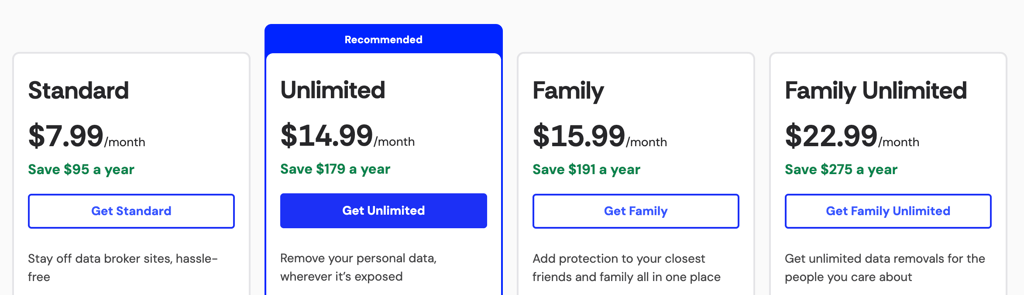
- Enter your email, country, and postcode, and hit “Proceed to Payment.”
- Choose your preferred payment method and complete your subscription.
- You’ll receive an email from Incogni. Click the link in the email to verify your identity.
- Create your profile and set up your password.
-
Review and sign the authorization form to permit Incogni to contact data brokers on your behalf.
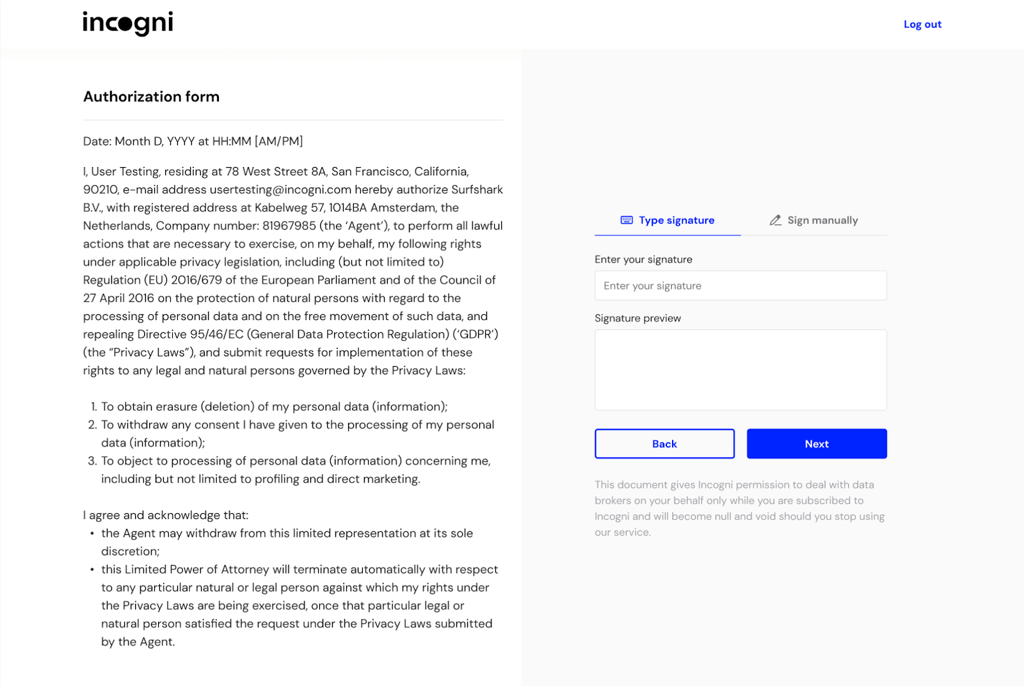
Once you complete these steps, Incogni automatically starts scanning for your personal information and requesting its removal from data broker sites.
Data removal timeline with Incogni
Depending on your state’s privacy laws, data brokers have between 30 and 45 days to remove your data after the initial opt-out request. However, there are a few other phases before and after the removal requests that you’ll need to take into account to gauge the time it takes for the entire process:
| Stage | Typical duration | Details |
| Initial scan | 24 to 48 hours | Incogni begins searching for all your information on data broker sites |
| Standard opt-out requests | Within 14 days | The majority of your PII gets removed from data brokers in this period |
| Continuous monitoring | Ongoing | Incogni detects the reemergence of your data online and automatically sends additional removal requests. |
| Custom data removal requests (URL-based submissions) | Up to 45 days per request | Incogni maintains a close follow-up with uncompliant data brokers until your data is removed. It’ll also flag the worst offenders and keep them on the suppression list so they can’t reupload your data in the future. |
Option 2: manually remove your data from data broker sites
The manual data removal option gives you full control over the data broker opt-out process and helps you save money. However, in exchange, you take up all responsibility for finding and removing your personal information from data broker sites. This means you’ll be responsible for the following.
- Finding individual brokers holding your data
- Reaching out to each one to request data removal
- Tracking the responses you get and sending follow-up requests as needed
- Continuously monitoring the internet to detect if or when your data reappears.
How to manually opt out of data broker sites
If you want to remove your personal information from data brokers via the manual opt-out process, here’s how you go about it.
Step 1: find brokers that have your data
- Set up online alerts with tools like Google Alerts and Avast to detect when your information is shared online
- Check Privacy advocacy sites for a list of popular data centers
- Check your state’s data broker registry for data brokers operating there
- Use privacy browsers like Privacy Badger to expose trackers on your device
Step 2: locate each broker’s opt‑out page
- Create a spreadsheet of each broker that has your personal information
- Visit each website and locate the opt-out page (usually found on the website footer)
Step 3: submit opt‑out requests
- Fill the opt-out form on each broker’s website and submit your request
- Wait for up to 72 hours for brokers to respond to your opt-out requests
Step 4: track and follow up
- When a broker responds and complies with your request, mark “done” on your spreadsheet
- Send follow-up requests to data brokers who have not yet responded.
- When you find another site with your data, add it to the spreadsheet and repeat all the steps

Challenges with manual opt‑out
From my research, I discovered that the manual data broker opt-out process is more complicated. This is because of the following reasons.
- Each data broker site has a different opt-out process
- Data brokers might ask you for extra verification information
- You’ll need a basic understanding of data protection laws like GDPR, CCPA, and PIPEDA
- Some data brokers are slow to respond
- Your data can still reappear online after previous removal, meaning you’ll have to repeat the entire process periodically
- Manual opt-out takes time and requires some persistence
Which method should you choose?
The data broker opt-out approach you choose will ultimately depend on several key factors. These include your budget, stress tolerance, desired level of control, and the time you can dedicate to monitoring.
If you want total control over the data removal process, want to save money, and have plenty of free time to dedicate to it, manual removal may be ideal for you. However, with all the follow-ups and ongoing monitoring you’ll need to do, it might not be the best long-term solution.
Personally, I recommend automatic removal for people who want comprehensive data monitoring and removal with minimal stress and effort. Automatic data removal tools like Incogni are designed to streamline the process and make it as simple as possible. They also provide continuous monitoring, so as soon as your data appears online, you can easily take action and remove it.
Reasons to remove your data from data broker sites
When your data falls into the wrong hands, you’re exposed to identity theft, financial fraud, data breaches, spam, and scammers. The best way to protect yourself from these risks is to opt out of data broker sites, which also brings the following benefits:
- Privacy protection: When you opt for a data broker site, you eliminate a source that could potentially expose your personal information. Having one less broker selling and sharing your data is a huge step towards protecting your privacy.
- Security: Getting data brokers to remove your information from their records prevents spammers, scammers, cybercriminals, and other unscrupulous actors from accessing your data. This helps prevent theft, doxing, unsolicited contact, and fraud.
- Personal control: Removing your personal data from broker sites lets you control who can access your data and what information they can see.
Removing your information from data broker sites can be particularly beneficial if you’re a victim of stalking or identity theft, as stalkers and fraudsters can’t use your info against you. It’s also beneficial if you’re regularly in the public eye and are concerned about doxing, unsolicited contact, and fraud.
Are you legally entitled to opt out of data broker sites?
Yes, you are legally entitled to opt out of data broker sites, but the extent of this right depends on where you live. In the European Union, the General Data Protection Regulation (GDPR) prohibits companies from collecting and processing data without the user’s explicit consent. Although GDPR is an EU regulation, it applies globally to any organization that processes data of EU residents, regardless of the organization’s location.
Meanwhile, in the US, there is currently no federal data privacy law, so each state sets its own regulations as it sees fit. This, in turn, means that the specific data privacy laws vary from state to state. I recommend doing a Google search to find out if your state has specific data privacy laws you can take advantage of.
That said, it is fairly common practice for data brokers to try to circumvent these laws to whatever extent they can. For example, a recent study found that more than 30 data brokers hid their opt-out pages, making it hard for users to delete their data.
How to keep your data from brokers
Removing data is one thing, but preventing your PII from getting into the hands of data brokers in the first place matters just as much, if not more. That’s why I compiled a list of strategies you can incorporate into your daily browsing routine to keep your data off of broker sites:
- Install privacy extensions. A good way to reduce the number of trackers is to install privacy-focused browser extensions. A Chrome ad blocker can also go a long way, as some ads can track your online activities.
- Use a reliable VPN. A virtual private network (VPN) doesn’t just change your virtual location. The best VPN services also enhance your online privacy and security by hiding your IP address and encrypting your traffic. This limits the amount of PII that can be collected.
- Get rid of any unused accounts. You’d think that not using an old email address would prevent your information from appearing online. Unfortunately, that’s not the case, as services get hacked and data leaks happen all the time. Brokers can then take advantage of these mishaps and buy any of your data that may have been leaked.
- Remove your data from Google. As the biggest search engine in the world, Google has heaps of information on you. It can also sell that data to brokers at any moment, so it’s a good idea to remove your PII from it.
- Delete your browser cookies. A browser cookie is a tiny text file that websites use to remember you and make further site visits faster. However, both cybercriminals and data brokers can exploit these small pieces of data, as demonstrated by constant cookie auctions, so it’s best to clear them out once in a while.
- Limit what you share online. Social media profiles are an abundant source of information for data broker websites, and an entirely legal one as well. The only thing you can do about it is avoid oversharing and lock down your profiles.
Read our full data broker opt-out guides
There are dozens of data brokers actively collecting your data from public records, social media accounts, and other readily available sources. The good news? You can legally opt out of each and every one of these broker websites.
To make this at least a bit easier, we’ve created detailed step-by-step guides you can follow to remove your data:
How to opt out of PeopleFinders
How to opt out of InstantCheckmate
How to opt out of SearchPeopleFREE
Conclusion
From Googling things and browsing social media to shopping online, almost everything you do on an internet-connected device can lead to your data ending up on a broker’s site. In fact, it’s virtually impossible to prevent this. From there, these services can then sell your data to spammers, scammers, and cybercriminals.
Thankfully, you can opt out of data brokers automatically (through a service like Incogni) or manually (by requesting removal from each broker yourself). The manual opt-out method is best for cost savings, while using a data removal service like Incogni is best for convenience, coverage, and efficiency. Either way, you reduce the risk of privacy invasions, targeted scams, identity theft, and even stalking or harassment.
And while removing what’s already collected is vital, having good cyber hygiene is just as important for preventing future data collection. This involves using trackers and ad blockers, connecting to the web via VPNs, deleting browser cookies and old accounts, and keeping your social media profiles private.
Why not share this article with friends and family? After all, most people don’t know that their data is being harvested and traded or that they can opt out of data broker sites to safeguard their privacy.
FAQ
Are data brokers useful?
Yes, data brokers are useful. Marketers, financial institutions, retailers, employers, and government agencies purchase data from these companies. This data is valuable for marketing, risk assessment, and consumer insights. But that doesn’t diminish the ethical and security concerns associated with data brokers.
How do data brokers get your info?
Data brokers collect your information mainly from public records and third parties. When you’re browsing the web, making a purchase, scrolling social media, or streaming, data brokers are likely collecting valuable info about you.
How do you remove your info from data broker sites?
You can request that your information be removed from a data broker site. Data removal services like Incogni handle this process automatically, ensuring your information doesn’t end up on any data broker site. Alternatively, you can contact data brokers individually and request to opt out of their databases.
How do you protect against data brokers?
To protect yourself from data brokers, you can opt out and have your data removed from their records. You can also use a VPN to help mask your online activity, use a privacy-focused browser to reduce tracking, and limit the information you share on public social media profiles.
Is a data broker legal?
Yes, data brokers are legal, provided they comply with privacy laws, such as the GDPR in Europe and the CCPA in California.
Is it free to opt out of data broker sites?
Yes, manual data removal is free. However, you should note that this can be very time-consuming, since you’ll have to contact each broker individually. Your data can also resurface in the future, at which point you’ll need to go through the opt-out process again.
How much do data removal services cost?
The subscription cost of automatic data removal can vary significantly. It depends on the service you opt for, as well as its data broker coverage, features, and ongoing monitoring. In Incogni’s case, you’re looking at $7.99/month if you get a yearly subscription with the Standard plan.
Are automatic data removal services effective?
Yes, they are! Not only can they quickly find your PII and send out dozens of opt-out requests simultaneously, but they also continuously monitor the web in case your data resurfaces. That said, a broker might refuse to cooperate, at which point you’ll have the option to take legal action against them.
How long does it take to remove my information from data broker sites?
This depends on the broker. Some will respond to Incogni’s opt-out requests within a few days. Others might drag it out into multiple weeks. That said, brokers have a maximum of 45 days to cooperate. If the process extends beyond that, you can take legal action.