US police now armed with Israeli spy vans simulating mobile phone towers
US police SUVs can sweep up every nearby phone signal
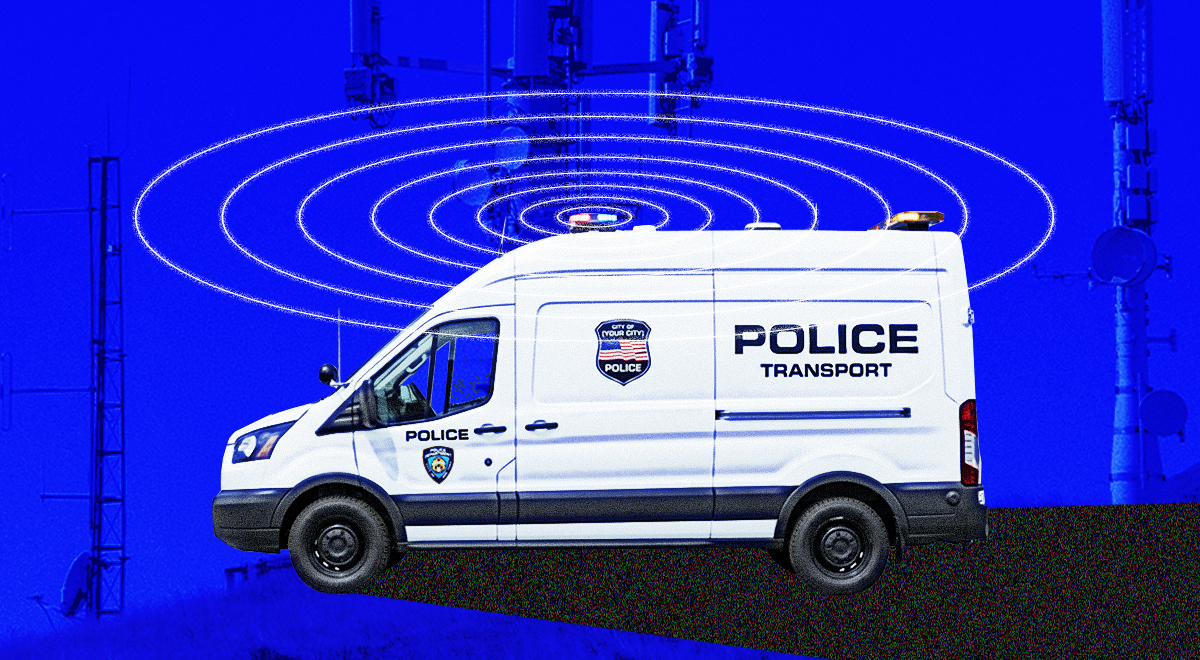
Image by Cybernews.

 Follow us
- Cognyte's Israeli-made FalcoNet devices mimic cell towers, forcing nearby phones to connect and reveal location data
- FalcoNet can’t selectively ignore phones that don’t belong to a suspect. It just sweeps all devices in the vicinity into the same signal
- Courts are pushing back, ruling that mass phone tracking without consent may violate Fourth Amendment privacy protections
Key Takeaways by nexos.ai, reviewed by Cybernews staff.
When the Texas Department of Public Safety purchased 4 brand-new Chevrolet Tahoes for $4.5 million this March, it looked like a routine fleet upgrade. In fact, the cars are equipped with controversial surveillance hardware that can monitor the location of every cell phone in the surrounding area. Privacy activists are alarmed.
The tech, made by Cognyte, an Israeli surveillance company, is called FalcoNet and has so far been mostly sold in Israel and Europe. Now, it’s making inroads in the United States.
The gadget simulates a cell tower and forces nearby phones to connect to it. Essentially, the phones have no choice, as they’re programmed to connect to the strongest signal automatically, without the owner’s knowledge.
In other words, the cops, driving in their SUVs, are able to track any phones in the vicinity – whether they belong to a suspect or, crucially, to an innocent law-abiding citizen.






Check if your data was exposed
Find out if your email and related personal information have appeared in known data breaches.
According to Forbes, the terms of Cognyte’s contract with the Lone Star State say that the FalcoNet simulator can be hidden inside a vehicle, tucked into a backpack for cops operating on foot, or even bolted to a helicopter.
Sweeps up data of innocent bystanders
Florida, for example, uses the system to canvas the waters off the Keys for migrant vessels or smuggling operations.
Where’s the problem, we can hear you asking: if cops have the best possible means to catch the bad guys, why shouldn’t they use the Cognyte tech? Here’s where the problems begin, though.
Obviously, it’s relatively fine if officers already have a suspect’s phone number and a rough location. Armed with FalcoNet, they can drive the device close enough and pinpoint the suspect’s exact coordinates.
The cops, driving in their SUVs, are able to track any phones in the vicinity – whether they belong to a suspect or, crucially, to an innocent law-abiding citizen.
But cops can also canvas an entire neighborhood and then sift through the data afterward to identify the relevant device. Cognyte claims its FalcoNet can be set up in 3 minutes and force thousands of devices to connect to it every minute.
The fact of the matter is that FalcoNet can’t selectively ignore phones that don’t belong to a suspect. It just sweeps all devices in the vicinity into the same signal, whether they belong to shoppers, commuters, or anyone else.
That’s a lot of data. But it’s unclear if that data is retained, for how long, and who can later access it – it depends entirely on the internal policies of whichever police department is using Falconet.
Controversial background
Naturally, civil liberty experts are concerned that innocent citizens will be caught up in the government dragnet.




Stay updated with our latest stories and follow us on social media
Be the first to discover new stories, ideas, and updates from our team.
“When you have these kinds of surveillance technologies that enable surreptitious collection of information about people, targeting of protesters, mapping of relationships, that always poses concerns for democratic functioning and accountability,” Rachel Levinson-Waldman, director of the Liberty and National Security Program at the Brennan Center for Justice think tank, told Forbes.
Earlier in July, a judge in Ohio actually slapped down an attempt to gain a canvassing warrant since it would have allowed cops to grab phone data from “thousands of uninvolved, unsuspecting individuals.”
And in late June, the US Supreme Court ruled in Chatrie v United States that people have a reasonable expectation of privacy in location data revealing their movements, and that even short-term tracking of that kind counts as a search under the Fourth Amendment.
Cognyte sells a lot of snake oil – for instance, the company claims to have created software that predicts where crime is likely to occur in the future.
Still, more police departments across the US are using FalcoNet and similar systems. The American Civil Liberties Union identified 75 agencies across 27 states known to own the cell-site simulators as of its last public count.
Based in Israel, Cognyte boasts clients in more than 100 countries and is aiming to rival Palantir, another surveillance tech firm.
The conversation on this topic is live. Join in the discussion.
Cognyte sells a lot of snake oil – for instance, the company claims to have created software that predicts where crime is likely to occur in the future. However, simulators like FalcoNet have proven to be popular.
The tech is also used controversially. In 2024, operatives close to former Brazilian president Jair Bolsonaro used Cognyte’s tools to spy on political opponents, and Cognyte also sold its tools to Myanmar, Kenya, Serbia, and other countries with weak human rights protections.