Groundbreaking discovery: Black holes less destructive than previously thought
Scientists believed that extreme conditions near a supermassive black hole made star formation impossible. However, a new discovery has proved them wrong.
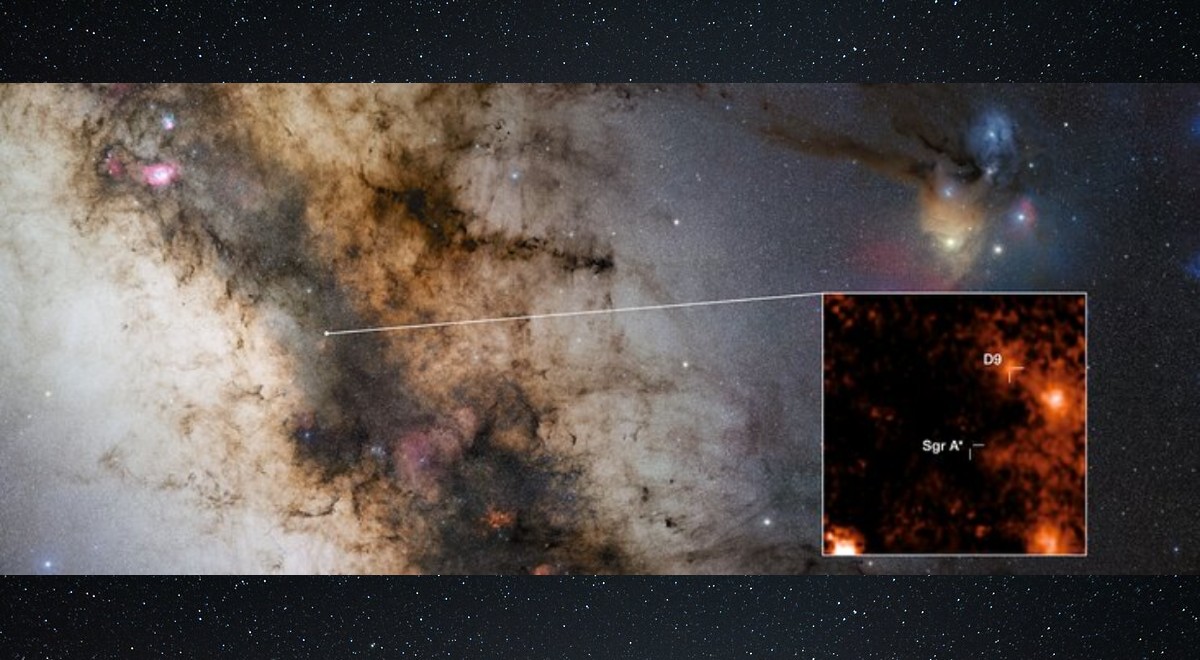
Credit: ESO

 Follow us
Scientists believed that extreme conditions near a supermassive black hole made star formation impossible. However, a new discovery has proved them wrong.
An international team of researchers has detected a binary star orbiting close to the supermassive black hole Sagittarius A* at the center of the Milky Way Galaxy.
The discovery is groundbreaking, as it unveils the secrets of how stars survive in environments with extreme gravity. While a couple of stars orbiting each other are quite typical in the Universe, they have never been observed orbiting near a supermassive black hole before. Mainly because the intense gravity can destabilize stellar systems very easily.
“Black holes are not as destructive as we thought,” commented Florian Peißker, a researcher at the University of Cologne, Germany, and lead author of the study.
For years, scientists believed the extreme conditions near a supermassive black hole made star formation impossible. However, finding a young binary star shows that even stellar pairs can form in such harsh environments.










The newly discovered binary star, called D9, is a young stellar system estimated to be only 2.7 million years old. It’s surrounded by gas and dust, which are clear signs of its early stage of development.
Due to the gravitational pull of the nearby black hole, often referred to as the silent killer of galaxies, the newly discovered twin stars are likely to merge into a single star within the next million years. This is a brief moment on the cosmic timescale, providing scientists with a unique opportunity to observe the phenomenon.
Astronomers discovered the star couple by accident while exploring a dense cluster of stars and other objects orbiting Sagittarius A*. Researchers wanted to observe mysterious G objects that behave like stars but look like clouds of gas and dust, but ending up finding a surprising pattern in D9.

“I thought that my analysis was wrong, but the spectroscopic pattern covered about 15 years, and it was clear this detection is indeed the first binary observed in the S cluster,” said Peißker.
Scientists believe their discovery could lead to the detection of planets near Sagittarius A*. It might also solve the mystery of the G objects, as the team alleges they could be a combination of binary stars that have not yet merged and the leftover material from already merged stars.
Astronomers collected data using the European Southern Observatory’s Very Large Telescope (ESO’s VLT), which operates at three sites in Chile. The research was published today in Nature Communications scientific journal.