Europe has powerful weapons against Trump and his tech bros. Will it use them?
The European Union (EU) may have lost the battle for the internet, but it still has some secret weapons against the United States (US) in the war for its digital sovereignty.

Image by Cybernews

 Follow us
The European Union (EU) may have lost the battle for the internet, but it still has some secret weapons against the United States (US) in the war for its digital sovereignty.
- The Donald Trump administration and US tech companies are increasing pressure on the EU to relax its digital laws, accusing the bloc of discrimination and censorship.
- Experts say the bloc should continue with proceedings against US tech companies to protect European users.
- Slowing down the export of Dutch ASML’s microchip-etching machines could have a major impact on Nvidia and the US economy.
- While the Anti-Coercion instrument could target US digital platforms, implementing the measure is challenging due to their multi-sided nature.
The US decision to impose a visa ban on Thierry Breton, a former EU commissioner and one of the architects of the bloc’s Digital Services Act, citing “coercion of American platforms,” has attracted condemnation from European capitals.
The move also marked a new level of escalation in the row between the EU, known for one of the most stringent tech regulations in the world, and American tech companies, which now have the full-fledged support of the Donald Trump administration.
Elon Musk, at the forefront of the fight, has recently called for abolishing the bloc after his platform X was slapped with a €120M ($140M) fine for breaching transparency rules under the DSA regarding the blue checkmark symbol and platforms' ads depository.

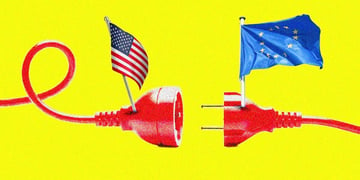










Washington and US tech giants claim that European regulators unfairly target American companies and impose censorship on social media.
Just last month, the US Trade Representative warned that if “discrimination” of US companies continues, European service providers like Spotify, Mistral, and Siemens could face consequences.
At the same time, the Trump administration openly despises the EU due to ideological differences and has threatened to invade Greenland, Denmark’s autonomous territory.
The rising tensions put the EU in an awkward position, as the old continent is highly dependent on American tech. Three US giants, Amazon Web Services, Microsoft Azure, and Google Cloud, are estimated to provide 70% of Europe’s cloud computing infrastructure.
In an apparent effort to appease Trump and the American tech industry, the Commission proposed the Digital Omnibus package last November, simplifying the rules regarding data and artificial intelligence (AI), which the US rejected.
Moreover, the US stated that it would only reduce the 50% tariffs on steel imposed last year if the EU softens its digital rules.
Experts tell Cybernews that the EU shouldn’t bend to Washington’s pressure and has significant leverage against the US. However, implementing these countermeasures may come at a cost.
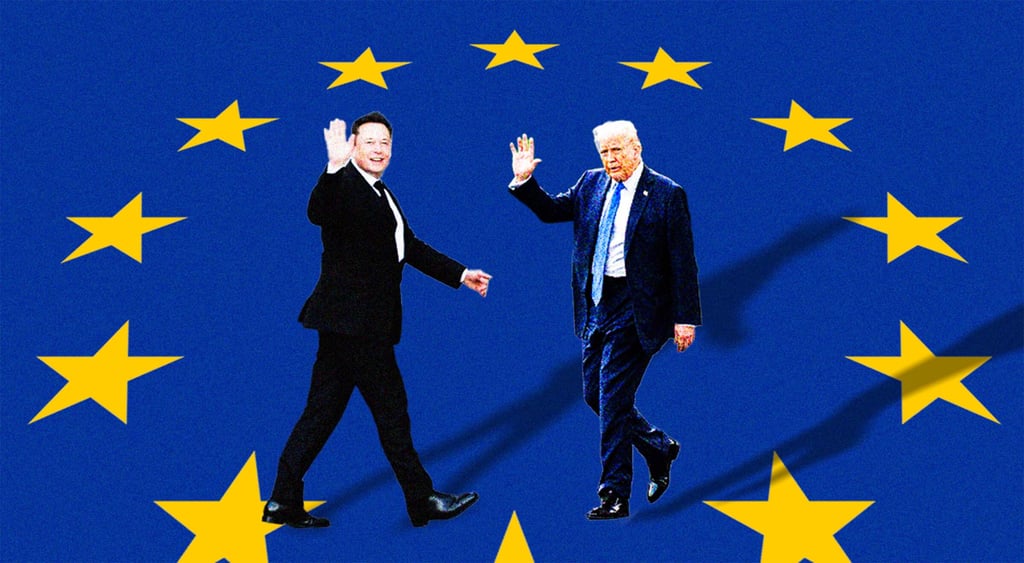
Keep calm and carry on
Lena-Maria Böswald, a senior policy researcher at Interface, a German non-profit think tank, says Europe must find a way to show strength in the standoff with the US.
First, the bloc needs to refrain from debating the US narrative that the EU is a censorship regime. Instead, the narrative should shift to ideas supported across the entire political spectrum, including online child protection and fair competition.
“The more you talk about the EU not being a censorship regime, the more the word censorship sticks with people,” Böswald tells Cybernews.
There are fundamental differences in how the US and the EU understand free speech and content moderation. The DSA, for example, is designed to increase the accountability of platforms and keep users safe by addressing illegal content and disinformation, among other issues.
Moreover, stringent EU regulations often result in US tech companies, which don’t want to lose access to the lucrative European market, applying stronger safeguards internationally, a phenomenon known as the Brussels effect.
The more you talk about the EU not being a censorship regime, the more the word censorship sticks with people.Lena-Maria Böswald
Böswald says the EU needs a more unified voice, as different member states are pursuing national approaches. Meanwhile, the Commission’s decision to conclude the proceedings against X gives hope that proceedings against other companies will be concluded in 2026.
“Once the European Commission refrains from implementing those ongoing proceedings, nothing will change on those particular platforms, which will be detrimental for users,” she says.
On Thursday, amid the global outcry over Grok-generated images of digitally undressed female users flooding X, the Commission ordered X to retain all internal documents and data relating to the company’s AI chatbot.
The Commission raised doubts about X’s compliance and stated that access to the documents would have to be provided if explicitly requested.
Bursting the AI bubble across the ocean
Miguel De Bruycker, the head of Belgium’s Centre for Cybersecurity, recently stated that Europe has effectively lost the internet due to its dependence on US cloud services and digital platforms. However, the technological dependency seems to go both ways.
Europe’s secret weapon against Trump is Dutch company ASML, which holds a global monopoly on the microchip-etching machines, Johnny Ryan, director of Enforce, a unit of the Irish Council for Civil Liberties, writes for the Guardian.
These machines are essential for Nvidia, the US AI microchip giant. Slowing the export of ASML machines to the US and Taiwan, where Nvidia’s most advanced chips are produced, would determine how much the US economy expands or contracts.
The US economy is highly dependent on AI-related investment. Without data centers, the US GDP growth rate was 0.1% annually, according to Harvard economist Jason Furman's calculations.
Have thoughts about this topic? Others do, too. Join them in the discussion.
Julia Hess, senior policy researcher for the Global Chip Dynamics programme at Interface, says the unique position of ASML gives the EU a “perfect choke point” and could be used as leverage in strategic negotiations.
However, implementing this in practice would be complicated, as any decision to restrict sales or influence global supply would require agreement among all EU member states.
Moreover, the semiconductor industry is highly interdependent, as Taiwan, South Korea, and the US each hold critical pieces of the supply chain. She says ASML is just one of many concentrated nodes in a complex global network.
“For the EU, the challenge is to map these chokepoints carefully: which ones can be used as leverage, and which ones are vulnerabilities because we depend on them. ASML is currently one of the most tangible ‘cards’ the EU has, especially when it comes to AI hardware and infrastructure,” Hess tells Cybernews.
“Trade bazooka” to fight coercion
Another widely-debated EU weapon against US economic bullying is the Anti-Coercion Instrument (ACI), introduced in 2023 as part of the bloc’s response to China’s attempt to blackmail Lithuania in a diplomatic row.
The instrument, known as the “trade bazooka,” involves official recognition of economic coercion and can lead to the EU’s unilateral countermeasures, ranging from tariff increases to exclusion from public procurement.
Amid an intensifying tariff war, Commission President Ursula von der Leyen has suggested that the EU could increase taxes on the advertising revenues of digital services provided by US tech companies, among other countermeasures.
However, experts note that digital platforms are challenging to target. Many companies have established legal entities in the EU, such as Apple and Google in Ireland, and Amazon in Luxembourg.
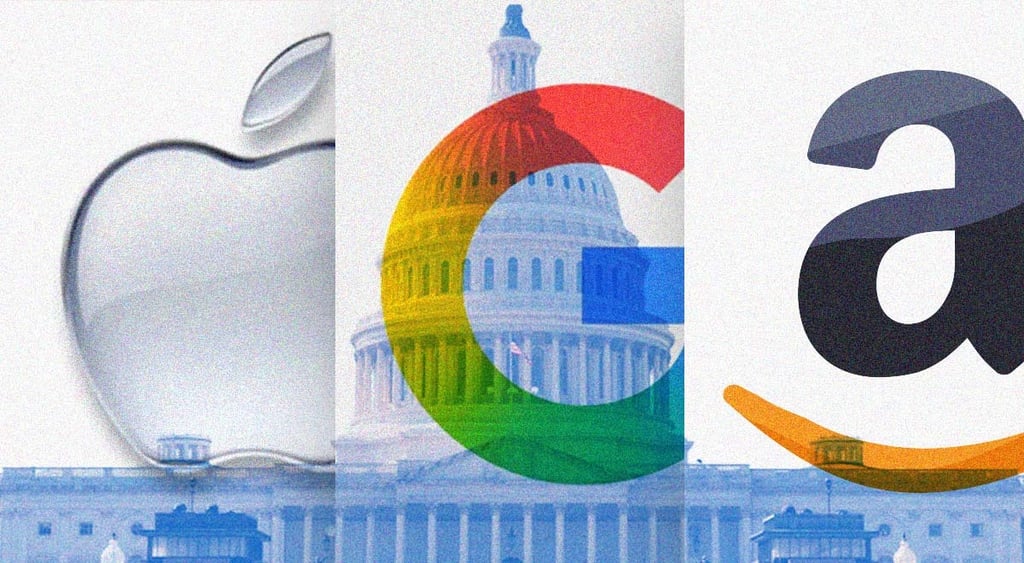
Platforms with substantive presence in the EU cannot be the target of trade measures under the ACI, Bertin Martens, a senior fellow at Bruegel, writes in an analysis.
These platforms are multi-sided marketplaces that bring together buyers, sellers, and advertisers. Pinning down the geographical location of parties in digital transactions is challenging, as is determining which agents have a substantial presence in the bloc.
Martens writes, “Imposing a tariff on advertising imports from the US rather than ad transactions between EU citizens would require detailed information on the locations or nationalities of all these agents.”
Strategic public compute use
Europe’s technological dependency, however, goes way beyond digital platforms and cloud services. Musk’s Starlink satellite internet services and Nvidia’s AI chips dominate the European market.
Ukraine, where Starlink is crucial for holding against the Russian invasion, offers a grim lesson on such dependency. The US reportedly threatened to turn off the service if Kyiv didn’t agree to sign a deal on critical minerals.
Moreover, the bloc is lagging behind the US in terms of AI investment and adoption. Between 2013 and 2024, US private investments in AI reached $109.1 billion (€92.33 billion), compared to US$19.42 billion (€16.43 billion) in Europe.
Hess says the EU can become more strategic about how it uses public compute. The key is to differentiate between types of workloads, because not all compute demand is equally sensitive, and not all phases of AI need large-scale infrastructure in one place.
For instance, government applications, military systems, and critical infrastructure are among the most sensitive use cases. However, they represent only a relatively small share of overall computing demand.
Meanwhile, commercial or consumer-facing uses, such as end users interacting with large language models or private sector needs, are less sensitive.
Hess tells Cybernews, “In the short term, the EU should prioritize moving these critical workloads onto more sovereign or trusted public computing infrastructure, where such capacity already exists or can be mobilized quickly.”
Unlock more exclusive Cybernews content on YouTube.