NASA is sending your names to the moon: here’s how to join the Artemis II crew
If you ever wanted your name in lights, well, today might be your last chance, as NASA is sending 1.5 million people’s names into space. Yours could be there, too.

Image by Cybernews

 Follow us
If you ever wanted your name in lights, well, today might be your last chance, as NASA is sending 1.5 million people’s names into space. Yours could be there, too.
Artemis II is set to launch early February of this year, and NASA has made it possible for the general public to send their names into space.
The Artemis II marks the first crewed mission into space in over 50 years, making it an exceptionally significant mission.
The mission will last roughly 10 days, and if there are no medical emergencies, it will aim to take astronauts further into space than ever before.
NASA’s moon-bound Artemis II rocket has reached its launch pad, ready for launch on February 6th, 2026.






The crew is comprised of four astronauts: Commander Reid Wiseman, Pilot Victor Glover, and Mission Specialists Christina Koch and Jeremy Hansen.
These four have been selected to “verify today’s capabilities for humans to explore deep space and pave the way for long-term exploration and science on the lunar surface,” NASA said.
How to get your name to the moon
Along with this monumental mission, NASA is giving people the opportunity to send their names up into space and receive a boarding pass for the Artemis II mission.
All you need to do is go to the NASA website and find the Artemis II “send your name to the moon” page, which can be located here.
Signing up is completely free.
Scroll down, and you’ll see a space where you can type your first and last name, along with your own unique four to seven-digit PIN code.
Make sure you don’t forget your PIN code, as you’ll need this to look up your boarding pass.
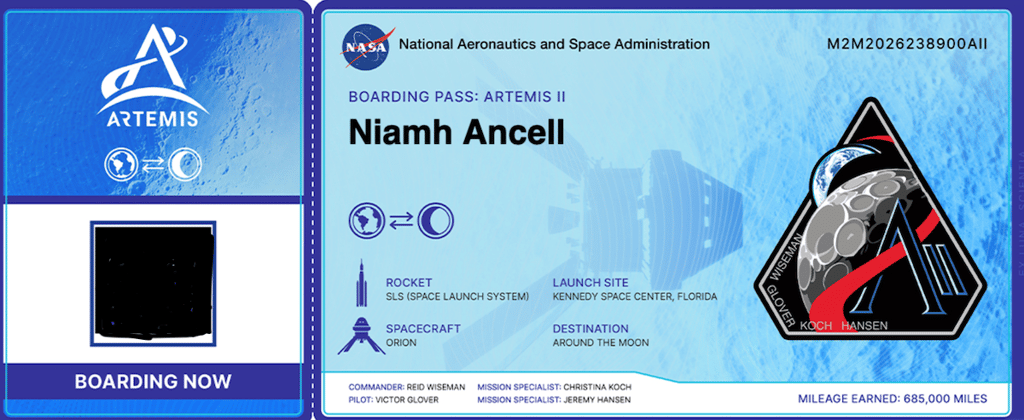
Once you’ve entered your details, NASA will present you with your very own boarding pass, which shows your name, the crew’s names, and other details related to the Artemis II flight.
Those 1.5 million-plus names submitted will be included on an SD card that will fly aboard Orion during the Artemis II mission.
While it’s unclear why NASA wants to send people’s names to the moon, it seems to be a symbolic gesture that assures the general public is also in on the action.
As this is the first lunar mission in over 50 years, NASA seemingly wanted to make it just that more special.






Unlock more exclusive Cybernews content on YouTube.