Where hiring is still happening, these two professions stand out
The job market is currently tough in the US, and whether the H1-B visa fee will do the trick is TBD. When it comes to job security and positive future prospects, two fields stand out.

Fired employees. Anna Moneymaker/Getty Images

 Follow us
The job market is currently tough in the US, and whether the H1-B visa fee will do the trick is TBD. When it comes to job security and positive future prospects, two fields stand out.
Donald Trump signed an executive order imposing a $100,000 fee on H-1B visas, which came into effect on September 21st. The move is supposed to alleviate the tough US job market, which has been experiencing seismic waves because of the federal layoffs, automation, and the overall AI startup boom.
Three things you need to know about the US job market right now
“We've not really seen the full effect of that yet show up in the unemployment numbers because while people are collecting unemployment, they don't show up while they're collecting or while they're collecting a severance,” Jim McCoy, CEO of Atlas, an employer of the record company, told Cybernews.






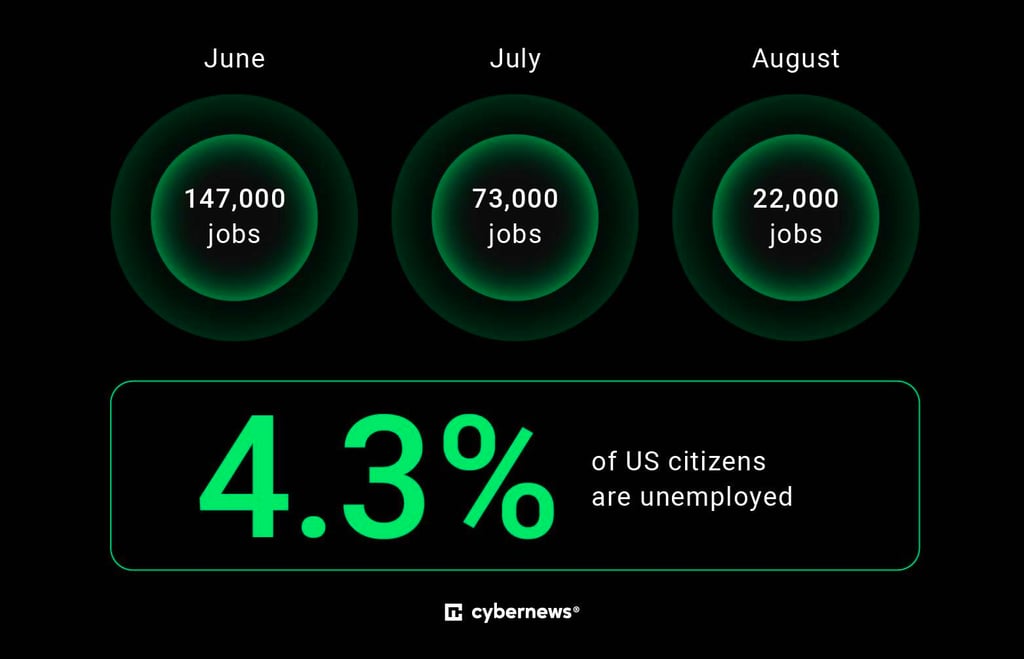
In August, the US added just 22,000 jobs, compared to 147,000 in June and 73,000 in July. 7,2 million people (4.3%) of US citizens are unemployed. Despite months of effort and hundreds of job applications, many skilled workers struggle to find jobs.
But why is that?
- Global trade tensions led to a decline in manufacturing. And when that happens, according to McCoy, it is followed by a drop in need for engineers and other more technical skillsets.
- The federal government has laid off approximately 300,000 people, so many of them are on the job hunt, too.
- The AI boom increases uncertainty. Businesses jumping on the AI bandwagon creates a lot of labor movement, with firms going either on a hiring or on a firing spree. On top of that, because of AI, some job roles these days are filled with AI tools instead of people. Statistics vary, but so far, it seems that the number of people fired as a direct result of AI focus fluctuates around a few dozen thousand.
For employers, complaining about the lack of skilled talent, the current situation might be beneficial, as some workers value stability over pay and are more mobile.
“They're not necessarily moving for pay raises. They may be moving for more stability. So you see that reflected in the numbers that the typical job mover is only moving for 3 to 4% increase. That's very unusual. More typically, especially in um, uh, more highly educated skill sets, you typically see job moves more than 10 to 15% range,”McCoy said.
The job market is also affected by the business's uncertainty aboout where to invest, which leads to flat staffing.
Young people have it worst
AI has begun to significantly affect entry-level employment. According to a 54-page-long paper from Stanford, called Canaries in the Coal Mine? Six Facts about the Recent Employment Effects of Artificial Intelligence, the employment for early-career workers has decreased since 2022, the year when ChatGPT was introduced to the public.

“AI seems to be shrinking routine areas of coding,” Darren Shou, Chief Strategy Officer at RSAC, told Cybernews. Instead, companies are now looking for people who can “satisfy the demand for judgment, transparency, integration and above all, security.”
People who are educating themselves also seem to be in high demand.
“Things that we look for are people who have demonstrated a variety of experiences that they are comfortable working in virtual and global environments, um, that they take the initiative to stay on top of their game, meaning they're looking for training and growth opportunities,” McCoy added.
Who’s still hiring

Both McCoy and Shou singled out professions that would be in high demand. To McCoy, given the ageing population, it’s healthcare and everything that is related, for example, technology. Shou sees a prosperous future for those in cybersecurity.
“Cybersecurity is one of those rare fields where AI creates more work than it automates away. That's because for every single thing the AI advances, it spawns a new attack surface as well as a new risk surface,” Shou said.
“We're growing about three times faster in cybersecurity job growth than in general. So I think all the trends suggest that this is a good place to be.”
More tips on how to land a job, based on cyber pros:
- Be mobile. Consider relocating to cities where the job market is more robust.
- Consider remote. While office experience is very important and formative for younger professionals, consider taking a remote role. Try it out before saying no.
- Target employers. Instead of simply sending hundreds of job applications, write a personalized job application, using LinkedIn, and reach out to people working in the company you want to work for. If you leave a good impression on them, your chances of getting a job will rise significantly.
“That is a smart investment of time if you're really serious about your job search,” McCoy said.
