AI on Device
Last updated: 18 December 2025
What is AI on Device?
AI on Device refers to technologies and frameworks that allow artificial intelligence models to operate directly on hardware devices instead of relying on cloud-based servers. This shift enables rapid data processing, enhanced privacy, and real-time responsiveness even without constant internet connectivity.
As consumer expectations grow for smart, responsive, and private technology, AI on Device has emerged as a crucial innovation across smartphones, wearables, IoT, and embedded systems. From real-time language translation to personalized photo enhancements and health monitoring, these solutions empower developers and users with new capabilities, untethered from the limitations of the cloud.
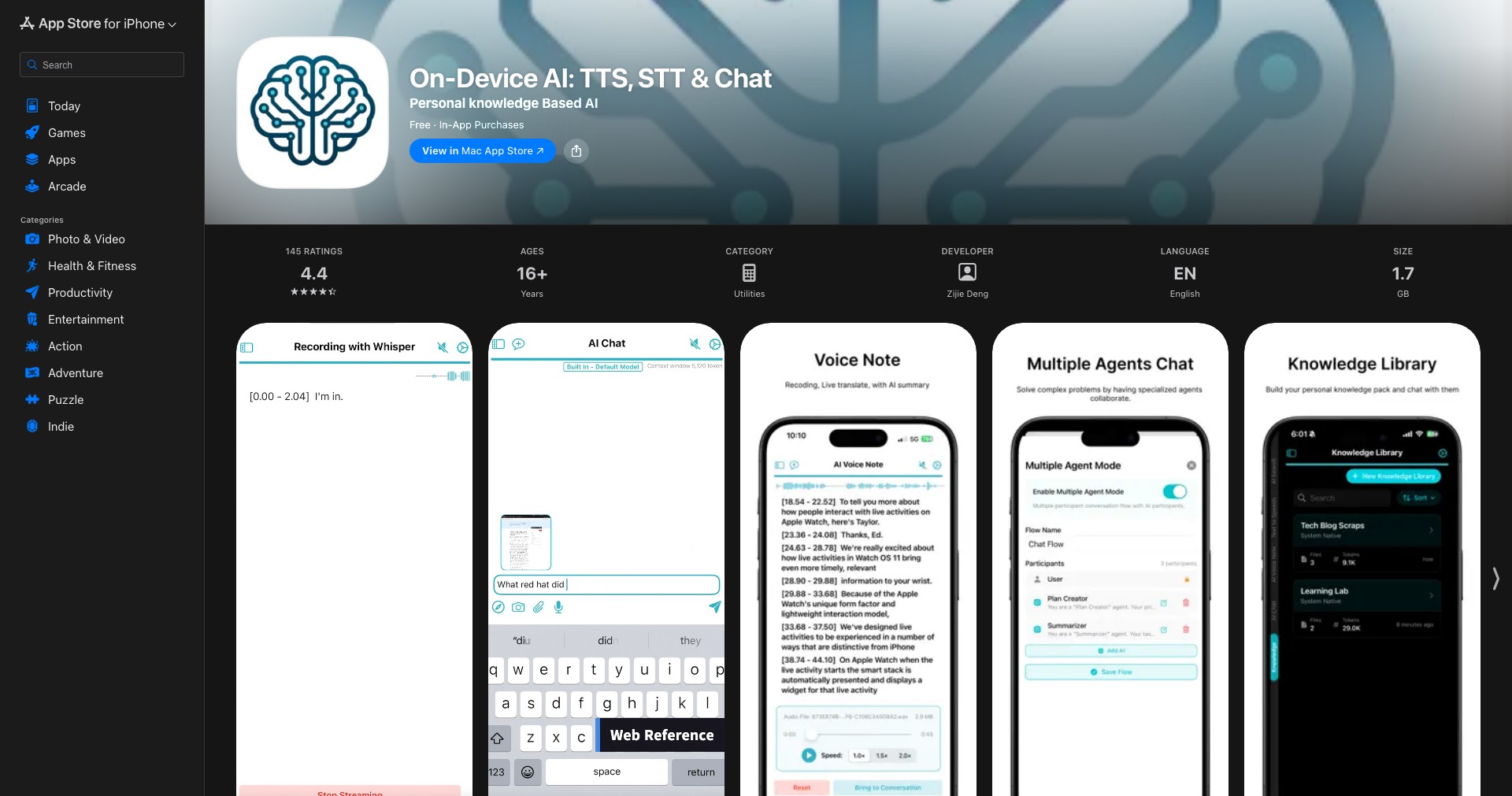
Key Features:
-
On-Device Inference:
Runs AI models—including neural networks and decision trees—locally, allowing data to be processed on the hardware in real time, resulting in faster responses for tasks such as image recognition or voice assistants. -
Enhanced Privacy:
Because sensitive data stays on the device rather than being transmitted to external servers, user privacy is significantly improved, addressing concerns in health, finance, and personal device use. -
Offline Functionality:
Many AI-powered features work without an internet connection, making the device useful in remote areas, for fieldwork, or in situations with poor network coverage. -
Optimized Performance & Efficiency:
Models are specifically optimized and compressed for the constraints of embedded devices, balancing accuracy with low power consumption and reduced memory usage. -
Customizable AI Pipelines:
Developers can train, fine-tune, or deploy their own unique models to adapt the device’s capabilities for specific industries, applications, or user requirements.
What makes AI on Device unique?
What sets AI on Device apart is its ability to deliver powerful AI experiences without relying on remote servers. Technologies like quantization, pruning, and model distillation make it possible to condense large, accurate models into compact and efficient versions suitable for mobile and edge hardware.
Unlike typical cloud AI solutions, AI on Device excels in latency-sensitive, privacy-focused, and mobile environments. High-profile examples include Apple's Neural Engine, Google's Tensor Processing Unit for Edge, and Qualcomm’s Snapdragon AI, each tailored to deliver optimized performance for their respective ecosystems.
Pros and Cons
Who is using AI on Device?
Mobile App Developers: Developers can integrate intelligent features into apps that work seamlessly offline and respect user privacy, such as real-time photo editing, language translation, and predictive text, directly on smartphones or tablets.
Enterprise & Field Professionals: Businesses in industries like healthcare, agriculture, and manufacturing benefit from AI on Device for analytics, monitoring, and automation at the edge—where internet connectivity may be unreliable or data privacy is paramount.
IoT & Embedded Systems Engineers: Engineers designing smart home devices, wearables, or industrial sensors can deploy lightweight AI models to enable local decision-making and autonomy.
Evolving Edge Intelligence
AI on Device began with basic sensor-based decisions and has rapidly expanded with advances in mobile chipsets and efficient model architectures. Early implementations focused on modest applications like fitness tracking or simple photo filters.
Breakthroughs in hardware acceleration and software toolkits, such as Apple’s Core ML, Android’s Neural Networks API, and TensorFlow Lite, have made deploying complex models possible on consumer devices. These advancements have allowed for increasingly sophisticated uses such as real-time language translation and augmented reality.
More recently, the integration of dedicated neural processing units (NPUs) and custom accelerators has pushed the frontier of on-device AI, supporting features like advanced voice assistants and proactive health monitoring—all while maintaining battery efficiency and device compactness.
Pricing
| Plan | Price | About |
| Open-Source SDK | Free | Many providers offer open-source toolkits to encourage developer adoption and experimentation. |
| Commercial License | Varies | Enterprises or device manufacturers can acquire licenses for advanced tools, runtime libraries, or model marketplaces. |
| Custom Enterprise Solutions | Negotiable | Tailored packages for high-scale deployment, support, or integration; typically priced per device or by usage. |
Verdict
AI on Device has established itself as a cornerstone for real-time, secure, and responsive AI applications across consumer and industrial environments. It allows businesses and developers to deliver smarter features, even in bandwidth-challenged settings, with improved user trust over privacy and security.
While some limitations in hardware and uniformity remain, the technology’s rapid progress—driven by dedicated hardware and innovative model compression—ensures it will only become more powerful and broadly adopted. Whether for mobile innovation, edge automation, or IoT intelligence, AI on Device marks a transformative shift in how artificial intelligence is deployed.


