Dstack
Last updated: 18 December 2025
What is Dstack?
Dstack is a next-generation platform tailored for data professionals seeking a smoother path from experimentation to production. By acting as a unified interface across data, compute, and AI tools, it empowers both individuals and teams to build, automate, and deploy AI/ML workflows without the usual complexity.
With integrations into modern data stacks and seamless connections to cloud resources, Dstack reduces friction between coding, collaborating, deploying, and monitoring data applications. This makes it a compelling choice for startups, SMEs, and teams within larger enterprises aiming to make their AI operations as nimble and efficient as possible.
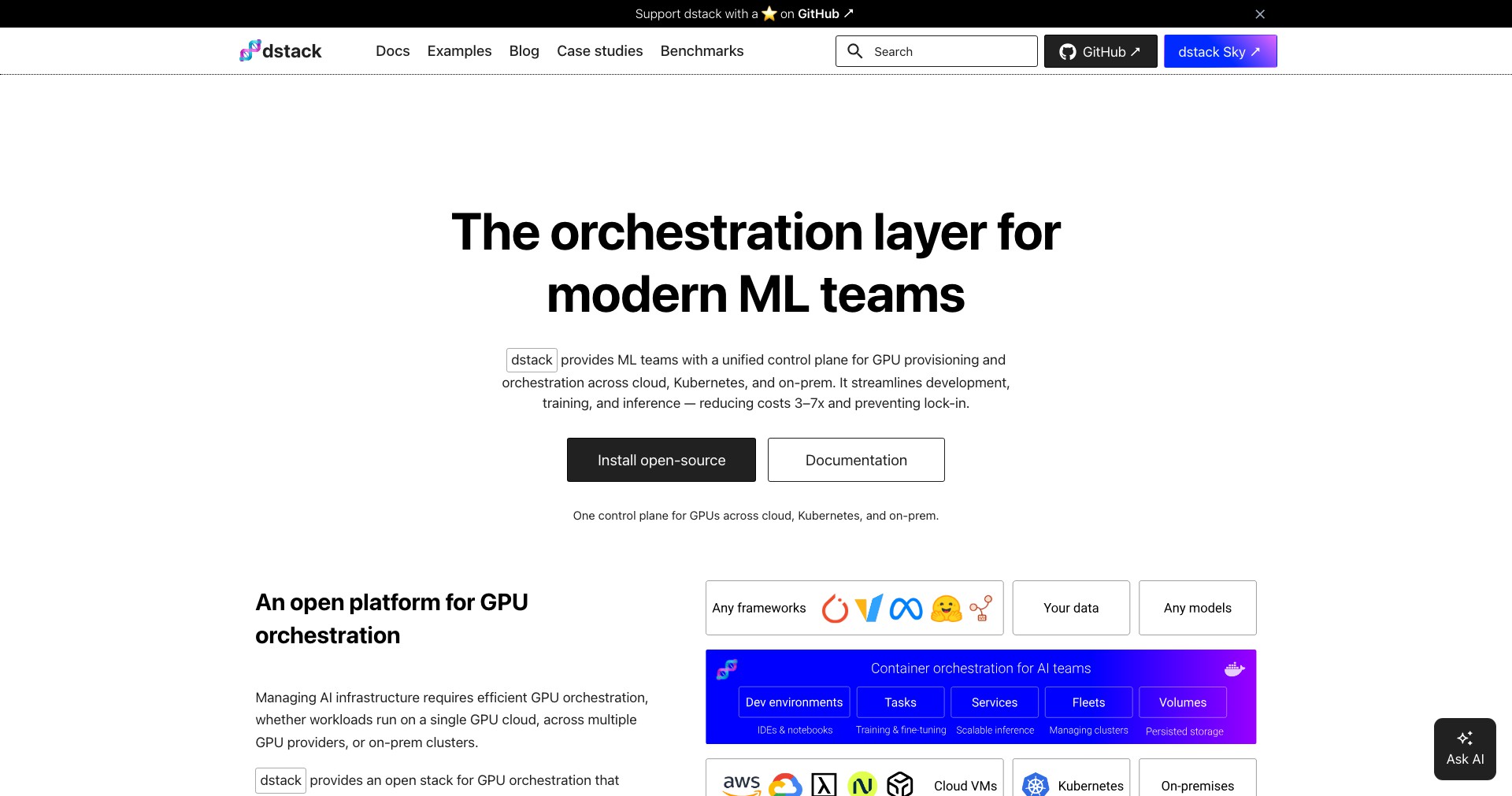
Key Features:
-
Unified Interface:
Dstack provides a single, user-friendly interface that connects data sources, notebooks, and deployment targets, eliminating the need to juggle multiple platforms. This increases productivity and reduces context switching. -
Seamless Cloud Integration:
It supports direct connections to popular cloud providers (AWS, Azure, GCP), allowing users to spin up compute resources or deploy applications with minimal manual configuration, saving valuable engineering time. -
Workflow Automation:
Users can automate repetitive steps in their ML or data pipeline, such as data preprocessing, model training, and deployment, enhancing reproducibility and collaboration among team members. -
Notebook Scheduling and Deployment:
Dstack enables scheduling and deployment of Jupyter and other notebooks as interactive web applications or reports. This is ideal for sharing insights and results with non-technical stakeholders. -
Support for Custom Stacks:
Teams can define their own 'stacks'—preconfigured sets of tools and environments—so that onboarding, scaling, and experimentation are consistent and rapid.
What makes Dstack unique?
Unlike traditional MLOps tools that can be cumbersome and developer-oriented, Dstack embraces a no-fuss, interface-driven approach that caters to both coders and low-code users. Its prebuilt integrations and drag-and-drop workflow builder enable quick prototyping, making advanced data engineering and AI infrastructure accessible even to smaller teams without dedicated DevOps staff.
Dstack's unique 'stack' concept—which allows easy replication of environments—is a major differentiator. It lets organizations enforce standards while maintaining agility, both crucial for scaling AI adoption without sacrificing maintainability or compliance.
Pros and Cons
Who is using Dstack?
Data Scientists and ML Engineers: They benefit from streamlined model experimentation, deployment, and monitoring, all orchestrated from a single workspace without the hassle of managing underlying infrastructure.
Startup Tech Teams: Startups leverage Dstack to quickly prototype, test, and scale AI features without hiring a large DevOps or MLOps team, optimizing both speed and resources.
Enterprises Scaling AI Projects: Larger organizations use Dstack for coordinated workflows, environment standardization, and smoother collaboration between data and engineering departments.
Continuous Platform Evolution
Since launch, Dstack has steadily expanded its portfolio of integrations, notably adding support for major cloud platforms and popular data tools, reflecting the needs of a fast-changing tech landscape.
The team adopted a user-driven development cycle, frequently releasing usability improvements like workflow automation, better authorization controls, and an enhanced drag-and-drop scheduling UI.
Community feedback has directly shaped new features and documentation clarity, ensuring Dstack remains competitive and in tune with the actual workflow pain points of data and ML teams.
Pricing
| Plan | Price | About |
| Free | $0 | Includes core features, limited users, and community support—ideal for personal projects and small teams. |
| Team | $20/user/month (estimated) | Adds collaboration, increased resource limits, and additional cloud integrations for growing teams. |
| Enterprise | Custom pricing | Includes all features, dedicated support, advanced security, and compliance required for large organizations. |
Verdict
Dstack stands out as a thoughtfully designed platform for MLOps and AI workflow management. Its focus on lowering the technical entry barrier and supporting the entire machine learning lifecycle—from prototyping to deployment—makes it an excellent option for startups and data science teams with limited DevOps resources.
While enterprise users looking for granular customization may find some constraints compared to legacy platforms, Dstack compensates with its agility, affordability, and rapid iteration based on community feedback. For most organizations aiming to streamline AI operations, it delivers excellent value and accelerates time-to-insight.


