Hume AI
Last updated: 18 December 2025
What is Hume AI?
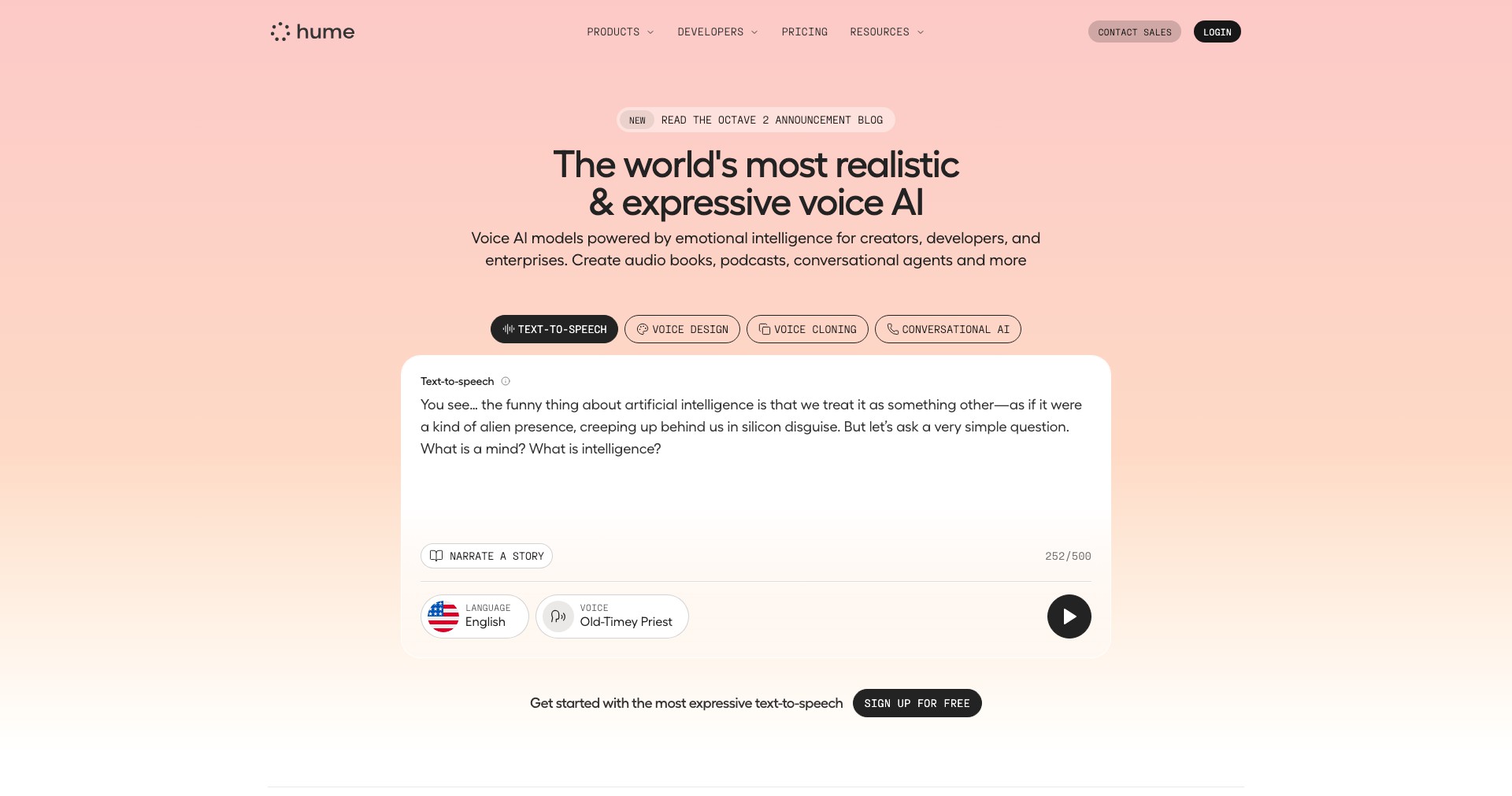
Hume AI is an advanced artificial intelligence platform focused on understanding and responding to human emotions through natural language and vocal signals. Designed primarily for developers and organizations seeking to create more empathetic and emotionally-intelligent applications, Hume AI’s models can detect a broad range of nuanced emotions from speech and text, making it a powerful tool for next-generation conversational AI.
With its suite of emotion recognition APIs, Hume AI empowers users to build products that respond to not just the words people use, but how they feel when saying them. This opens the door for more natural, supportive, and human-like interactions in everything from customer service bots to mental health applications and beyond.
Key Features:
-
Emotion Recognition API:
Hume AI’s core API leverages advanced deep learning models to analyze audio and text input, accurately identifying a spectrum of emotional states and expressions. This enables applications to tailor responses based on user emotions for more engaging conversations. -
Voice and Speech Analysis:
The platform can process and interpret vocal features like tone, pace, and modulation, providing rich context about a speaker’s emotional state. Developers can use this data to improve sentiment analysis or to trigger empathetic responses in voicebots. -
Text-based Empathy Modelling:
By analyzing written text, the models assess emotions such as joy, frustration, or sadness, helping chatbots and messaging platforms respond more intelligently and with greater sensitivity. -
Developer-Friendly API:
Comprehensive documentation, SDKs, and sample code make it easy for developers to integrate Hume AI’s emotion detection into new or existing products, shortening development time and reducing complexity. -
Privacy-First Design:
Data privacy and ethical considerations are built into the platform. Hume AI employs anonymization and robust security protocols to ensure user data is handled safely and in compliance with regulations.
What makes Hume AI unique?
What sets Hume AI apart is its specialized focus on empathic AI—its models go beyond simple sentiment analysis to distinguish subtle human emotions, including complex blends and transitions of feeling, which many competitors struggle to detect. The algorithms are trained on vast, diverse datasets encompassing global languages and accents, boosting accuracy across different demographic and cultural contexts.
Additionally, the platform’s real-time analysis capabilities and detailed breakdowns of nuanced affective states offer developers a fine-grained understanding of user emotions. This granular insight enables not just reactive but proactive emotional intelligence in AI, paving the way for applications that can adapt tone and content to user moods on the fly.
Pros and Cons
Who is using Hume AI?
Conversational AI Developers: Developers creating chatbots, virtual assistants, or voicebots can integrate Hume AI to deliver emotionally-intelligent responses, making digital interactions more natural and satisfying.
Customer Service Platforms: Companies running customer service operations can use Hume AI to detect customer frustration or satisfaction, allowing automated systems to prioritize sensitive cases or escalate calls to human agents as necessary.
Mental Health and Wellness Apps: Product teams in mental health or wellness industries can adopt Hume AI to help assess users’ emotional wellbeing through conversations, supporting more empathetic check-ins and adaptive guidance.
Evolution and Improvements
Since launch, Hume AI has continually refined its emotion recognition models through iterative training on increasingly diverse datasets, leading to enhanced accuracy and robustness.
The company has expanded its offerings from basic sentiment detection to detailed affective state parsing, including support for complex emotions, voice nuances, and multilingual capabilities.
Recent updates focus heavily on usability—with improved API documentation, example integrations, and elevated security measures to bolster trust and compliance in enterprise deployments.
Pricing
| Plan | Price | About |
| Enterprise Custom Plan | Contact for pricing | Flexible, usage-based pricing for organizations with large-scale or specialized needs. |
| Developer/Starter Plan | Contact for pricing or limited free tier | Typically offers access to basic API features for developers to experiment and prototype, with limits on usage. |
Verdict
Hume AI stands out for its sophisticated approach to emotion AI, offering tools that enable richer, more empathetic digital experiences. The platform’s algorithms surpass simple sentiment analysis, providing nuanced, culturally-aware emotion understanding in real time— a major asset for developers and organizations wanting to bring emotional intelligence into their products.
While the lack of transparent pricing and reliance on cloud-based APIs may deter some users, the breadth of features and focus on privacy and ethics make it well-suited for innovators in conversational AI, customer service, and wellness sectors. Overall, it’s a forward-thinking toolkit for those who want to truly humanize their applications.


