Lmql
Last updated: 18 December 2025
What is Lmql?
LMQL (Language Model Query Language) is a specialized, open-source language developed by researchers at ETH Zurich for querying and constraining the outputs of large language models. Built on top of Python, LMQL allows users to write structured prompts and apply constraints to LLM responses for a higher level of control than standard prompt engineering.
Unlike simple text prompts or manual post-processing, LMQL enables precise control and integration with various LLMs, including OpenAI GPT-3 and Meta’s Llama. It’s an ideal toolkit for developers and researchers who want to ensure their AI outputs meet rigorous criteria in applications such as data extraction, information retrieval, and complex dialogue systems.
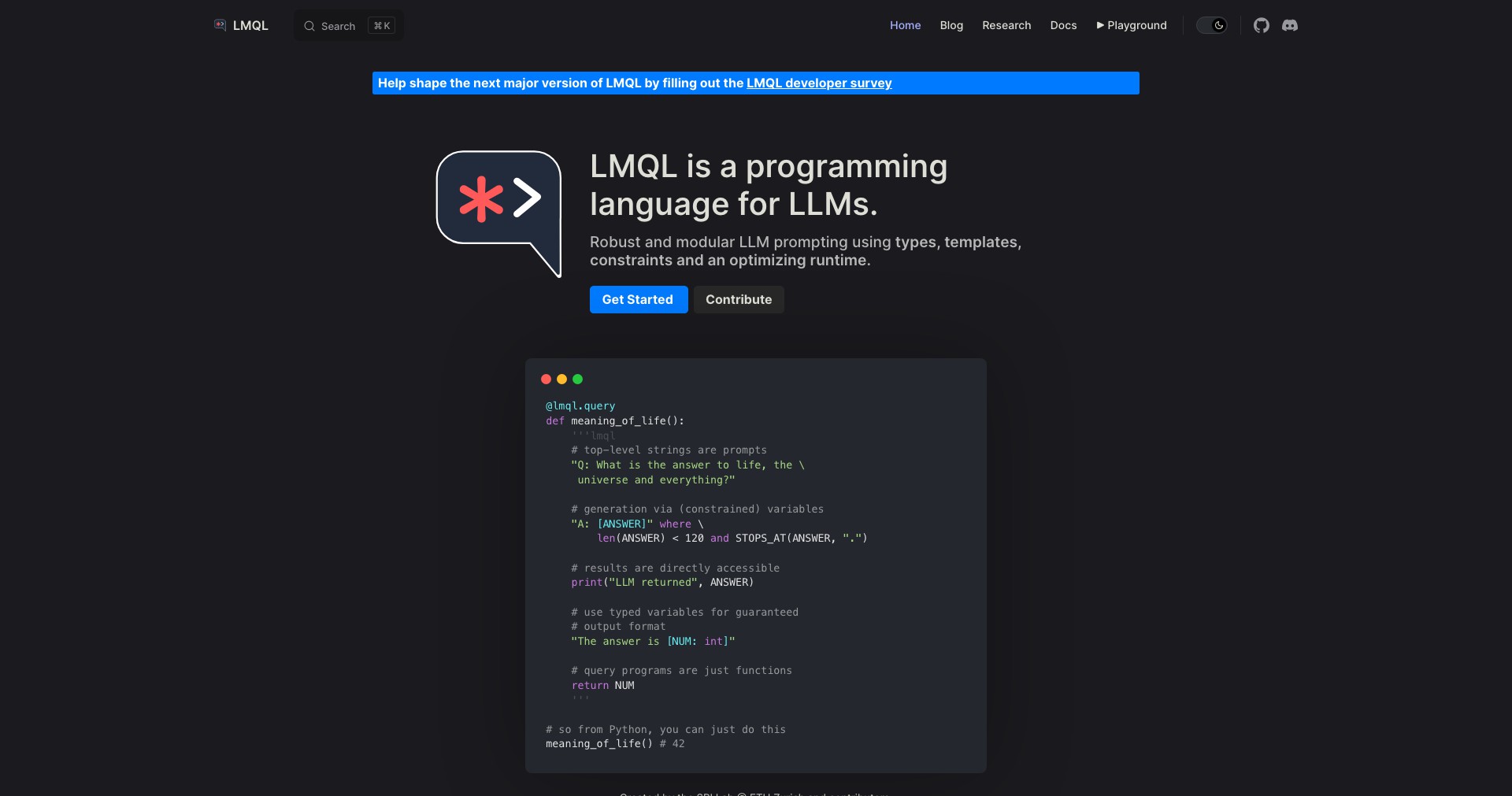
Key Features:
-
Constraint-Based Prompting:
LMQL enables users to define strict constraints directly within prompts, ensuring model outputs meet precise requirements. This eliminates the need for complex post-processing and improves output reliability. -
Python Integration:
The language augments Python code, allowing seamless incorporation into existing AI and data workflows. Scripts written in LMQL can import Python libraries, call functions, and manage output natively. -
Multi-Backend Support:
LMQL can interact with several LLM providers, including OpenAI, GooseAI, and open-source models, making it adaptable and future-proof for diverse LLM ecosystems. -
Interactive Debugging:
LMQL comes with tools for step-by-step tracing and debugging, helping developers quickly troubleshoot constraints, queries, and LLM outputs for optimal prompt design. -
Dynamic Variable Binding:
It supports dynamic assignment of output variables—extracting and enforcing structured results, such as named entities, dates, or key-value pairs, directly from model responses.
What makes Lmql unique?
What makes LMQL exceptional is its dedicated syntax for integrating constraints directly into LLM queries, which goes far beyond the capabilities of traditional prompt engineering. This tight control over model outputs is invaluable for scenarios needing structured, accurate, and predictable results, like information extraction or regulatory compliance.
Furthermore, LMQL’s close coupling with Python and its compatibility with multiple LLM backends set it apart from most prompt management tools, which are often bound to a single model or lack scripting capabilities. Its open-source status promotes transparency, community contributions, and rapid iteration.
Pros and Cons
Who is using Lmql?
AI Researchers and Academics: Researchers testing the boundaries of LLM output manipulation or studying prompt injection attacks benefit substantially from LMQL’s control and constraint capabilities.
Developers and Data Scientists: Anyone building LLM-powered products, from chatbots to information extractors, gains from LMQL’s ability to structure and filter outputs programmatically.
Enterprises and Regulated Industries: Organizations needing accurate, predictable, and auditable LLM outputs (e.g., legal or healthcare sectors) can leverage LMQL to ensure compliance and safety.
Evolution and Improvements
Since its debut, LMQL has shifted from a research prototype to a robust, open-source programming language for LLM querying. Early versions focused on proof-of-concept constraint-based prompting, which has since expanded.
Recent updates introduced better Python interoperability, more granular debugging, and broader model backend support. The documentation and community tutorials have grown significantly, making onboarding smoother for new users.
Continuous feedback from academic and developer communities drives ongoing enhancements, including new debugging tools, richer constraints, and improved compatibility with the latest LLMs.
Pricing
| Plan | Price | About |
| Free, Open-Source | $0 | LMQL is entirely free to use and modify under an open-source license. |
Verdict
LMQL uniquely empowers developers and researchers seeking strict control over LLM outputs, blending the flexibility of Python with constraint-based, model-agnostic querying. Its thoughtful design makes it indispensable for complex tasks requiring reliability, structure, and repeatability—areas where vanilla prompt engineering often falls short.
While it may not suit absolute beginners, those with Python knowledge and a desire to harness LLMs for advanced tasks will find LMQL a powerful addition to their toolkit. Its open-source roots and active community promise continued innovation and real-world applicability for demanding AI applications.


