MemoriPy
Last updated: 18 December 2025
What is MemoriPy?
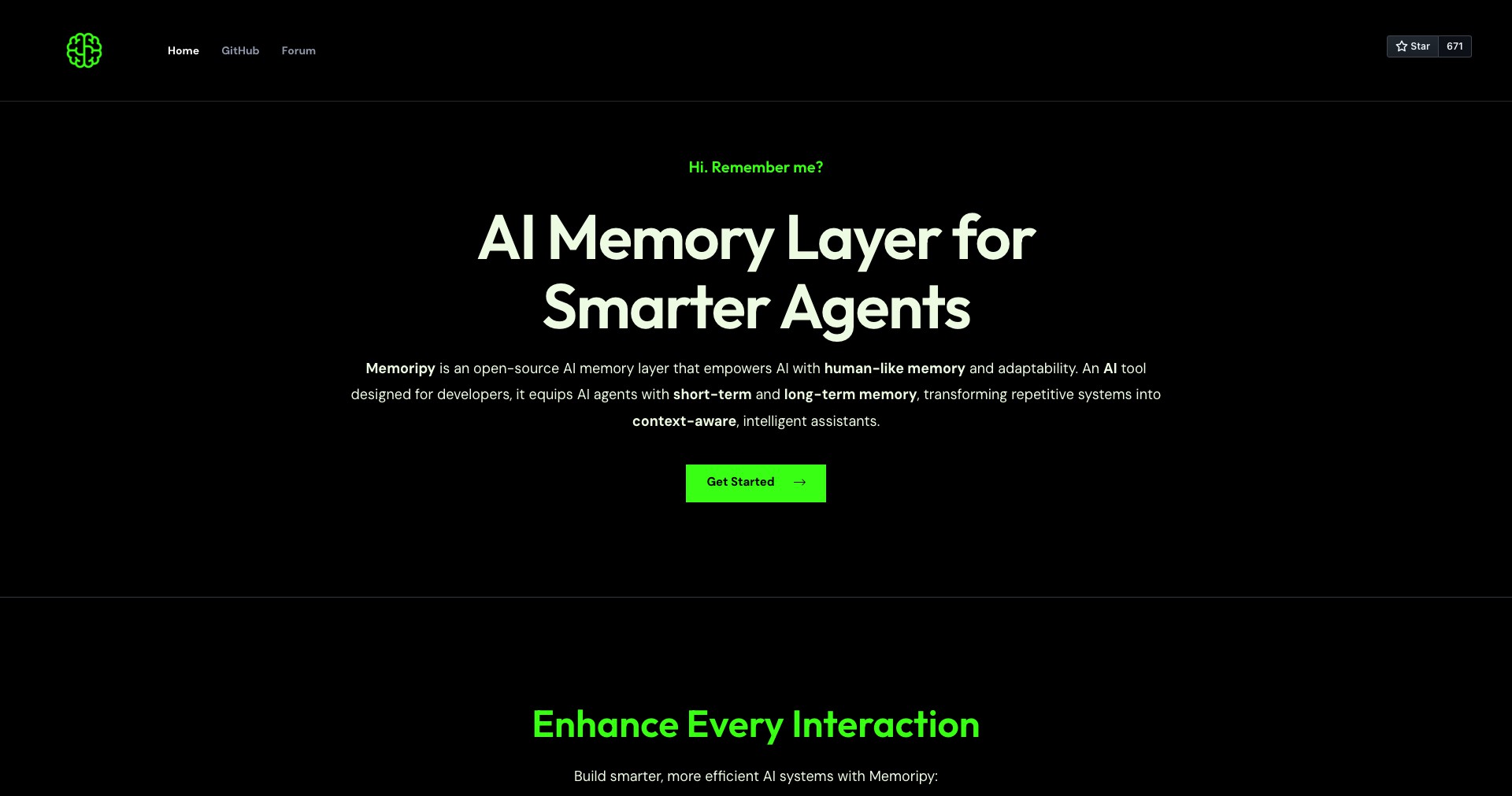
MemoriPy is an innovative Python library geared toward AI enthusiasts, developers, and researchers looking to build advanced memory systems for artificial intelligence applications. Drawing inspiration from human-like memory processes, MemoriPy allows users to represent, store, and retrieve memories using natural language constructs, making it uniquely suited for projects that require contextual understanding and continuity.
By providing an open-source solution, MemoriPy empowers its community to customize, expand, and optimize cognitive memory models for various use cases, from virtual agents to intelligent assistants. Its focus on persistent and structured memory storage fills a crucial gap for those designing more robust, context-aware AI systems.
Key Features:
-
Natural Language Memory:
MemoriPy lets you encode and access 'memories' as natural language statements. This approach provides intuitive storage and semantic retrieval, helping AI better understand and use context. -
Persistent Memory Storage:
The library enables persistent storage of knowledge, ensuring that learned information is retained across AI sessions—ideal for applications such as chatbots and personal assistants requiring long-term memory. -
Semantic Search and Retrieval:
MemoriPy supports powerful semantic search capabilities, allowing users to retrieve relevant memories by meaning rather than just keywords, enabling more flexible and context-aware reasoning. -
Open Source Flexibility:
With its open-source license, developers can freely modify and extend the tool, making it suitable for experimentation, academic research, and production use. -
Python Integration:
MemoriPy is designed for easy integration with Python projects, providing a clear API and compatibility with common AI and NLP libraries, ensuring quick setup and extensibility.
What makes MemoriPy unique?
MemoriPy stands out in the AI infrastructure landscape due to its focus on natural language-based memory representation, making it fundamentally different from traditional vector stores or key-value memory systems. This allows for highly contextual and human-like memory operations—a sought-after feature for conversational agents and research on cognitive architectures.
Moreover, its open-source nature enables rapid innovation by the community, lowering entry barriers for both individuals and institutions. Few memory libraries offer this blend of semantic search, persistent storage, and natural-language-friendly design, making MemoriPy a pioneering toolkit in its niche.
Pros and Cons
Who is using MemoriPy?
AI Researchers: Researchers experimenting with cognitive architectures or studying memory systems in artificial intelligence can leverage MemoriPy for controlled, extensible experiments.
Conversational Agent Developers: Developers building advanced chatbots, virtual assistants, or interactive storytelling systems will benefit from MemoriPy's natural language memory capabilities and persistent context features.
Academic Institutions: Institutions teaching AI, NLP, or cognitive science can use MemoriPy as a practical tool for demonstrations or student projects focused on memory modeling and retrieval.
Evolution and Enhancements
Since its introduction, MemoriPy has grown from a basic persistent memory store to a library featuring natural language support and semantic search. Early versions focused on core storage and retrieval, while subsequent releases prioritized integration with NLP models for richer memory processing.
The library has actively incorporated user and community feedback, gradually expanding its documentation and use case examples. Compatibility with external AI and NLP toolkits has been refined, streamlining the process for developers to plug MemoriPy into their workflows.
Ongoing development efforts are aimed at improving scalability and performance, broadening the library's applicability to larger-scale or more demanding AI projects. The open-source repository continues to attract contributions that enhance both features and usability.
Pricing
| Plan | Price | About |
| Open Source | Free | Available at no cost under an open-source license for personal, academic, or commercial projects. |
Verdict
MemoriPy is a unique and forward-thinking library that fills a specialized role in the AI tooling ecosystem. Its natural language memory representation and semantic retrieval open new possibilities for building context-rich, persistent AI systems.
While not the largest or most mainstream tool, its open-source flexibility, developer focus, and innovative memory modeling make it an excellent choice for AI researchers, advanced developers, and educators looking to push the boundaries of artificial cognitive systems.


