Study blames remote work rather than AI for young college graduates not getting hired
Many analysts have attributed the recent labor market challenges faced by young college graduates to generative AI. However, a study has found that businesses are actually reluctant to hire young workers for “remotable” jobs.

Image by Cybernews.

 Follow us
Many analysts have attributed the recent labor market challenges faced by young college graduates to generative AI. However, a study has found that businesses are actually reluctant to hire young workers for “remotable” jobs.
- Remote work, not AI, is responsible for nearly two-thirds of rising unemployment among young college graduates.
- Employers avoid hiring inexperienced graduates for remote roles due to mentorship and training difficulties.
- Co-located workers receive more feedback, giving younger employees a critical on-the-job development advantage.
According to a study by the Federal Reserve Bank of New York, the rise in remote work since the pandemic has been the key driver of higher unemployment rates among recent college graduates.
The report compared occupations that can be done remotely – like software development – with those that are done in person, such as nursing, and found that the unemployment rate among young college graduates in “remotable” jobs rose by about 1 percentage point from 2017-2019 to 2022-2024.
Gen Z’ers don’t like AI





The study, led by New York Fed research economist Natalia Emanuel, concludes that businesses are reluctant to hire new college grads for remote work because it is harder to train and mentor them when they work outside the office.
All in all, remote work is responsible for nearly two-thirds of the rise in the unemployment rate for young college graduates since the pandemic.

“Employers may not want to hire fresh graduates onto distributed teams because it is more difficult to teach them the requisite skills from afar,” the study says.
By contrast, in non-remotable jobs, young graduates’ relative unemployment rate ticked up in 2020 but returned to baseline soon afterward.
The Cybernews community is talking about this. Be a part of the conversation.
In other words, it’s not AI, even though the current labor market challenges are usually attributed to technology and automation of the white-collar economy.
This might be surprising, and of course, it’s just a single study. AI has indeed been making inroads into a variety of jobs, including finance, media, and law.

Check if your data was exposed
Find out if your email and related personal information have appeared in known data breaches.
Just a couple of weeks ago, students booed Eric Schmidt, the ex-Google CEO, for praising AI at a graduation commencement speech. The same happened at the University of Central Florida.
Forty-eight percent of Gen Z’ers say the risks of the technology outweigh the benefits, and last year, a report by SignalFire, a venture capital firm based in San Francisco, found that the hiring of new graduates at big tech companies such as Google, Amazon, Apple, Meta, Microsoft, Nvidia, and Tesla has declined by more than 50% since 2022.
Younger remote workers miss out on constructive comments
However, researchers for this particular study claim to have worked with proprietary data from a Fortune 500 company and say they’re able to shed light “on the underlying reasons for labor market changes.”
According to the study, the pattern is pretty clear and logical. When people work next to their colleagues, they receive more feedback on their output and more mentorship – and when they’re separated even by a short distance, that feedback tapers off dramatically.
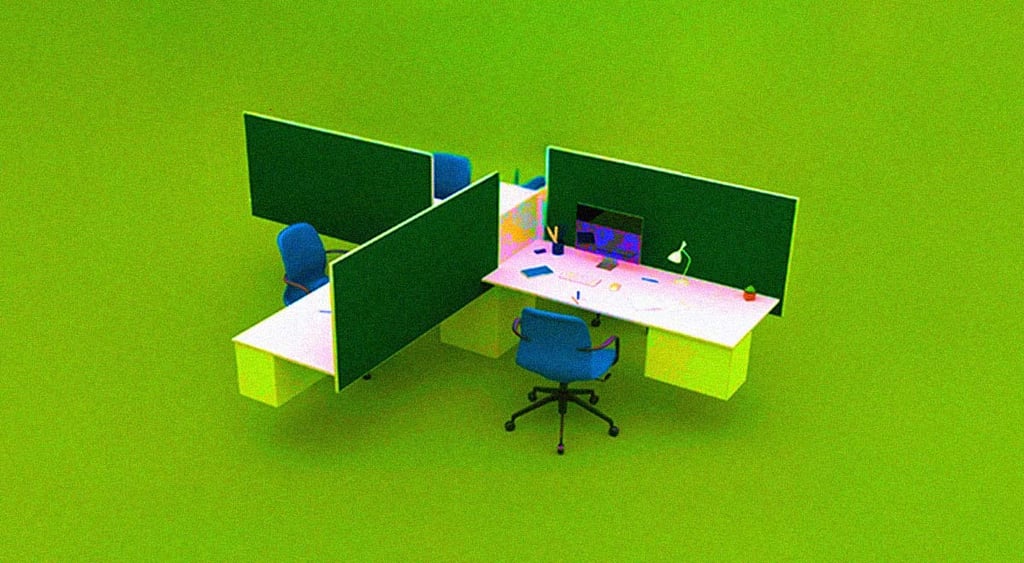
The loss in feedback is then more pronounced for younger workers who miss out on constructive comments that spur their development.
“Further, when we analyze the firm’s return-to-office mandates, we find that workers on co-located teams, who experienced a more meaningful change in their proximity to colleagues, likewise showed greater improvements in their work quality,” the study said.
The firm’s hiring patterns allegedly suggest that it understood the pitfalls of distance for worker development. When its offices were closed due to the pandemic, the firm hired fewer inexperienced workers and more experienced workers, who might need less mentorship to do their jobs well.






Once its offices reopened, the company resumed hiring younger workers. However, there is a twist: for positions on distributed teams, the firm consistently hired more experienced workers, even after reopening.
“This divergence suggests that the firm’s hiring decisions were influenced by the complications of remote work rather than other macroeconomic trends,” explains the study.
“Overall, the firm’s hiring patterns suggest that it is willing to teach junior workers when proximity is feasible but shies away from employing inexperienced workers if distance creates barriers to training and development.”
Unlock more exclusive Cybernews content on YouTube.